On eBird ↗
Bornean Crested Fireback
Live sightings near you, the range map, bar charts of when it is seen, and Macaulay Library photos and recordings.
Bornean Crested Fireback
Lophura ignita
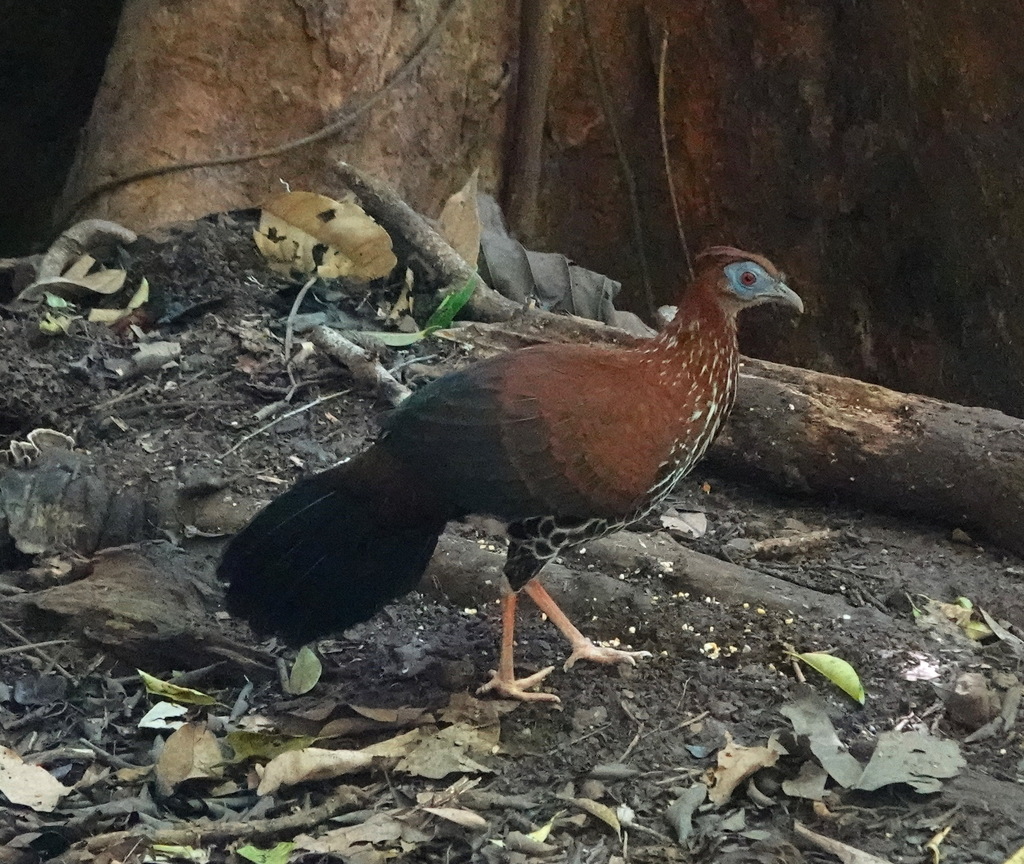
The Bornean crested fireback, Lophura ignita, is a large, sexually dimorphic, and distinctly-coloured pheasant of the family Galliformes endemic to the rainforests of Borneo and the surrounding islands. It is a non-migrating omnivorous species, often seen in groups of 5–6 in the rainforest lowlands. As of 2020 they were classified as Vulnerable by the IUCN due to population decline from habitat loss and deforestation, hunting, and trapping for the cage bird trade.
From the article Bornean crested fireback on Wikipedia (CC BY-SA), quoted section by section
Description
The Bornean crested fireback maintains a similar body plan to most other species in Galliformes (heavy bodied ground-dwellers). Similar to other species in the genus Lophura, L. ignita has strong coloration, with a dark plumage contrasting vibrant accents.
Juvenile. Before sex-specific coloration appears, juvenile females may be distinguished from males by their overall lighter plumage. The juveniles' plumage is like that of adult females, although they lack the crest seen on adults and have large black spots on the upper wing coverts. The adult female of related species, L. bulweri, often look like juvenile L. ignitia, but they can be distinguished by the black covert spots seen in L. ignitia. As well, L. ignitia has dark chestnut plumage, light underside markings, and pale legs. Juveniles are often seen with adults during post-natal care periods.
Immature male. The average body length is 43 cm, the average tail length is 16 cm, and the average spur length is 3mm. Spurs are often bulbous on the base as they are still developing. Immature males' plumage resembles a dull version of the adult's at around 4–6 months of age, but they still lack the distinct crest and have smaller wattles. They have chestnut vermiculation on the mantle. Bill colour varies but is usually pale. …
Range & habitat
The species is endemic to Borneo and present throughout much of the lowlands, including regions of Malaysia (Sabah and Sarawak), Brunei, and Indonesia (Kalimantan), and Bangka Island in southeastern Sumatra. It is a non-migrating species and maintains a consistent distribution year-round.
Wikipedia: “Distribution”
What it does
The species tends to be wary and live in mixed-sex groups of 5–6 individuals. They can become habituated to humans if exposed for prolonged periods.
Vocalizations. Bornean crested firebacks have extensive vocalizations. Cornell Lab identified the following divisions: Squeal: "Loud squeals or piping whistles" with variable, but usually shrill, notes. These calls are exclusive to males during intrasexual conflict or other aggressive activity and usually lasts for 0.6–1.0 seconds. Squirrel call: A snapping note similar to that of the squirrel. It consists of a low-pitched sound followed by a downslurred call, like "guh-CHIK!". The call is repeated at a rate of 2–4 calls/second, with a call duration of 0.1 seconds. The downslurred note drops in frequency from 7 kHz to 1 kHz. This call likely acts as an alarm signal. Mellow notes: These calls vary and often only heard at close range. They are all below 600 Hz. Grunts: These often occur in tandem with mellow notes, and are characterized as "short faint growls, grunts, barks, or clucks". Along with mellow notes, this call is used to maintain contact over short distances. Cackle: Males may release soft and rhythmic cackles during their wing-whirring courtshit ritual. The impact of environment or life stage on vocalizations is understudied, but most vocalizations can likely be heard year round. …
Wikipedia: “Behaviour”
Listen
Looking for field recordings…
Where it lives
Recorded sightings
—
geo-referenced records in GBIF, from museums, herbaria and field observers.
Drag the globe to turn it. Dots are where records exist, not a range map; darker means more records.
In the stacks
Searching the stacks…
Every page naming Lophura ignita in the Biodiversity Heritage Library →
This page is assembled live from iNaturalist, GBIF, Wikipedia, the Source Library and the Internet Archive. It is not yet part of the hand-edited codex. iNaturalist taxon 1118.