- Animals
- ›Chordates
- ›Vertebrates
- ›Mammals
- ›Therians
- ›Placental Mammals
- ›Ungulates, Carnivorans, and Allies
- ›Bats
- ›Yangochiroptera
- ›Vespertilionoid Bats
- ›Free-tailed Bats
- ›Molossinae
- ›Eumops
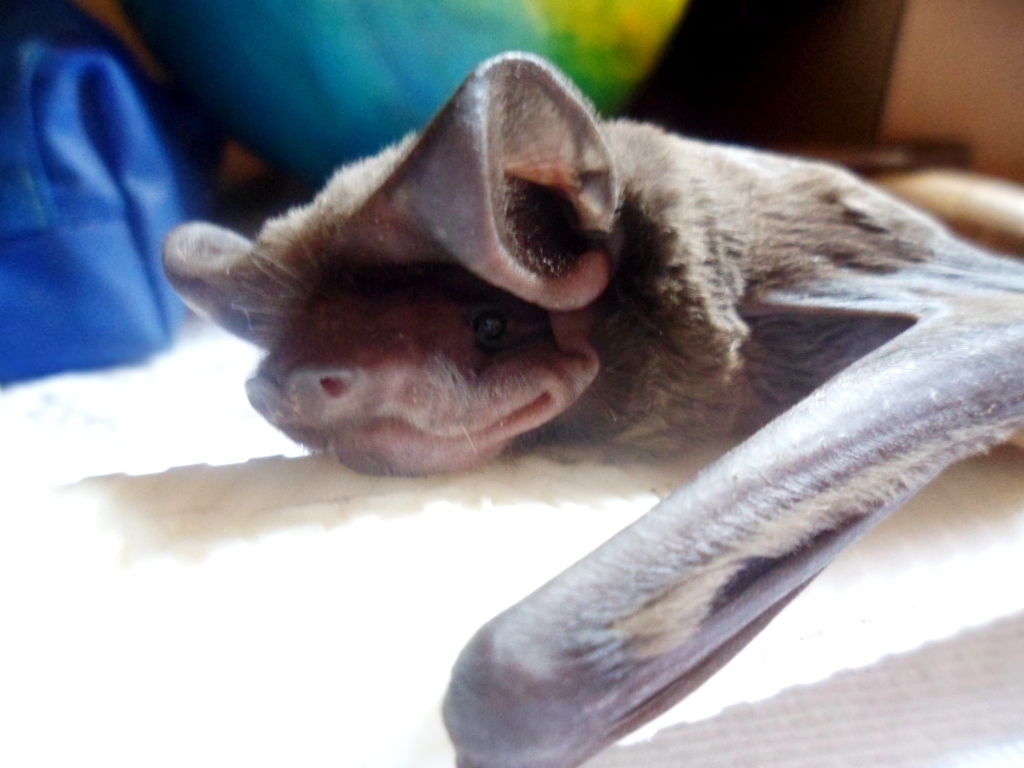
Wagner's Bonneted Bat
Eumops glaucinus
Wagner's bonneted bat, or Wagner's mastiff bat (Eumops glaucinus), is a species of bat in the family Molossidae. It is found in the Americas from Argentina and Peru north to Mexico, and Cuba. Populations in Florida in the United States are now recognized as the Florida bonneted bat (E. floridanus).
From the article Wagner's bonneted bat on Wikipedia (CC BY-SA), quoted section by section
Description
Eumops glaucinus is a medium-sized mastiff bat, but its size varies across its range. It is roughly 24–25 centimeters (9.4–9.8 in) long and between 30 and 47 grams (1.1 and 1.7 oz) in weight, with pregnant females sometimes heavier. The male is generally larger than the female. The species has a short, shiny pelage of bicolored hairs that are lighter at the bases, and the overall coat color can be black, brown, grayish, or cinnamon. The underparts are duller and paler. The bat has a long snout. It lacks a leaf-shaped nose appendage and protruding upper lip, but it has a keel above the eye. The ears are about 2 centimeters (0.8 in) in length and are wider than long. They are joined to form the "bonnet" shape. The wingspan is about 41–47 centimeters (16–19 in). The wings are narrow, as in other mastiff bats. The wings are adapted to long but rapid flights, especially in open areas. This bat has a musky odor. The male has a gular-thoracic gland of unknown function; it may be used to mark females or territory.
What it does
This bat is common in subtropical and tropical forest habitat, but it has often been recorded living in urban areas, including large cities. It appears to be attracted to the heat of metal roofs. It can also be found in deserts, swamps, and scrubland. It roosts in the canopies of trees and in cavities in the trunks, including abandoned woodpecker nests. It has been observed in royal palm (Roystonea regia), degame (Calycophyllum candidissimum), gumbo-limbo (Bursera simaruba), and Cuban palm (Copernicia gigas). It has been recorded at elevations up to 2,750 meters (9,020 ft). This species may live near other bats, such as the velvety free-tailed bat (Molossus molossus), the broad-eared bat (Nyctinomops laticaudatus), the little goblin bat (Mormopterus minutus), and Pallas's long-tongued bat (Glossophaga soricina).
Wikipedia: “Ecology”
In human culture
The origin of E. glaucinus is found in the Blancan of the Pliocene roughly 3.3 million years ago.
== References ==
Wikipedia: “Fossil history”
Listen
Looking for field recordings…
Where it lives
Recorded sightings
—
geo-referenced records in GBIF, from museums, herbaria and field observers.
Drag the globe to turn it. Dots are where records exist, not a range map; darker means more records.
In the stacks
Searching the stacks…
Every page naming Eumops glaucinus in the Biodiversity Heritage Library →
This page is assembled live from iNaturalist, GBIF, Wikipedia, the Source Library and the Internet Archive. It is not yet part of the hand-edited codex. iNaturalist taxon 1104627.