- Animals
- ›Chordates
- ›Vertebrates
- ›Mammals
- ›Therians
- ›Placental Mammals
- ›Ungulates, Carnivorans, and Allies
- ›Bats
- ›Yangochiroptera
- ›Vespertilionoid Bats
- ›Free-tailed Bats
- ›Molossinae
- ›Eumops
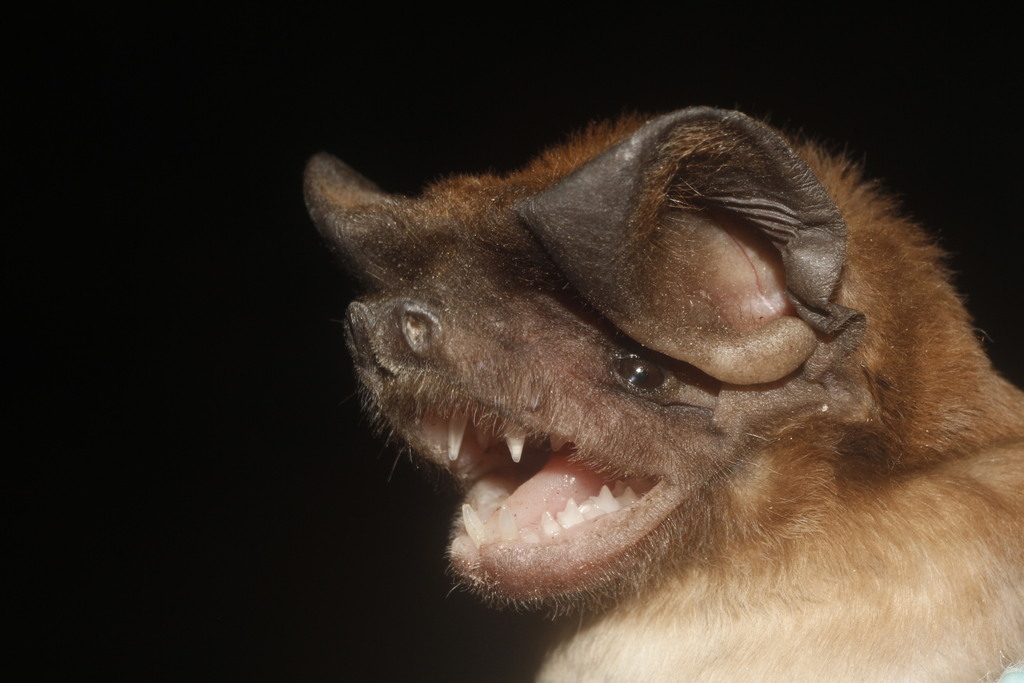
Fierce Bonneted Bat
Eumops ferox
Eumops ferox, the fierce bonneted bat or the chestnut mastiff bat, is a species of free-tailed bat found in the Caribbean and Mexico. Until recently, it was synonymous with Wagner's bonneted bat.
From the article Eumops ferox on Wikipedia (CC BY-SA), quoted section by section
Description
This is the species of bat that Philip Henry Gosse referred to as the chestnut mastiff bat in his 1851 book, A Naturalist's Sojourn in Jamaica. Its ears are so large that they hang over its face. It has long, narrow wings. Like other members of its genus, it has a gular-thoracic gland, with the glands of the males producing a "very rank odour." Its ears are hairless, while its toes have long, bristly hairs. From head to tail, it is 131–151 mm (5.2–5.9 in). Its tail is 49–58 mm (1.9–2.3 in) long; its forearm is 57 mm (2.2 in) long. Individuals weigh approximately 38 g (1.3 oz).
In human culture
It was described as a new species in 1861 by Cuban naturalist Juan Gundlach. Gundlach initially placed it in the genus Molossus, with the name Molossus ferox. It has been considered synonymous with Wagner's bonneted bat, Eumops glaucinus. It was generally recognized as synonymous with Wagner's bonneted bat until a 2008 study concluded that Wagner's bonneted bat was actually a species complex that should be broken into four species: Eumops ferox, the Florida bonneted bat, E. wilsoni, and Wagner's bonneted bat. Its species name "ferox" is of Latin origin meaning "ferocious" or "fierce." When handling an individual in Jamaica, Philip Henry Gosse remarked the following:
When handled, its impatience of confinement is manifested by a continuous screeching, not very loud, but excessivly harsh and shrill . . . The mouth also is then opened widely and threateningly, and a sufficiently grim armature of teeth developed.
Wikipedia: “Taxonomy and etymology”
Listen
Looking for field recordings…
Where it lives
Recorded sightings
—
geo-referenced records in GBIF, from museums, herbaria and field observers.
Drag the globe to turn it. Dots are where records exist, not a range map; darker means more records.
In the stacks
Searching the stacks…
Every page naming Eumops ferox in the Biodiversity Heritage Library →
This page is assembled live from iNaturalist, GBIF, Wikipedia, the Source Library and the Internet Archive. It is not yet part of the hand-edited codex. iNaturalist taxon 1102769.