- Animals
- ›Molluscs
- ›Gastropods
- ›Heterobranchs
- ›Euthyneura
- ›Tectipleura
- ›Eupulmonata
- ›Common Land Snails and Slugs
- ›Helicina
- ›Helicoidei
- ›Helicoidea
- ›Camaenidae
- ›Bradybaeninae
- ›Aegistini
- ›Aegista
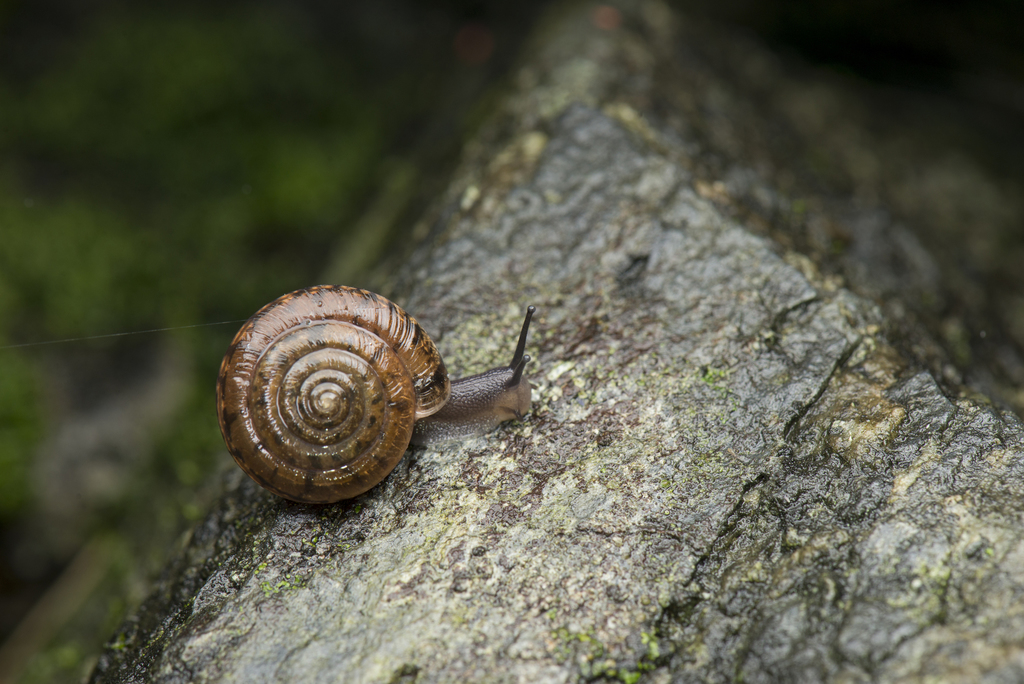
Aegista diversifamilia
Aegista diversifamilia is a species of air-breathing land snails, a terrestrial pulmonate gastropod mollusk from Taiwan.
From the article Aegista diversifamilia on Wikipedia (CC BY-SA), quoted section by section
Description
The shell is depressed and spherical, between 1.98 centimetres (0.78 in) and 3.24 centimetres (1.28 in) wide and 0.97 centimetres (0.38 in) to 1.68 centimetres (0.66 in) high. The shell is thin but strong, with a depressed conic spire. The aperture is ovate, 0.78 centimetres (0.31 in) to 1.32 centimetres (0.52 in) wide by 0.48 centimetres (0.19 in) to 1.05 centimetres (0.41 in) tall. The shell is a glossy chestnut- or yellow-brown, with a thin light brown stripe running along the periphery. The peristome is white.
Reproductive system. A. diversifamilia is hermaphroditic. The penis is long and thin, but shorter than the epiphallus. The dart sac is positioned in the vagina, which is equal in length to the penis. The spermoviduct is approximately four times as long as the penis and oviduct, and two times as long as the hermaphroditic duct. Individuals lay 20–30 white, 3 mm diameter round eggs per spawning.
Range & habitat
A. diversifamilia is endemic to eastern Taiwan, bounded on the north by the Lanyang River. It is found in the Yilan and Hualien Counties, but not on Guishan Island. The species is usually found in lowland hardwood forests, living in or under moist leaf litter.
Wikipedia: “Distribution and habitat”
Where it lives
Recorded sightings
—
geo-referenced records in GBIF, from museums, herbaria and field observers.
Drag the globe to turn it. Dots are where records exist, not a range map; darker means more records.
In the stacks
Searching the stacks…
Every page naming Aegista diversifamilia in the Biodiversity Heritage Library →
This page is assembled live from iNaturalist, GBIF, Wikipedia, the Source Library and the Internet Archive. It is not yet part of the hand-edited codex. iNaturalist taxon 1096738.