- Animals
- ›Chordates
- ›Vertebrates
- ›Ray-finned Fishes
- ›Spiny-rayed fishes
- ›Perches, Scorpionfishes, Sticklebacks, and Allies
- ›Perches, groupers and allies
- ›Perches, Darters, and allies
- ›Darters
- ›Percina
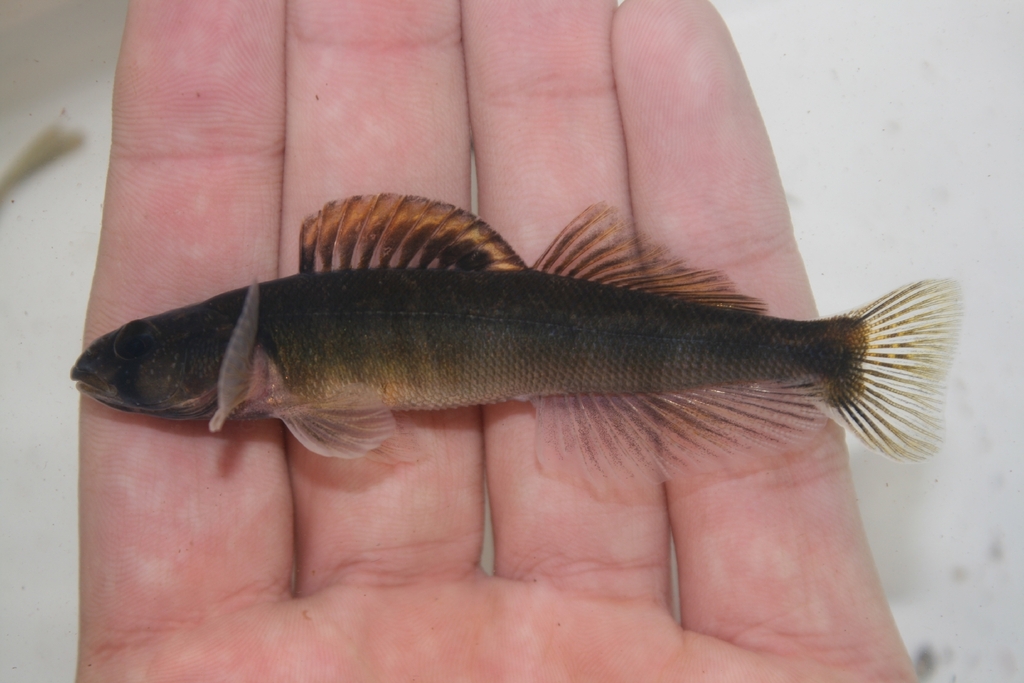
River Darter
Percina shumardi
Percina shumardi (river darter) is a benthic species of freshwater ray-finned fish, a darter from the subfamily Etheostomatinae, part of the family Percidae, which also contains the perches, ruffes and pikeperches. It is native to North America. It is an inhabitant of small and medium rivers where it occurs in rocky riffles with clear, fast-flowing water. The river darter can reach up to 7.3 cm (2.9 in) in length and has an average lifespan of three years. It can be distinguished from other darters by its unique front and rear spots on the dorsal fin.
From the article Percina shumardi on Wikipedia (CC BY-SA), quoted section by section
Description
Darters are characterized by two dorsal fins and dorsal scutes, a line of modified scales along the midline of the body. They have two anal spins and a complete lateral line. Darters have a moderately pointed snout and a subterminal mouth. River darters are olive brown with distinct dorsal blotching and a mottled back. The dorsal blotches form 8–15 faint bars along the body that become more discernibly ovular towards the tail. A distinctive bar can be seen below the eye. The dorsal fins are clear with light banding. Nuptial males have a bright, golden band in the posterior region of the first, spiny dorsal fin. The second dorsal fin has up to 16 soft rays. The anal fin has 11 rays. Males are darker and more distinctly marked during spawning season, but do not develop bright colors like many other darters. Tubercles develop on the caudal, pelvic and anal fins, and occasionally also occur on the heads of males during the breeding season.
Range & habitat
The river darter is a species native only to the United States and Canada. Within Canada, the river darter is native to southern regions including the Hudson Bay basin, Ontario, and Manitoba. Within the United States, the river darter is native to a band that starts northward in Canada and extends into Minnesota and North Dakota and continues to the Gulf drainages in Alabama and Texas. The river darter is the most common species of darter in the Mississippi River Channel.
Wikipedia: “Geographic distribution”
What it does
The river darter is an invertivore that primarily feeds during the day. Adult individuals feed on a wide variety of all aquatic invertebrates such as midge and caddisfly larvae, which are common in streams and rivers. Snails are another fundamental aspect of the diet of mature river darters. Chironomids, trichopteras, and small crustaceans are other key elements of the adult diet of river darters. Juvenile river darters typically feed on much smaller prey. Primarily food sources for juveniles include small zooplankton floating in their freshwater habitats.
Wikipedia: “Diet”
In human culture
The river darter's scientific name comes from the Greek root word Percina or 'little perch' and the word shumardi which was given in honor of its discoverer, Dr. George Getz Shumard (1823–1867), a surgeon with the United States Pacific Railroad Survey.
== References ==
Wikipedia: “Etymology”
Where it lives
Recorded sightings
—
geo-referenced records in GBIF, from museums, herbaria and field observers.
Drag the globe to turn it. Dots are where records exist, not a range map; darker means more records.
In the stacks
Searching the stacks…
Every page naming Percina shumardi in the Biodiversity Heritage Library →
This page is assembled live from iNaturalist, GBIF, Wikipedia, the Source Library and the Internet Archive. It is not yet part of the hand-edited codex. iNaturalist taxon 109102.