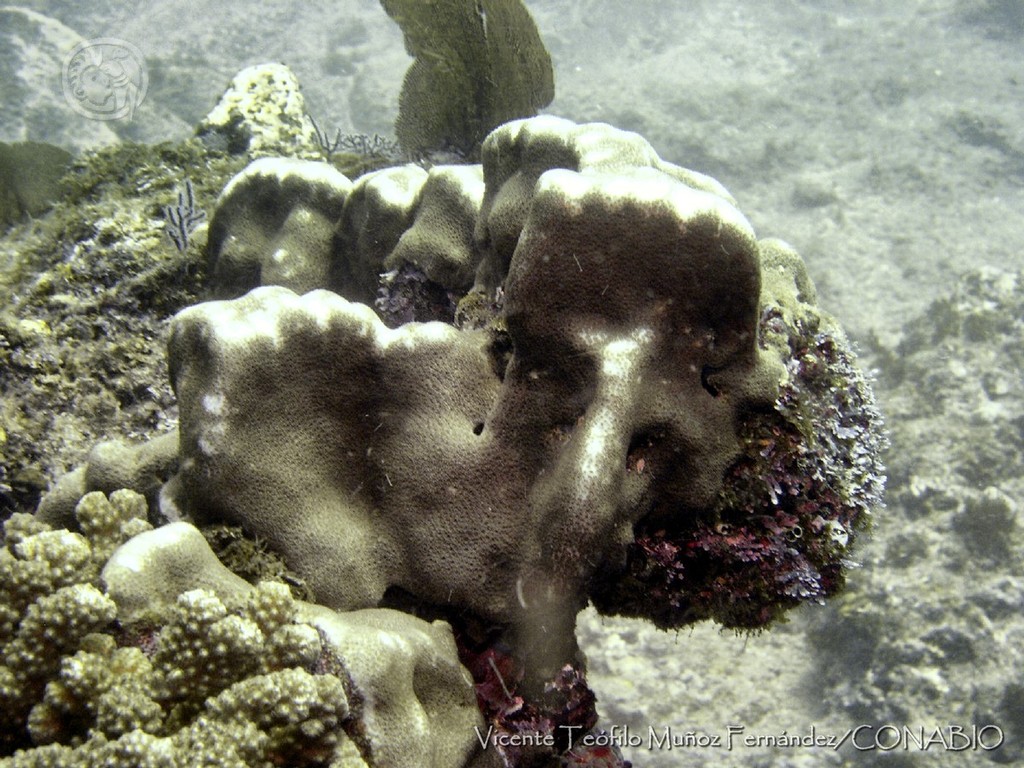
Porkchop Coral
Pavona duerdeni
Pavona duerdeni, the porkchop coral, is a coral that forms clusters of cream-colored lobes or discs. They grow in large colonies, divided into ridges or hillocks. The coral is considered to be uncommon due to its low confirmed abundance, yet they are more commonly found in Hawaii, the Indo-Pacific, and the Tropical Eastern Pacific. They make up some of the largest colonies of corals, and have a slow growth rate, as indicated by their dense skeletons. Their smooth appearance is due to their small corallites growing on their surface.
From the article Pavona duerdeni on Wikipedia (CC BY-SA), quoted section by section
Description
Pavona duerdeni is usually a uniform grey color, having yellow and brown coloration on the surface of the coral. The coral receives its coloration from the aggregation of the yellow-brown symbiotic zooxanthellae on its hard, lobe-shaped structure. The dimensions of the typical Pavona duerdeni were recorded to be above 1.5m in height and 3m in diameter. Pavona duerdeni are Hermatypic corals, as part of the order Scleractinia, they sediment hard, calcareous material to form the skeleton of the coral upon which the reef is built. Small corallites made out of calcium carbonate skeletons, serving as polyp's protection against predation, are found on the surface of Pavona duerdeni, giving the stony coral an overall smooth appearance. The coral's polyps are only expanded during the day, except when encountered with rapid currents, or water flow, in which case the polyps retreat inside of their corallites. Pavona duerdeni colonies are considered to be massive corals; with the larger structure divided into small hillocks with irregular ridges. Massive corals are typically boulder-shaped and grow at a slower rate in comparison to corals of reduced size. Due to their stable structures and profiles, massive corals are rarely impacted or disabled by strong wave action, unless the force of impact causes a dislodge from their holdfasts.
Wikipedia: “Appearance”
Range & habitat
The coral is considered to be uncommon due to its low confirmed abundance, yet has been found in Hawaii, the Indo-Pacific, and the Tropical Eastern Pacific. Large aggregations of Pavona duerdeni have been confirmed in: the Gulf of Panama; the Carrizales, Colima coral reef, located the Western Mexican coast; in Thailand in Koh Tao reef; in the Johnston Atoll reef; in the Hawaiian Archipelago and the Emperor seamount chain.
Wikipedia: “Geographic distribution”
What it does
As part of the Anthozoa class, Pavona duerdeni, releases spawning-eggs and sperm into the water columns simultaneously. After fertilization, it develops into a planula larvae, with a solid, flattened body using cilia to prevail as free-swimming larvae, further transported by the aid of surface currents. Once the larvae are fully developed, they will settle on the seabed and attach to the substrate, eventually growing into coral polyps. The corals, being hermatypic, will build reefs by depositing hard, calcareous material to form large structures. With time the coral will reach the status of massive coral, creating boulder-sized formations, for the support of life around and within them.
Wikipedia: “Reproduction”
Where it lives
Recorded sightings
—
geo-referenced records in GBIF, from museums, herbaria and field observers.
Drag the globe to turn it. Dots are where records exist, not a range map; darker means more records.
In the stacks
Searching the stacks…
Every page naming Pavona duerdeni in the Biodiversity Heritage Library →
This page is assembled live from iNaturalist, GBIF, Wikipedia, the Source Library and the Internet Archive. It is not yet part of the hand-edited codex. iNaturalist taxon 108977.