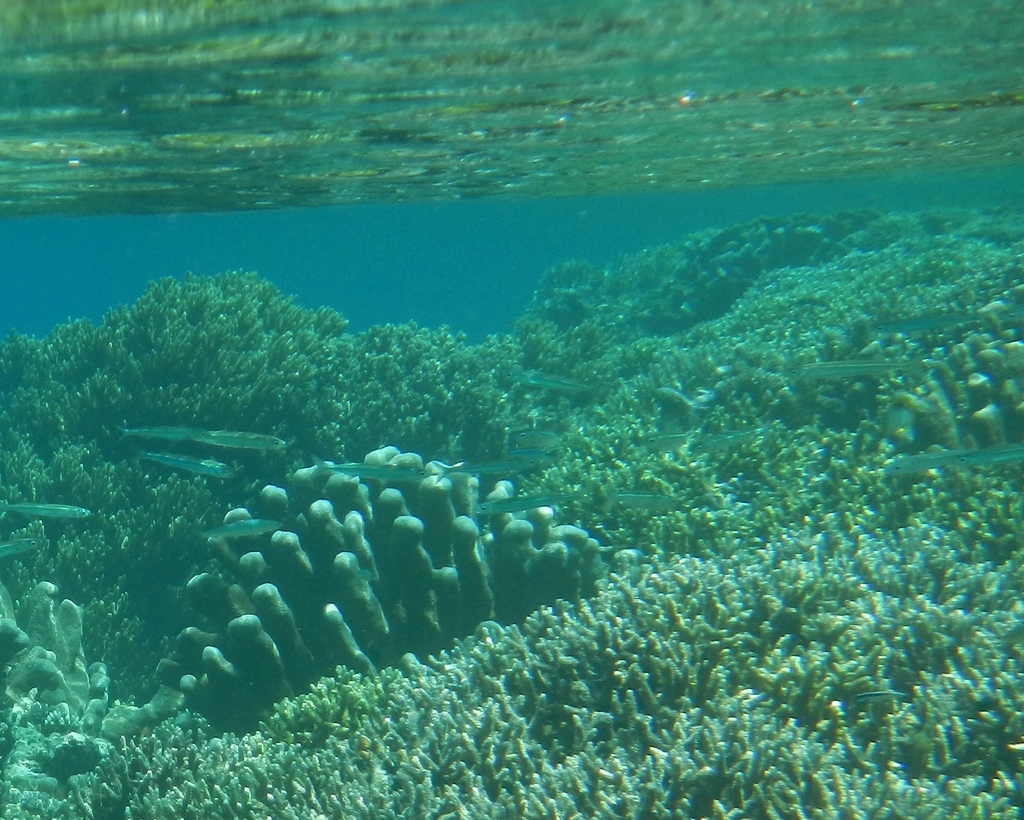
Shoulderblade Coral
Pavona clavus
Pavona clavus (common name shoulder blade coral) is a species of colonial stony coral in the family Agariciidae. It is a widespread but uncommon species known from the Indo-Pacific region, the South China Sea, the Red Sea, and the Gulf of Aden. A P. clavus colony in the Solomon Islands is considered to be the world's largest known coral.
From the article Pavona clavus on Wikipedia (CC BY-SA), quoted section by section
Description
Pavona clavus is a cream, yellow, brown, or pale grey coral typically forming columnar or club-shaped colonies, though it may also form flattened plates. The columns are generally smooth and uniform in size, typically measuring up to 20 cm (7.9 in) tall and 3–5 cm (1.2–2.0 in) in diameter. They are capable of dividing but not fusing. The colonies may range from 10 cm (3.9 in) in diameter to over 10 m (33 ft) across, sometimes forming extensive single-species stands. The corallites of this species are circular and very small, measuring 2.5–3.5 mm (0.098–0.138 in) in diameter, with thick, well defined walls. The corallites may be arranged irregularly or in short valleys. Flattened colonies of P. clavus may resemble P. bipartita, and the corallites are similar to those of P. duerdeni.
Range & habitat
Pavona clavus is typically found on coral reefs at depths of 2–40 m (6 ft 7 in – 131 ft 3 in), often on slopes and in areas exposed to currents. It prefers protected or semi-protected habitats and is absent from very shallow, high energy reef platforms. P. clavus is widely distributed, with its range extending from the western Indian Ocean to the eastern Pacific Ocean along with the South China Sea, the Red Sea, and the Gulf of Aden. This range includes the coasts of eastern Africa and West Asia (including the Comoros, Djibouti, Egypt, Eritrea, Jordan, Kenya, Madagascar, the Maldives, Mauritius, Mayotte, Mozambique, Réunion, Saudi Arabia, Seychelles, Somalia, South Africa, Sudan, Tanzania, and Yemen), Asia (including Brunei, Cambodia, India, Indonesia, Japan, Myanmar, the Philippines, Singapore, Sri Lanka, Taiwan, Thailand, Timor-Leste, and Vietnam) and Oceania (including American Samoa, Australia, the Cook Islands, the Federated States of Micronesia, Fiji, Guam, Kiribati, the Marshall Islands, Nauru, New Caledonia, Niue, the Northern Mariana Islands, Palau, Papua New Guinea, the Pitcairn Islands, Samoa, Solomon Islands, Tokelau, Tonga, Tuvalu, Vanuatu, and Wallis and Futuna), through to western Central America and South America (including Colombia, Costa Rica, Ecuador, El Salvador, Guatemala, Honduras, Mexico, Nicaragua, and Panama).
Wikipedia: “Distribution and habitat”
What it does
Pavona clavus is a reef-building species that grows at rates of 0.9–1.3 cm (0.35–0.51 in) per year. It is a preferred prey species of the crown-of-thorns starfish (Acanthaster planci) and one of two known host species of the gall crab Opecarcinus cathyae.
Wikipedia: “Ecology”
Where it lives
Recorded sightings
—
geo-referenced records in GBIF, from museums, herbaria and field observers.
Drag the globe to turn it. Dots are where records exist, not a range map; darker means more records.
In the stacks
Searching the stacks…
Every page naming Pavona clavus in the Biodiversity Heritage Library →
This page is assembled live from iNaturalist, GBIF, Wikipedia, the Source Library and the Internet Archive. It is not yet part of the hand-edited codex. iNaturalist taxon 108973.