- Animals
- ›Chordates
- ›Vertebrates
- ›Ray-finned Fishes
- ›Carps, Characins, Catfishes and Allies
- ›Catfishes
- ›Siluroidei
- ›Shark Catfishes
- ›Pangasianodon
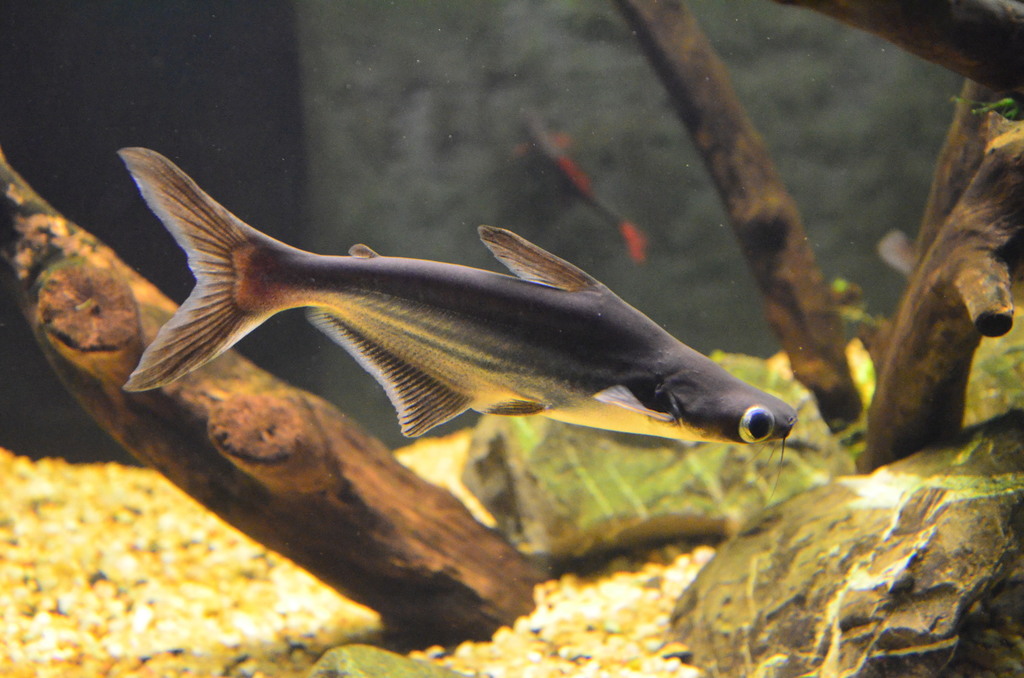
Iridescent Shark
Pangasianodon hypophthalmus
The iridescent shark or iridescent shark catfish (Pangasianodon hypophthalmus) is a species of shark catfish (family Pangasiidae) native to the rivers of Southeast Asia. Despite its name, it is not a real shark. It is found in the Mekong basin as well as the Chao Phraya River, and is heavily cultivated for food.
The meat is often marketed under the common name swai (from Thai สวาย). It has also been introduced into other river basins as a food source, and its striking appearance and iridescence have made it popular with fishkeeping hobbyists, among whom it is also known as the Siamese shark catfish or sutchi catfish. The swai's omnivorous diet consists of crustaceans, other fish, and plant matter.
From the article Iridescent shark on Wikipedia (CC BY-SA), quoted section by section
Description
Adults reach up to 130 cm (4.3 ft) in length and can weigh up to a maximum of 44 kg (97 lb). They have a shiny, iridescent color that gives these fish their name. However, large adults are uniformly grey. The fins are dark grey or black. Juveniles have a black stripe along the lateral line and a second black stripe below the lateral line.
Range & habitat
Iridescent sharks originate in the large rivers Chao Phraya and Mekong in Asia, though they have been introduced into other rivers for aquaculture. They are a freshwater fish that natively live in a tropical climate and prefer water with a 6.5–7.5 pH, a water hardness of 2.0–29 dGH, and a temperature range of 22–26 °C (72–79 °F). They can tolerate hypoxic conditions thanks to their swim bladder which can be used as an air-breathing organ. They prefer large bodies of water similar to the deep waters of their native Mekong river basin. The iridescent shark is a migratory fish that in most regions moves upstream to spawn during the flood season while the waters are high and returns downstream to seek rearing habitats when the river water levels recede. The dates of the migrations vary depending on the river system. In the Mekong river basin, they migrate upstream in May to July and return downstream during September through December. South of the Khone Falls, upstream migration occurs in October to February, with its peak in November to December; here, it appears to be triggered by receding waters at the end of the flood season. In August 2015, an environmental group in Santander, Colombia, confirmed that iridescent sharks had been found in one of the tributaries that feed into the Magdalena River, having been accidentally introduced from illegal farm fisheries in the area. …
Wikipedia: “Distribution and habitat”
At the table
Pangasius does not have a gourmet reputation and is sold cheaply as swai (, from Thai สวาย s̄wāy) in the United States, panga (or pangas) in Europe and cream dory and basa in several Asian countries and in Australia and the UK. Despite its lowly reputation, the total export of pangasius from Vietnam reached US$1.8 billion in 2014. Pangasius fillets are an increasingly popular product because of their low cost, mild taste and firm texture. Recipes for other whitefish such as sole or halibut can be adapted to pangasius. Pangasius is an omnivorous fish, and thus does not require a high level of animal protein in its diet. Typical grading sizes are 3–5 oz (85–140 g), 5–7 oz (140–200 g), and 7–9 oz (200–260 g).
Wikipedia: “Culinary profile”
Where it lives
Recorded sightings
—
geo-referenced records in GBIF, from museums, herbaria and field observers.
Drag the globe to turn it. Dots are where records exist, not a range map; darker means more records.
In the stacks
Searching the stacks…
Every page naming Pangasianodon hypophthalmus in the Biodiversity Heritage Library →
This page is assembled live from iNaturalist, GBIF, Wikipedia, the Source Library and the Internet Archive. It is not yet part of the hand-edited codex. iNaturalist taxon 108332.