- Animals
- ›Chordates
- ›Vertebrates
- ›Ray-finned Fishes
- ›Carps, Characins, Catfishes and Allies
- ›Minnows, Suckers, Carps, and Loaches
- ›Carps and Minnows
- ›True Minnows
- ›Western Minnows
- ›Orthodon
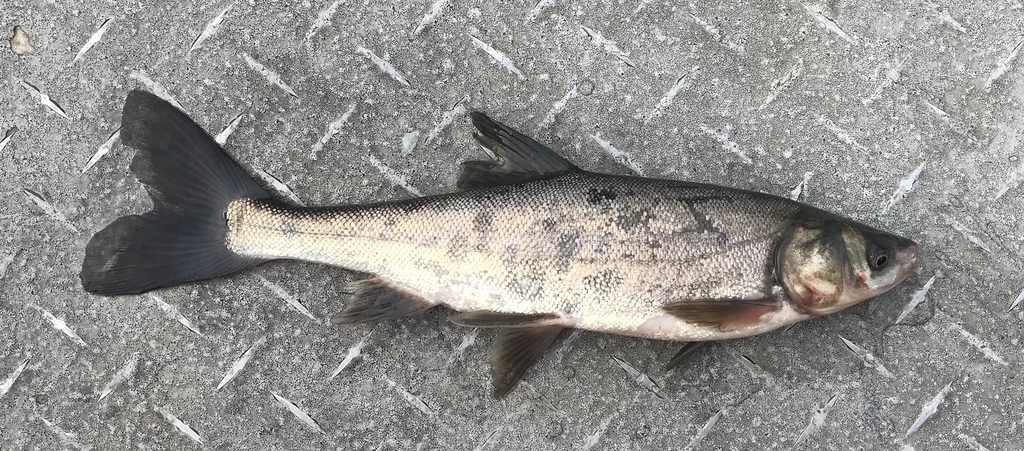
Sacramento blackfish
Orthodon microlepidotus
The Sacramento blackfish (Orthodon microlepidotus) is a species of freshwater ray-finned fish belonging to the family Leuciscidae, which includes the daces, chubs, Eurasian minnows and related fishes. This species is endemic to central California. It is the only member of the monospecific genus Orthodon.
From the article Sacramento blackfish on Wikipedia (CC BY-SA), quoted section by section
Description
Blackfish are named for their glossy black color. Younger individuals are more silvery, but darken as they age. The scales are unusually small, numbering 90–114 along the lateral line. The forehead has a straight-line profile, the eyes are small, and the terminal mouth slants upwards. The dorsal fin starts just behind the pelvic fins, and has 9–11 rays, while the anal fin has 8–9 rays, and the pelvic fins 10 rays. The pharyngeal teeth are distinctly long, straight, and knife-shaped, not seen in similar species in California; the grinding surface of the blackfish, used to process its food, is relatively narrow. Adults commonly reach a length of 35 centimetres (14 in), but they have been recorded at up to 55 centimetres (22 in) in length.
The Sacramento blackfish can reach weights of up to 1.5 kg (3.3 lb) at maturity. The dark grey color of the adults can sometimes take on an olive hue, they have an elongated and narrow peduncle connecting the body to the caudal fin. It is one of the largest native minnow species in California, ranking third behind the Hardhead (Mylopharodon conocephalus) and the Sacramento Pikeminnow (Ptychocheilus grandis). …
Wikipedia: “Anatomy and morphology”
Range & habitat
Blackfish are primarily denizens of the warm and cloudy waters found on the floor of the Central Valley, such as sloughs and oxbow lakes connected to the Sacramento and San Joaquin Rivers. They are also common in Clear Lake, Pajaro River, Salinas River, the small creeks that feed into San Francisco Bay. A population is present in the Russian River, believed to have been introduced. It is not native to the Russian River. They were introduced to the Carmel River, parts of Southern California and western Nevada. Early spawning allows them to thrive in reservoirs, and they have been spread to a number of California reservoirs via the California Aqueduct, and into Nevada via the Lahontan Reservoir (1964) where they have further colonized the Humboldt River drainage. The Sacramento blackfish is found in several major California watersheds, including but not limited to: Sacramento River, San Francisco, San Joaquin River, Tulare Lake, and North Coast Watersheds.
The Sacramento blackfish prefers waters that run on the warmer side, one of the only native species that is able to survive in such environments. This temperature range is typically 22 to 28 °C (72 to 82 °F), though they have historically even endured temperatures higher than 30 °C (86 °F) and their young can survive at temperatures up to 37 °C (99 °F). …
Wikipedia: “Distribution and habitat”
What it does
Unlike most North American cyprinids, Sacramento blackfish filter feed on zooplankton, planktonic algae, and floating detritus, including rotifers, copepods, cladocerans, diatoms, and the like. While younger blackfish pick at food items individually, adults primarily use their oral cavity and gills to filter food from water. The blackfish opens and closes its mouth rapidly to pump large volumes of water, the food bits are caught in a patch of mucus on the roof of the mouth, where it is secreted by the palatal organ, and the food bits are swallowed with the mucus. The size of a blackfish influences its eating behavior; larger blackfish, with consequently larger oral cavities and easier means of filter feeding, are not seen pursuing individual prey like shorter blackfish. The gill rakers of the Sacramento blackfish are long and thin, similar to those of other species of filter feeders, but these gill rakers are not necessarily used for filtering the food material. Instead, the gill rakers act as directional structures to send the water stream they gulp up to the roof of their mouth in order to trap food material in the mucus.
Wikipedia: “Feeding behavior”
In human culture
They are also seen as a potential aquaculture species. This is because they can grow at a steady rate even on a plant-based diet, despite the fact that they are omnivorous. Studies have shown that they grow at an "acceptable rate" compared to other aquaculture species and have the capacity to grow at an even faster rate with the inclusion of proteins and lipids in their diet or even with natural nutrient availability in shallow water, making their species an admissible aquaculture candidate.
Wikipedia: “Aquaculture”
Where it lives
Recorded sightings
—
geo-referenced records in GBIF, from museums, herbaria and field observers.
Drag the globe to turn it. Dots are where records exist, not a range map; darker means more records.
In the stacks
Searching the stacks…
Every page naming Orthodon microlepidotus in the Biodiversity Heritage Library →
This page is assembled live from iNaturalist, GBIF, Wikipedia, the Source Library and the Internet Archive. It is not yet part of the hand-edited codex. iNaturalist taxon 107997.