- Animals
- ›Chordates
- ›Vertebrates
- ›Mammals
- ›Therians
- ›Placental Mammals
- ›Primates, Rodents, and Allies
- ›Primates
- ›Lemurs, Lorises, and Allies
- ›Lemurs
- ›Lemurs
- ›Koala Lemurs
- ›Megaladapis
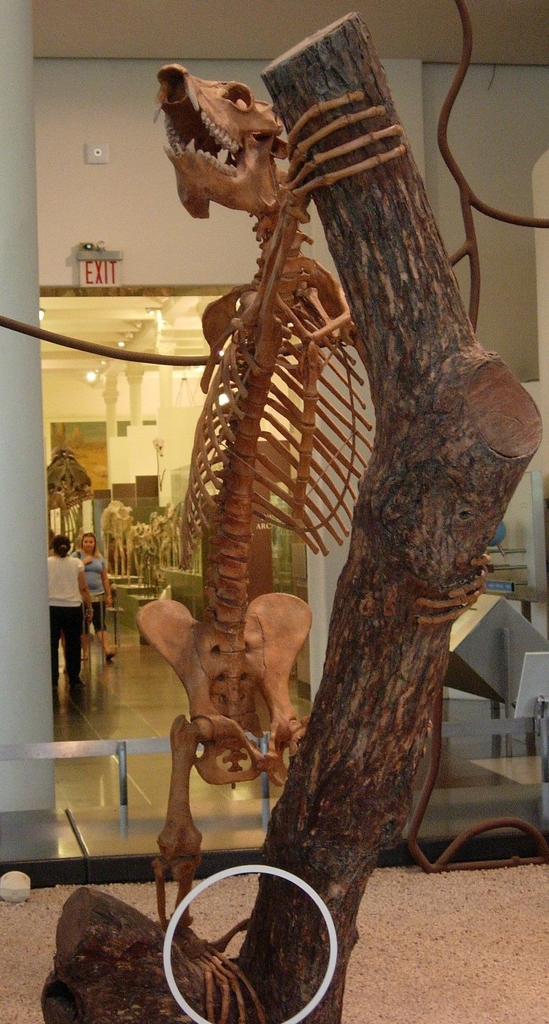
Giant Koala Lemur
Megaladapis edwardsi
Megaladapis, informally known as koala lemur, is an extinct genus belonging to the family Megaladapidae, consisting of three extinct species of lemurs that once inhabited the island of Madagascar. The largest measured between 1.3 to 1.5 m (4 to 5 ft) in length.
From the article Megaladapis on Wikipedia (CC BY-SA), quoted section by section
Description
Megaladapis was quite different from any living lemur. Its body was squat and built like that of the modern koala. Its long arms, fingers, feet, and toes were specialized for grasping trees, and its legs were splayed for vertical climbing. The morphology of its foot suggests Megaladapis evolved to live in an arboreal environment, having a large hallux and lateral abductor musculature that helped it to grasp vertically on trees. These features are shared by other arboreal species. The hands and feet were curved and the ankles and wrists did not have the usual stability needed to travel on the ground that most other lemurids have. Its body weight reached 140 kg (310 lb). Other estimates suggest 46.5–85.1 kg (103–188 lb) but it is still much larger than any extant lemur. It had the largest body size of any lemur, with double the body mass of the next largest extinct lemur.
Cranial anatomy. The shape of its skull was unique among all known primates, with a nasal region which showed similarities to those of rhinoceros, a feature that probably combined with an enlarged upper lip for grasping leaves. Its head was unlike that of any other primate; most strikingly, its eyes were on the sides of its skull, instead of forward on the skull as in all other primates. …
Listen
Looking for field recordings…
Where it lives
Recorded sightings
—
geo-referenced records in GBIF, from museums, herbaria and field observers.
Drag the globe to turn it. Dots are where records exist, not a range map; darker means more records.
In the stacks
Searching the stacks…
Every page naming Megaladapis edwardsi in the Biodiversity Heritage Library →
This page is assembled live from iNaturalist, GBIF, Wikipedia, the Source Library and the Internet Archive. It is not yet part of the hand-edited codex. iNaturalist taxon 1079246.