- Animals
- ›Chordates
- ›Vertebrates
- ›Ray-finned Fishes
- ›Salmons, Pikes and Mudminnows
- ›Salmons, Trouts, and Whitefishes
- ›Salmons, Trouts, and Whitefishes
- ›Salmons and Trouts
- ›Oncorhynchus
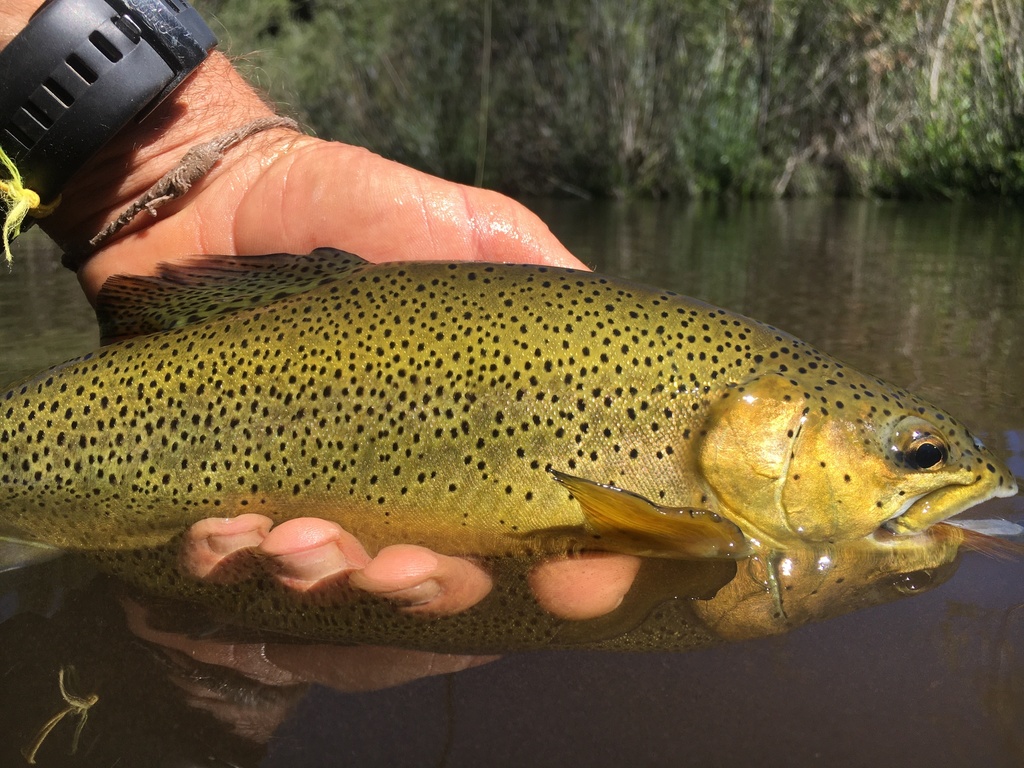
Apache Trout
Oncorhynchus apache
The Apache trout or Arizona trout (Oncorhynchus apache), is a species of freshwater fish in the salmon family (family Salmonidae) of order Salmoniformes. It is closely related to Gila trout and is one of the critically endangered Pacific trouts.
From the article Apache trout on Wikipedia (CC BY-SA), quoted section by section
Description
The Apache trout measures in length from 6 to 24 in (15–61 cm), and weighs between 0.4 to 6 lb (0.2–2.7 kg). It rarely exceeds 10 in (25 cm), but can reach up to 16 in (40 cm) in its native, headwater streams. Apache trout are a yellowish-gold color with a golden belly and have medium-sized dark spots that are evenly spaced and that may extend below the lateral line and onto the dorsal and tail fins. The top of its head and back are dark olive in color, and it has the appearance of having a black stripe/mask through each of its eyes, due to two small black dots on either side of the pupil. There can be a throat mark below the lower jaw, ranging in color from yellow to gold.
Range & habitat
The Apache trout is the state fish of Arizona, and is one of only two species of trout native to that state, with the other being closely related the gila trout (O. g. gilae). It natively lives in clear, cool streams in the White Mountains that flow through coniferous forests and marshes, but has been introduced into several lakes in the area. The Apache trout is native to the upper Salt River watershed (Black and White rivers) and the upper Little Colorado River watershed. Apache trout have been introduced into isolated streams outside of their historic range in the Pinaleño Mountains and the North Rim of the Grand Canyon. Apache trout exist in their most pure form within headwater streams at an elevation of 2,100 meters (6,900 feet) or higher in the White Mountain Apache Reservation.
Wikipedia: “Distribution”
In human culture
The Apache trout spawns from March to the middle of June, and varies with elevations. Maturity was found to occur in three years, and fecundity is based on the size of trout. One female typically produces from 72 to 240 eggs in 13.1 to 19.1 cm (5.2 to 7.5 in) fish and from 646 to 1,083 eggs in 29.8 to 34.9 cm (11.7 to 13.7 in) fish. The eggs hatch after 30 days. The Apache trout eats both terrestrial and aquatic insects, such as Trichoptera and Diptera. In lakes, they also eat small fishes and zooplankton.
Wikipedia: “Life history”
Where it lives
Recorded sightings
—
geo-referenced records in GBIF, from museums, herbaria and field observers.
Drag the globe to turn it. Dots are where records exist, not a range map; darker means more records.
In the stacks
Searching the stacks…
Every page naming Oncorhynchus apache in the Biodiversity Heritage Library →
This page is assembled live from iNaturalist, GBIF, Wikipedia, the Source Library and the Internet Archive. It is not yet part of the hand-edited codex. iNaturalist taxon 107567.