- Animals
- ›Chordates
- ›Vertebrates
- ›Birds
- ›Pelicans, Herons, Ibises, and Allies
- ›Herons, Egrets, and Bitterns
- ›Typical Herons and Egrets
- ›Nycticorax
On eBird ↗
Rodrigues Night Heron
Live sightings near you, the range map, bar charts of when it is seen, and Macaulay Library photos and recordings.
Rodrigues Night Heron
Nycticorax megacephalus
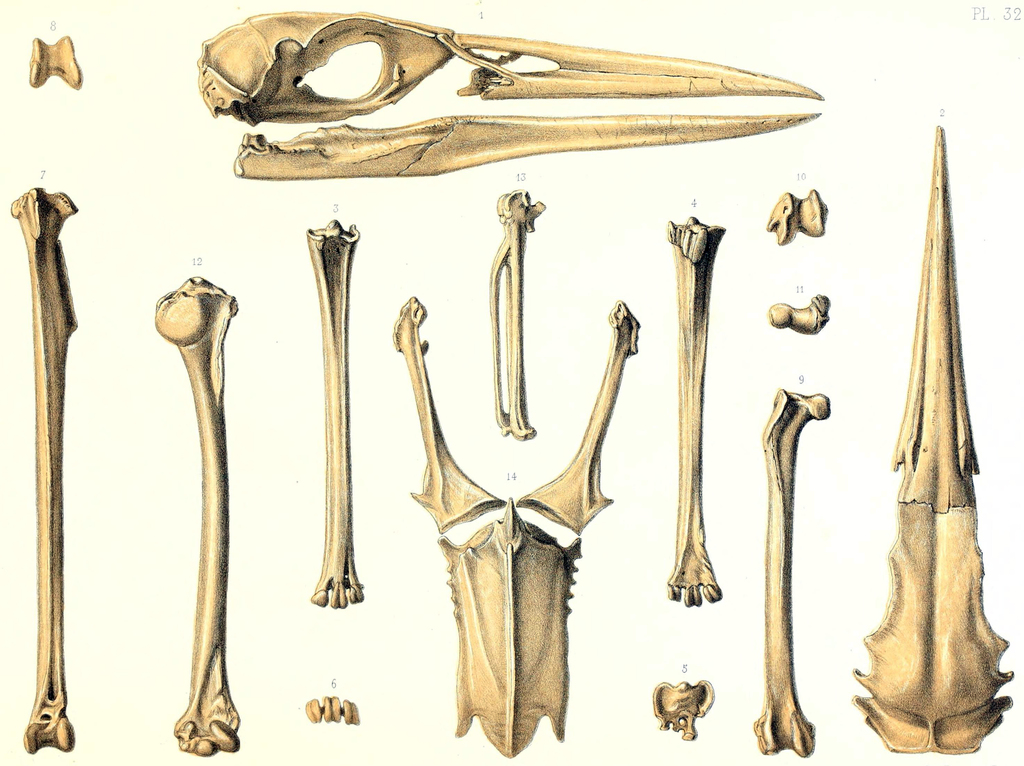
The Rodrigues night heron (Nycticorax megacephalus) is an extinct species of heron that was endemic to the Mascarene island of Rodrigues in the Indian Ocean. The species was first mentioned as "bitterns" in two accounts from 1691–1693 and 1725–1726, and these were correlated with subfossil remains found and described in the latter part of the 19th century. The bones showed that the bird was a heron, first named Ardea megacephala in 1873, but moved to the night heron genus Nycticorax in 1879 after more remains were described. The specific name megacephala is Greek for "great-headed". Two related extinct species from the other Mascarene islands have also been identified from accounts and remains: the Mauritius night heron and the Réunion night heron.
The Rodrigues night heron was robust, its bill was comparatively large, stout and straight, and its legs were short and strong. It is estimated to have been 60 cm (24 in) long, and its appearance in life is uncertain. There was marked sexual dimorphism, males being larger. Little is known about the bird's behaviour, but the contemporary accounts indicate that it ate lizards (probably the Rodrigues day gecko), was adapted to running, and although able to fly, rarely did so. Examinations of the known remains have confirmed its terrestrial adaptations; one researcher thought the species flightless but this idea has not been accepted by others. The species could not be found by 1763, and it is thought to have been driven to extinction by human-related factors such as the introduction of cats.
From the article Rodrigues night heron on Wikipedia (CC BY-SA), quoted section by section
Description
The Rodrigues night heron was robust, its bill was comparatively large, stout and straight, and its legs were short and strong, and more robust than those of the related Mauritius night heron. There was marked sexual dimorphism in the Rodrigues night heron, which is also present in the black-crowned night heron, and the male was the largest. There is a 17.5% length difference in the tibiotarsus between male and female specimens, 9.3% difference in the tarsometatarsus, and a 9.1% difference in the available mandibles. The difference was almost the same in the Mauritius night heron, and there was little dimorphism in the Réunion night heron. The Rodrigues night heron is estimated to have been 60 cm (24 in) long. Measurements of the bones available by the late 19th century show that the skull was 154 mm (6.1 in) long, the upper mandible was 94 mm (3.7 in) long and 22 mm (0.87 in) wide at the base, and the lower mandible was 147 mm (5.8 in) long. The sternum was 64–88 mm (2.5–3.5 in) long, the scapula 72 mm (2.8 in), the coracoid 59–67 mm (2.3–2.6 in), the humerus 118–180 mm (4.6–7.1 in), the ulna 121 mm (4.8 in), the radius 117 mm (4.6 in), and the metacarpal 62–98 mm (2.4–3.9 in). The pelvis was 63 mm (2.5 in) long, the femur 90–92 mm (3.5–3.6 in), the tibiotarsus 140–210 mm (5.5–8.3 in), the tarsometatarsus 95–162 mm (3.7–6.4 in), and the second phalanx bone 20 mm (0.79 in). …
What it does
Little is known about the behaviour of the Rodrigues night heron apart from the two contemporary descriptions, but it was better documented that its Mauritius relative. Leguat's 1708 description reads as follows, referring to these birds as "bitterns":
We had Bitterns as big and as fat as capons. They are tamer and more easily caught than the 'gelinotes' [Rodrigues rails]... The lizards often serve as prey for the birds, especially for the Bitterns. When we shook them down from the branches with a pole, these birds ran up and gobbled them down in front of us, in spite of all we could do to prevent them; and even if we only pretended to do so they came in the same manner and always followed us about. The "lizards" mentioned were probably geckos of the genus Phelsuma (there were six gecko species on Mauritius), such as the now extinct Rodrigues day gecko, which reached 23 cm (9.1 in) in length. Leguat and his companions were fond of these quite tame lizards, letting them feed from their tables, and therefore tried to protect them from the aggressive herons. …
Wikipedia: “Behaviour and ecology”
Listen
Looking for field recordings…
Where it lives
Recorded sightings
—
geo-referenced records in GBIF, from museums, herbaria and field observers.
Drag the globe to turn it. Dots are where records exist, not a range map; darker means more records.
In the stacks
Searching the stacks…
Every page naming Nycticorax megacephalus in the Biodiversity Heritage Library →
This page is assembled live from iNaturalist, GBIF, Wikipedia, the Source Library and the Internet Archive. It is not yet part of the hand-edited codex. iNaturalist taxon 107322.