- Animals
- ›Chordates
- ›Vertebrates
- ›Ray-finned Fishes
- ›Carps, Characins, Catfishes and Allies
- ›Minnows, Suckers, Carps, and Loaches
- ›Carps and Minnows
- ›True Minnows
- ›North American Minnows
- ›Notropis
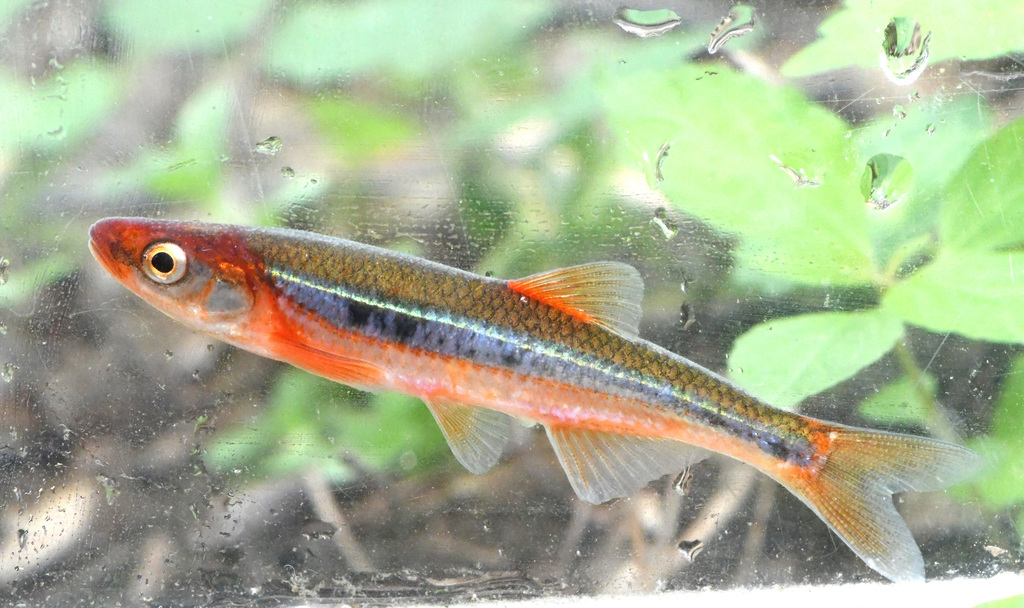
Carmine Shiner
Notropis percobromus
The carmine shiner (Notropis percobromus) is a freshwater fish species. In Manitoba, it was once known as the rosyface shiner (Notropis rubellus). It is now recognized as a different species within the rosyface shiner species complex, largely based on zoogeographic information. The carmine shiner is a member of the Minnow family, Cyprinidae. It has the following characteristics and distinguishing features:
From the article Carmine shiner on Wikipedia (CC BY-SA), quoted section by section
Description
The carmine shiner has the following characteristics and distinguishing features:
A slender, elongate minnow, typically 55 to 60 mm (2.2 to 2.4 in) in length (Whitemouth River) Snout length is equal to the eye diameter Adults are olive green dorsally, silvery on the sides and silvery white on the belly Black pigment outlines the scale pockets dorsally; the opercula and cheeks may be pinkish Breeding males develop fine, sandpaper-like nuptial tubercles on the head, pectoral fins and some predorsal scales. They also turn pinkish violet around the head with a reddish tinge at the base of the dorsal fin. Breeding females are usually lighter in colour Seldom survives capture or handling and scales are easily dislodged
Range & habitat
Eastern North America, in the United States it is found throughout the eastern part of the country from North and South Dakota in the west as far south as Arkansas. In Canada, this species has been found only in the Winnipeg River system, including the Whitemouth watershed. It may occur upstream to Lake of the Woods, Ontario. The Manitoba populations are at the northwestern limit of the distribution, separated from the continuous range of the species by 450 km (280 mi).
Wikipedia: “Distribution”
What it does
This fish eats primarily aquatic insects, some terrestrial insects, fish eggs, algae and diatoms. Prey are located by sight.
Wikipedia: “Diet”
In human culture
Carmine shiners typically summer at midwater depths of clear, fast flowing streams and small rivers over clean gravel or rubble substrates. They often school in riffles and pools near the confluence with larger streams and rivers. Habitat use during other seasons and by young-of-the-year has not been studied in Manitoba, nor has spawning. However, a ripe and running female was taken in the Pinawa Channel in 19.3 °C (66.7 °F) water. Southern populations typically spawn in riffles in May/June at temperatures of 20 to 28.9 °C (68.0 to 84.0 °F). Adhesive eggs are deposited into depressions in gravel, often in the nests of other minnow species. Eggs hatch within 60 hours at 21 °C (70 °F) and newly hatched larvae work their way vertically into the gravel. These fish are mature at one year and live about three years. Individuals likely move into deeper water to winter.
Wikipedia: “Habitat and life history”
Where it lives
Recorded sightings
—
geo-referenced records in GBIF, from museums, herbaria and field observers.
Drag the globe to turn it. Dots are where records exist, not a range map; darker means more records.
In the stacks
Searching the stacks…
Every page naming Notropis percobromus in the Biodiversity Heritage Library →
This page is assembled live from iNaturalist, GBIF, Wikipedia, the Source Library and the Internet Archive. It is not yet part of the hand-edited codex. iNaturalist taxon 107246.