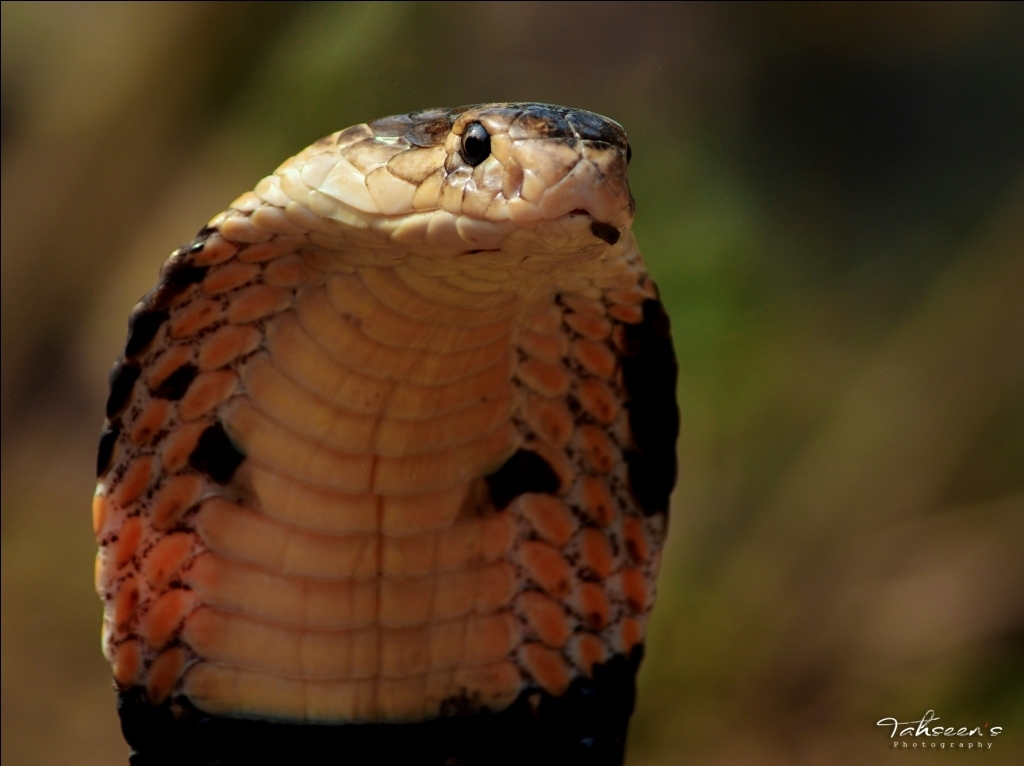
Monocellate Cobra
Naja kaouthia
The monocled cobra (Naja kaouthia), also called monocellate cobra and Indian spitting cobra, is a venomous cobra species widespread across South and Southeast Asia. It is characterized by a distinctive circular or "monocle"-shaped marking on the hood, though the pattern can be highly variable or even absent in some individuals. It occupies a wide range of habitats, including forests, agricultural land, and areas near human settlements. It is responsible for a significant proportion of snakebite incidents and fatalities in its range, due to its potent neurotoxic venom and frequent proximity to human settlements. Some populations of the monocled cobra have the ability to spit venom with notable accuracy, though not all individuals exhibit this behavior.
From the article Monocled cobra on Wikipedia (CC BY-SA), quoted section by section
Description
The monocled cobra has an O-shaped, or monocellate hood pattern, unlike that of the Indian cobra, which has the "spectacle" pattern (two circular ocelli connected by a curved line) on the rear of its hood. The elongated nuchal ribs enable a cobra to expand the anterior of the neck into a "hood". Coloration in the young is more constant. The dorsal surface may be yellow, brown, gray, or blackish, with or without ragged or clearly defined cross bands. It can be olivaceous or brownish to black above with or without a yellow or orange-colored, O-shaped mark on the hood. It has a black spot on the lower surface of the hood on either side, and one or two black cross-bars on the belly behind it. The rest of the belly is usually the same color as the back, but paler. As age advances, the snake becomes paler, wherein the adult is brownish or olivaceous. A pair of fixed anterior fangs is present. The largest fang recorded measured 6.78 mm (0.678 cm). Fangs are moderately adapted for spitting. Adult monocled cobras reach a length of 1.35 to 1.5 m (4.4 to 4.9 ft) with a tail length of 23 cm (9.1 in). Many larger specimens have been recorded, but they are rare. Adults can reach a maximum of 2.3 m (7.5 ft) in length.
Scalation. The monocled cobra has 25 to 31 scales on the neck, 19 to 21 on the body, and 17 or 15 on the front of the vent. …
Range & habitat
The monocled cobra is distributed from India in the west through to China, Vietnam and Cambodia. It also occurs on the Malay Peninsula and is native to West Bengal, Bangladesh, Bhutan, Myanmar, Laos, Nepal, and Thailand. It can adapt to a range of habitats, from natural to anthropogenically impacted environments. It prefer habitats associated with water, such as paddy fields, swamps and mangroves, but lives also in grasslands, shrublands, forests, agricultural land at elevations of up to 1,000 m (3,280 ft) and human settlements including cities.
Wikipedia: “Distribution and habitat”
What it does
The monocled cobra is terrestrial and most active at dusk. In rice-growing areas, it hides in rodent burrows in the dykes between fields and has become semi-aquatic in this type of habitat. Juveniles feed mostly on amphibians whereas adults prey on small mammals, snakes and fish. When disturbed it prefers to escape. However, when threatened it will raise the anterior portions of the body, spread its hood, usually hisses loudly and strikes in an attempt to bite and defend itself. It often hides in tree holes and areas where rodents are plentiful. Some monocled cobra populations have the ability to spray venom, earning them the name "Indian spitting cobra".
Wikipedia: “Behaviour and ecology”
Toxicity
The venom of the monocled cobra from three different localities was reported to exhibit different intravenous and subcutaneous median lethal doses: Thailand, 0.18-0.22 μg/g; Malaysia, 0.90-1.11 μg/g; and Vietnam, 0.90-1.00 μg/g, of mouse body weight. These results reflect the distinct difference in the lethal potency of the monocled cobra and response to antivenom neutralization. The major toxic components in cobra venoms are postsynaptic neurotoxins, which block the nerve transmission by binding specifically to the nicotinic acetylcholine receptor, leading to flaccid paralysis and even death by respiratory failure. The major α-neurotoxin in the monocled cobra's venom is a long neurotoxin, α-cobratoxin; the minor α-neurotoxin is different from cobrotoxin in one residue. The neurotoxins of this particular species are weak. The venom of this species also contains myotoxins and cardiotoxins. Envenomation usually presents predominantly with extensive local necrosis and systemic manifestations to a lesser degree. Drowsiness, neurological and neuromuscular symptoms will usually manifest earliest; hypotension, flushing of the face, warm skin, and pain around bite site typically manifest within one to four hours following the bite; paralysis, ventilatory failure or death could ensue rapidly, possibly as early as 60 minutes in very severe cases of envenomation. …
Wikipedia: “Venom”
Where it lives
Recorded sightings
—
geo-referenced records in GBIF, from museums, herbaria and field observers.
Drag the globe to turn it. Dots are where records exist, not a range map; darker means more records.
In the stacks
Searching the stacks…
Every page naming Naja kaouthia in the Biodiversity Heritage Library →
This page is assembled live from iNaturalist, GBIF, Wikipedia, the Source Library and the Internet Archive. It is not yet part of the hand-edited codex. iNaturalist taxon 106447.