- Fungi Including Lichens
- ›Basidiomycete Fungi
- ›Higher Basidiomycetes
- ›Mushrooms, Bracket Fungi, Puffballs, and Allies
- ›Phallomycetidae
- ›stinkhorns and allies
- ›Clathraceae
- ›Aseroe
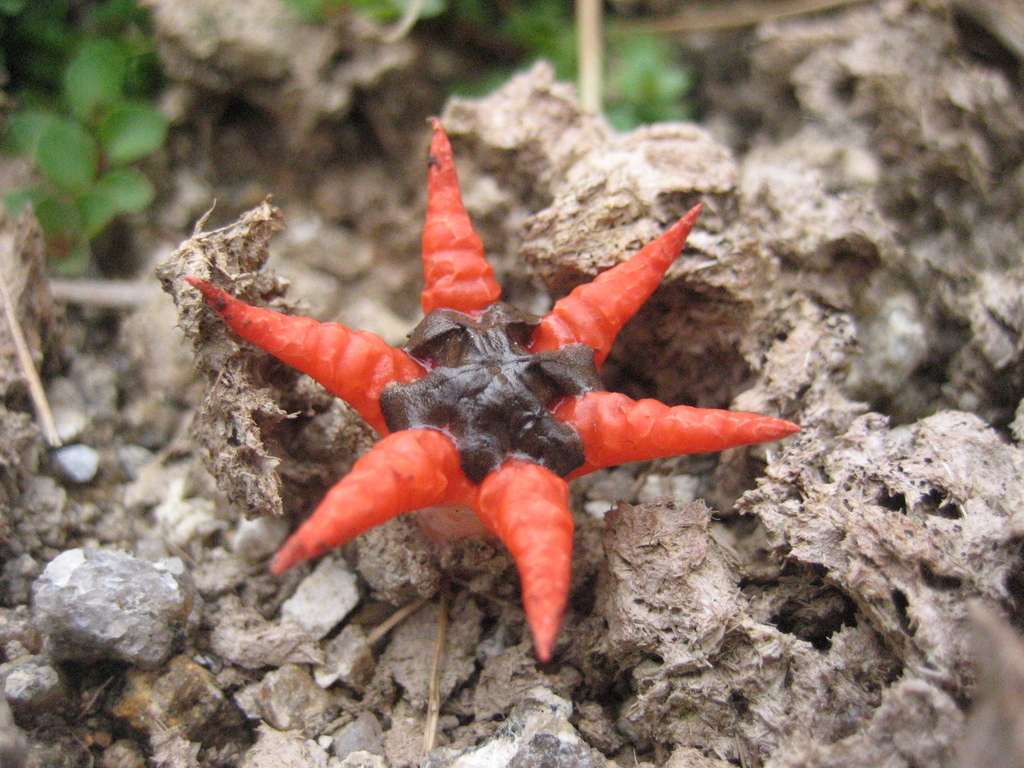
Aseroe coccinea
Aseroe coccinea is a species of stinkhorn fungus in the genus Aseroe. First reported in Japan in 1989, it was not formally validated as a species until 2007, the delay related to a publication error. The receptacle, or fruit body, begins as a partially buried whitish egg-shaped structure, which bursts open as a hollow white stipe with reddish arms, then erupts and grows to a height of up to 15 mm (0.6 in). It matures into a star-shaped structure with seven to nine thin reddish tubular "arms" up to 10 mm (0.4 in) long radiating from the central area. The top of the receptacle is covered with dark olive-brown spore-slime, or gleba. A. coccinea can be distinguished from the more common species A. rubra by differences in the color of the receptacle, and in the structure of the arms. The edibility of the fungus has not been reported.
From the article Aseroe coccinea on Wikipedia (CC BY-SA), quoted section by section
Description
Like all Phallaceae species, A. coccinea begins its development in the form of a roughly spherical whitish "egg" that is 10–15 mm (0.39–0.59 in) in diameter, lying on or partially submerged in the substrate. On the base of the egg is a white strand of mycelium. The exoperidium (the outer tissue layer) is white to cream-colored with a fibrous surface. The inner layer is membranous, with a hyaline (translucent) endoperidium (inner tissue layer). The slimy spore-bearing mass, the gleba, is olive-brown to greenish-black, with a slightly fetid odor. When the mushroom is mature, it covers the upper surface of a disc on the top of the receptacle. The receptacle has a cylindrical stipe, 10–15 mm (0.39–0.59 in) tall, 7–15 mm (0.28–0.59 in) in diameter at the top, somewhat fusiform (tapered at both ends) or sometimes just tapered towards the base. The stipe is pale pink near the top, white to cream at the base, spongy in texture, and hollow. The top of the receptacle is flattened to form a disc that bears 7–9, narrow, tapering "arms". The arms consist of a single bright red tube-like chamber, that is 4–10 mm (0.16–0.39 in) long and 0.7–2 mm (0.0–0.1 in) thick.
The thick-walled spores are ellipsoid to cylindrical, and measure 4–5 by 2–2.5 μm. They are hyaline (translucent), have a smooth surface, and are sometimes truncated at the base. …
Range & habitat
Although Kasuya did not explicitly define the mode of nutrition for A. coccinea, most Phallaceae species are suspected to be saprobic—decomposers of wood and plant organic matter. The fruit bodies of A. coccinea, known only from temperate regions of Japan (Tochigi Prefecture), grow solitarily or in groups on rice husks, straw, or dung. They are found from summer to autumn.
Wikipedia: “Habitat and distribution”
Where it lives
Recorded sightings
—
geo-referenced records in GBIF, from museums, herbaria and field observers.
Drag the globe to turn it. Dots are where records exist, not a range map; darker means more records.
In the stacks
Searching the stacks…
Every page naming Aseroe coccinea in the Biodiversity Heritage Library →
This page is assembled live from iNaturalist, GBIF, Wikipedia, the Source Library and the Internet Archive. It is not yet part of the hand-edited codex. iNaturalist taxon 1063405.