- Animals
- ›Chordates
- ›Vertebrates
- ›Ray-finned Fishes
- ›Spiny-rayed fishes
- ›Perches, Scorpionfishes, Sticklebacks, and Allies
- ›Perches, groupers and allies
- ›Groupers
- ›Mycteroperca
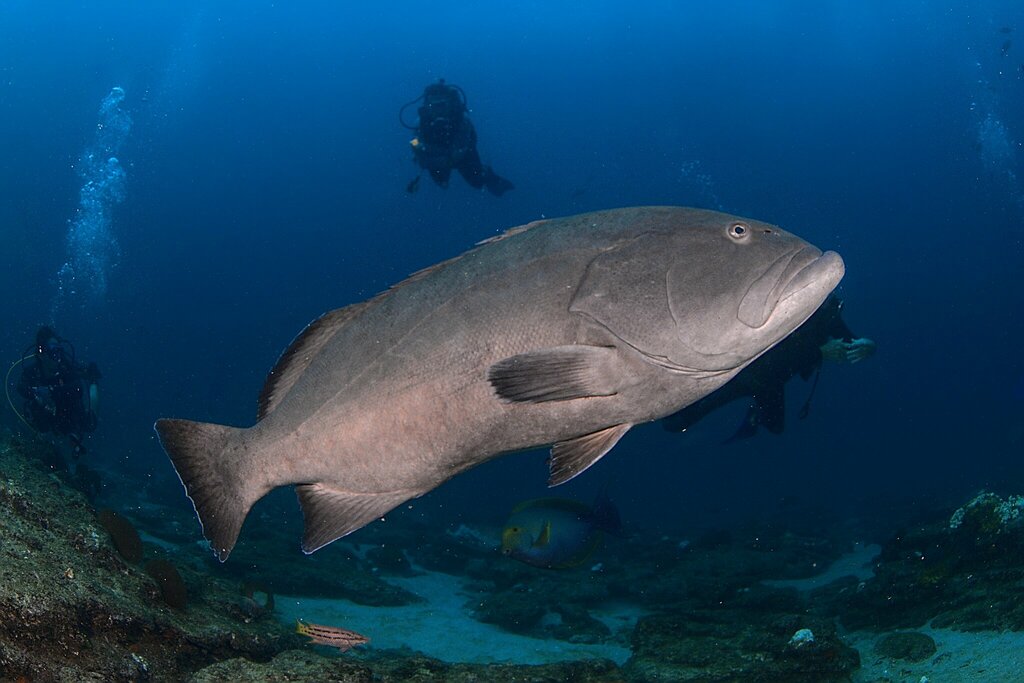
Gulf Grouper
Mycteroperca jordani
The Gulf grouper (Mycteroperca jordani) is a species of marine ray-finned fish, a grouper from the subfamily Epinephelinae which is part of the family Serranidae, which also includes the anthias and sea basses. It is endemic to Mexico.
From the article Gulf grouper on Wikipedia (CC BY-SA), quoted section by section
Description
The Gulf grouper has an elongate, robust and compressed body which is no deeper at the origin of the dorsal fin than it as the origin of the anal fin. It standard length is 3.1 to 3.4 times its depth. The preopercle is rounded, lacking a lobe, and has a finely serrated margin. The dorsal fin contains 11 spines and 16-17 soft rays while the anal fin contains 3 spines and 10–11 soft rays. The caudal fin is straight to concave. The colour of the adults is normally a uniform dark brown or grey, although they have the ability to quickly change colour and to adopt a pattern resembling that of juveniles. In the larger adults, the margin of the pectoral fin is white and the dorsal, anal and caudal fins have a narrow white edge. The juveniles are greyish brown marked with large, dark grey roughly rectangular blotches on the upper part of the body and fins. The maximum published total length for this species is 198 centimetres (78 in) and the maximum published weight is 91 kilograms (201 lb).
Range & habitat
The Gulf grouper is found in the eastern Pacific Ocean where it is endemic to Mexican waters from San Carlos, Baja California Sur south to Mazatlán. It is found throughout the Gulf of California and around the Revillagigedos Islands. It has been recorded as a vagrant off San Diego in the 1940s and 1950s. Abundance of the Gulf Grouper has declined significantly since the mid-20th century due to commercial fishing. According to the NOAA fisheries, Bahía Magdalena has the only known population of Gulf Groupers along the coast of the Baja California peninsula.
Wikipedia: “Distribution”
What it does
Gulf groupers at a young age tend to prey on different types of fish and invertebrates such as crabs and shrimp. As Gulf Groupers mature, they tend to primarily prey on different fish species. Mature adults tend to hunt during dawn and dusk when the sun is not too bright on the water. According to scientists at NOAA fisheries, the Gulf grouper has a large mouth to completely swallow prey whole and the size of their mouth determines the type of fish that they consume. Mature Gulf groupers like to stay in hideouts outside of the reproduction period of the year. Reproduction period starts in April and ends in June where they gather in packs to form spawning areas that are typically in reefs.
Wikipedia: “Behavior and diet”
Where it lives
Recorded sightings
—
geo-referenced records in GBIF, from museums, herbaria and field observers.
Drag the globe to turn it. Dots are where records exist, not a range map; darker means more records.
In the stacks
Searching the stacks…
Every page naming Mycteroperca jordani in the Biodiversity Heritage Library →
This page is assembled live from iNaturalist, GBIF, Wikipedia, the Source Library and the Internet Archive. It is not yet part of the hand-edited codex. iNaturalist taxon 106307.