- Animals
- ›Chordates
- ›Vertebrates
- ›Cartilaginous Fishes
- ›Sharks and Rays
- ›Sharks
- ›Galean Sharks
- ›Ground Sharks
- ›Houndsharks
- ›Triakine Houndsharks
- ›Mustelus
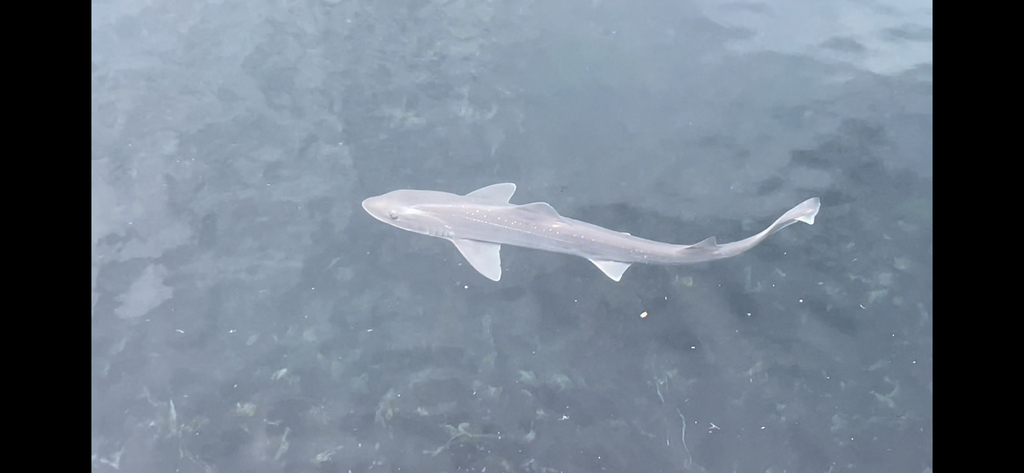
Starspotted Smooth-hound
Mustelus manazo
The starspotted smooth-hound (Mustelus manazo) is a houndshark of the family Triakidae. It is a medium-sized shark with irregular white spots across its body. It is found in Northwestern Pacific as well as Kenyan water. This shark mainly inhabits shallow seas and feeds on benthic animals. This shark is ovoviviparous and gives birth to 2-6 larvae per clutch. Currently, due to overfishing, this species is on the edge of extinction.
From the article Starspotted smooth-hound on Wikipedia (CC BY-SA), quoted section by section
Description
Compared with other sharks, the star-spotted smooth-hound has a medium size. Sexually mature individuals typically have lengths between 62-72 cm. Largest known male has a total length of 96 cm while the largest female has a length of 118 cm. Its body is elongated with a long tail and a flat head. Its dorsal side is gray or grayish brown, with irregular white spots scattered near their lateral lines, and its abdomen is white. Its eyes are oval with deep concavities outside. Its nostrils is wide with triangular nasal valves. The star-spotted smooth-hound has a triangular mouth with a large amount of small and interconnected teeth. Its teeth are oval or rhombus, overall blunt, unlike those possessed by other predatory sharks. Its first pair of dorsal fins are slightly larger than the second pair, starting at the end of the pectoral fins. The frontmost end of the anal fins is roughly at the midpoint of the second pair of dorsal fins.
Range & habitat
The star-spotted smooth-hound is mainly found around the coastal waters of the northwest Pacific Ocean, ranging from southern Russia in the north to Brunei in the south, but some are also found in the coastal waters of Kenya in Africa. In addition, there are unconfirmed sightings of star-spotted smooth-hound recorded in the Andaman Sea and in the coastal waters of Madagascar and Bangladesh.
Wikipedia: “Distribution”
What it does
The star-spotted smooth-hound mainly feeds on benthic organisms. Most of its prey are crustaceans such as mantis shrimps, crabs, and shrimps. They also occasionally prey on annelids, brittle stars, cephalopods, shellfish, and small fishes. Some studies have pointed out that the stomach content weight of star-spotted smooth-hound in Tokyo Bay waters has a downward trend, which may be due to the decline in the benthic invertebrate populations on which they feed on.
Wikipedia: “Diet”
Where it lives
Recorded sightings
—
geo-referenced records in GBIF, from museums, herbaria and field observers.
Drag the globe to turn it. Dots are where records exist, not a range map; darker means more records.
In the stacks
Searching the stacks…
Every page naming Mustelus manazo in the Biodiversity Heritage Library →
This page is assembled live from iNaturalist, GBIF, Wikipedia, the Source Library and the Internet Archive. It is not yet part of the hand-edited codex. iNaturalist taxon 106262.