On eBird ↗
Blyth's Tragopan
Live sightings near you, the range map, bar charts of when it is seen, and Macaulay Library photos and recordings.
Blyth's Tragopan
Tragopan blythii
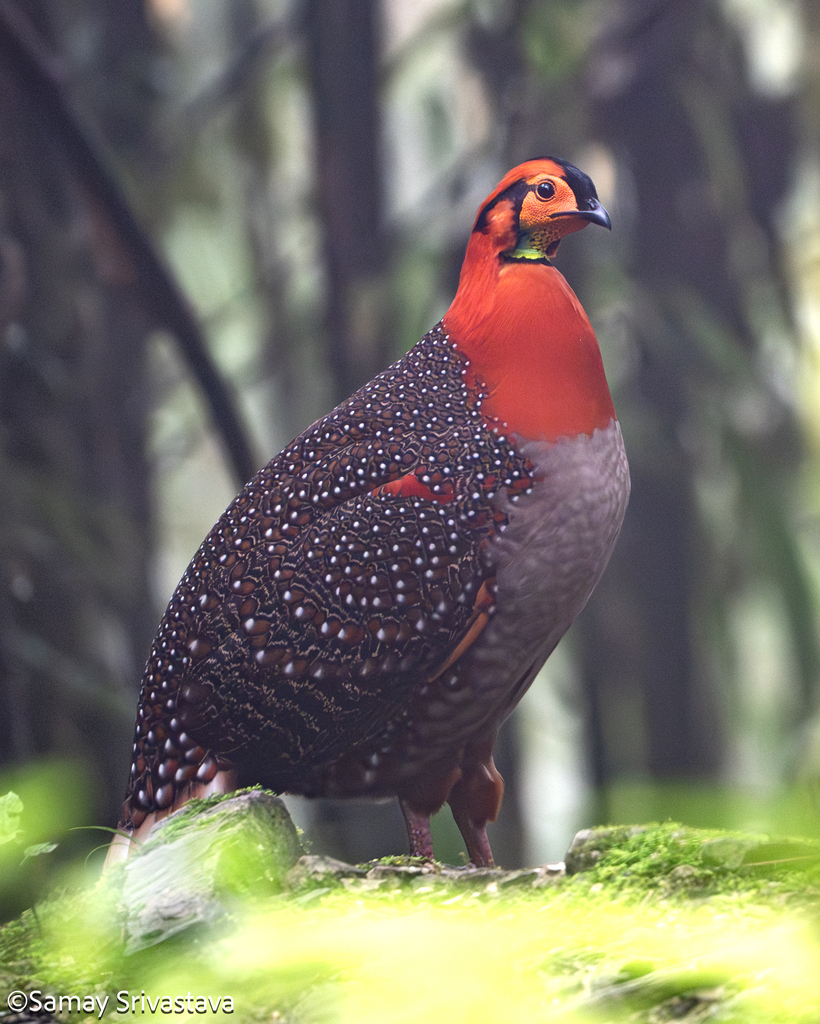
Blyth's tragopan (Tragopan blythii) or the grey-bellied tragopan is a pheasant that is a vulnerable species. The common name commemorates Edward Blyth (1810–1873), English zoologist and Curator of the Museum of the Asiatic Society of Bengal. It is the state bird of Nagaland.
From the article Blyth's tragopan on Wikipedia (CC BY-SA), quoted section by section
Description
Blyth's tragopan pheasant is the largest of the genus Tragopan. Like most pheasants, the male is brightly colored. It is recognized by its rusty red head, yellow facial skin, and that it is spotted with small white dots on its back called ocelli. A black band extends from the base of the bill to the crown coupled with another black band extending behind the eyes. Like the rest of the tragopans, males have two pale blue horns that become erect during mating. Its lappet, a decorated flap, hangs from the throat and is brightly colored. This lappet can be expanded and exposed during mating season as well. Females are not as brightly colored as the male tragopan, for they do not need the extravagant appearance to attract a male counterpart. Overall, they are dark brown with a mixture of black, buff and white mottling. Their simple and dull look is a protection mechanism from other animals, known as camouflage. It also allows the females to protect their young that are in the early stages of life.
Range & habitat
The pheasant-like bird's population is small and is believed to be decreasing at a rapid rate. Blyth's tragopan is located in many different areas, including Bhutan through north-east India, north Myanmar to south-east Tibet, and also China. These birds may travel up and down the slopes of the Himalayan mountains to find food, and based on seasonal temperature changes. The total population is estimated to be about 2,500 to 9,999 birds. This estimate is a very small number compared to some of its relative birds. Tragopan blythii normally flocks to wooded areas as it prefers the undergrowth of evergreen oak and rhododendron forests, and other dark, quiet places. This bird lives at a higher elevation than most birds.
Wikipedia: “Distribution and population”
What it does
Blyth's tragopan are generalists. In the wild, they consume seeds, berries, fruits, and buds. Captive birds usually consume insects, worms, and even small frogs. While they are primarily vegetarians, most birds have a predilection for berries and fruit.
Wikipedia: “Diet”
Listen
Looking for field recordings…
Where it lives
Recorded sightings
—
geo-referenced records in GBIF, from museums, herbaria and field observers.
Drag the globe to turn it. Dots are where records exist, not a range map; darker means more records.
In the stacks
Searching the stacks…
Every page naming Tragopan blythii in the Biodiversity Heritage Library →
This page is assembled live from iNaturalist, GBIF, Wikipedia, the Source Library and the Internet Archive. It is not yet part of the hand-edited codex. iNaturalist taxon 1062.