- Fungi Including Lichens
- ›Ascomycete Fungi
- ›Sac Fungi and Lichens
- ›Sordariomycetes
- ›Hypocreomycetidae
- ›Hypocreales
- ›Cordycipitaceae
- ›Cordyceps
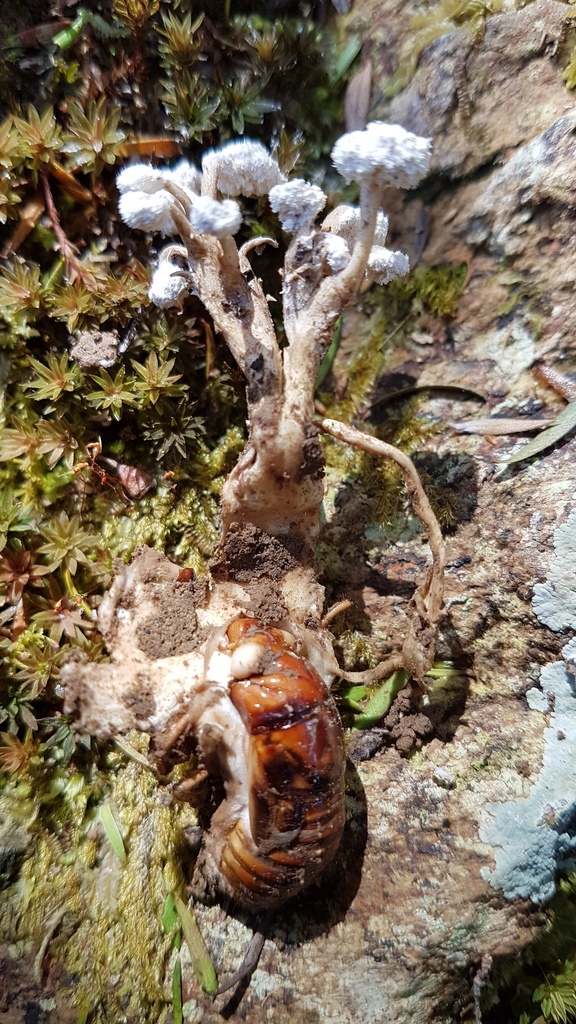
Cordyceps sinclairii
Isaria sinclairii is a species of entomopathogenic fungus mostly infecting the underground nymphs of cicadas. It produces myriocin, from which the synthetic drug fingolimod, a treatment for multiple sclerosis, was developed.
From the article Isaria sinclairii on Wikipedia (CC BY-SA), quoted section by section
What it does
Isaria sinclairii is a fungus which attacks insects, including cicada larvae. The larvae typically die just beneath the soil surface, and the fungus produces white tufts which grow up from the soil and release powdery white spores. I. sinclairii is found from Asia (particularly China, Japan, and Korea) through to New Zealand. In New Zealand it attacks cicadas of the genera Amphipsalta and Melampsalta. In the lab it can be cultured on the bodies of silkworms.
Wikipedia: “Ecology”
At the table
Isaria sinclairii and similar vegetable caterpillar species such as Ophiocordyceps sinensis have been used in traditional Tibetan medicine and in traditional Chinese medicine as tonics believed to impart eternal youth. A sphingolipid derivative produced by I. sinclairii, myriocin, was discovered to have powerful immunosuppressive properties, a function of the way the fungus attacks living insects. Because myriocin is too toxic to use in humans, a synthetic derivative was developed in 1992, named FTY720 or fingolimod. Under its trade name Gilenya, fingolimod was approved by the FDA in 2010 as the first oral drug for treating the autoimmune disease multiple sclerosis. Fingolimod shows promise as a cancer medication, and has been tested as a possible treatment for obesity.
Wikipedia: “Uses”
Where it lives
Recorded sightings
—
geo-referenced records in GBIF, from museums, herbaria and field observers.
Drag the globe to turn it. Dots are where records exist, not a range map; darker means more records.
In the stacks
Searching the stacks…
Every page naming Cordyceps sinclairii in the Biodiversity Heritage Library →
This page is assembled live from iNaturalist, GBIF, Wikipedia, the Source Library and the Internet Archive. It is not yet part of the hand-edited codex. iNaturalist taxon 1045388.