- Animals
- ›Chordates
- ›Vertebrates
- ›Ray-finned Fishes
- ›Carps, Characins, Catfishes and Allies
- ›Minnows, Suckers, Carps, and Loaches
- ›Carps and Minnows
- ›True Minnows
- ›Western Minnows
- ›Lavinia
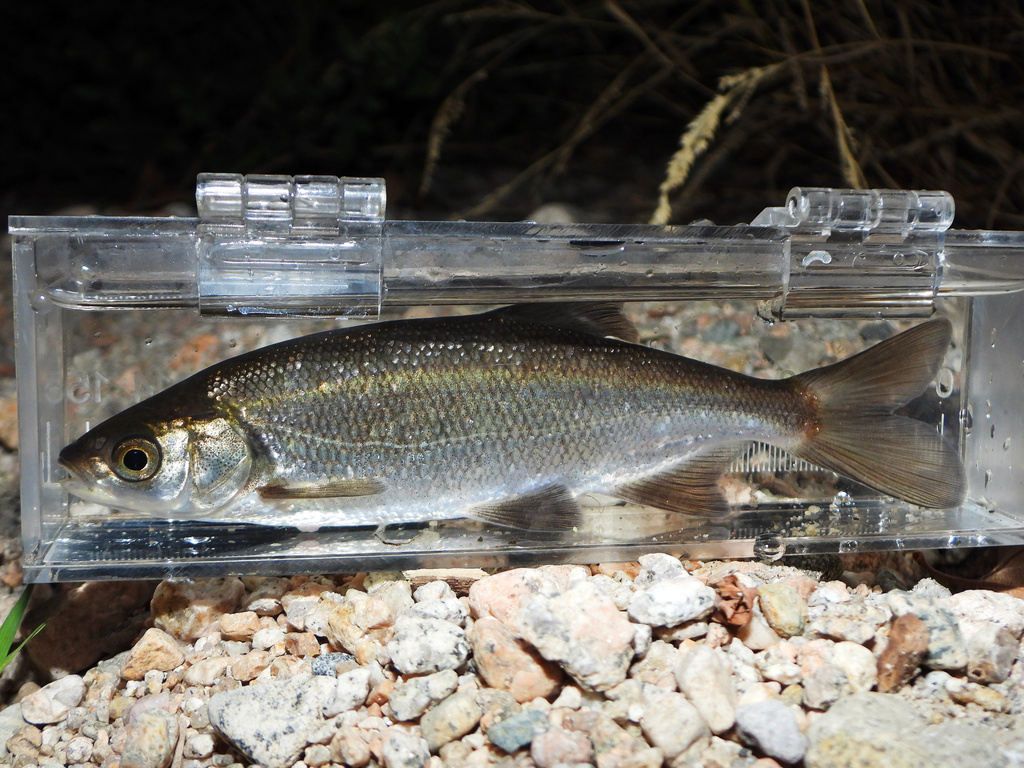
Hitch
Lavinia exilicauda
Lavinia exilicauda, the hitch, is a species of freshwater ray-finned fish belonging to the family Leuciscidae, which includes the daces, chubs, Eurasian minnows and related fishes. This species is endemic to central California, and was once very common. The common name may derive from a Pomoan word for this species. It is the only species in the monospecific genus Lavinia.
From the article Lavinia exilicauda on Wikipedia (CC BY-SA), quoted section by section
Description
Lavinia exilicauda has a deep and laterally compressed body, with a small head, and a terminal mouth pointing upwards. They are generally silver all over; younger fish have a black spot at the base of the tail, losing it as they age, and becoming generally darker as well. The anal fin is noticeably longer than for other California minnows, with 11–14 rays, while the dorsal fin has 10–13 rays, and is placed further back, the base being positioned between pelvic and anal fins. The tail fin is large and deeply forked. They can get large for minnows, with lengths of up to 36 centimetres (14 in) total length. All of these features make them look much like the golden shiner. The hitch is closely related to the California roach (Hesperoleucus symmetricus complex), and these taxa can hybridize with each other. Hitch are omnivores of the open water, eating a combination of filamentous algae, insects, and zooplankton. They can be found in lakes, sloughs, and slow-moving sections of rivers and streams. With the highest temperature tolerance among the native fish of the Central Valley, they can be found in both warm and cool water; they also have considerable salt tolerance, for instance occurring in Suisun Marsh (7–8 ppt salinity), and Salinas River lagoon (9 ppt).
Range & habitat
Lavinia exilicauda has a range which includes the Sacramento River–San Joaquin River System of the Central Valley, the Russian River, Clear Lake, Pajaro River, and Salinas River. Although once abundant, but no longer commercially fished in Clear Lake, populations have been declining. The most likely cause appears to be loss of springtime spawning water flows due to water diversion and damming.
Wikipedia: “Distribution”
Where it lives
Recorded sightings
—
geo-referenced records in GBIF, from museums, herbaria and field observers.
Drag the globe to turn it. Dots are where records exist, not a range map; darker means more records.
In the stacks
Searching the stacks…
Every page naming Lavinia exilicauda in the Biodiversity Heritage Library →
This page is assembled live from iNaturalist, GBIF, Wikipedia, the Source Library and the Internet Archive. It is not yet part of the hand-edited codex. iNaturalist taxon 104127.