- Animals
- ›Chordates
- ›Vertebrates
- ›Ray-finned Fishes
- ›Spiny-rayed fishes
- ›Perches, Scorpionfishes, Sticklebacks, and Allies
- ›Perches, groupers and allies
- ›Groupers
- ›Hyporthodus
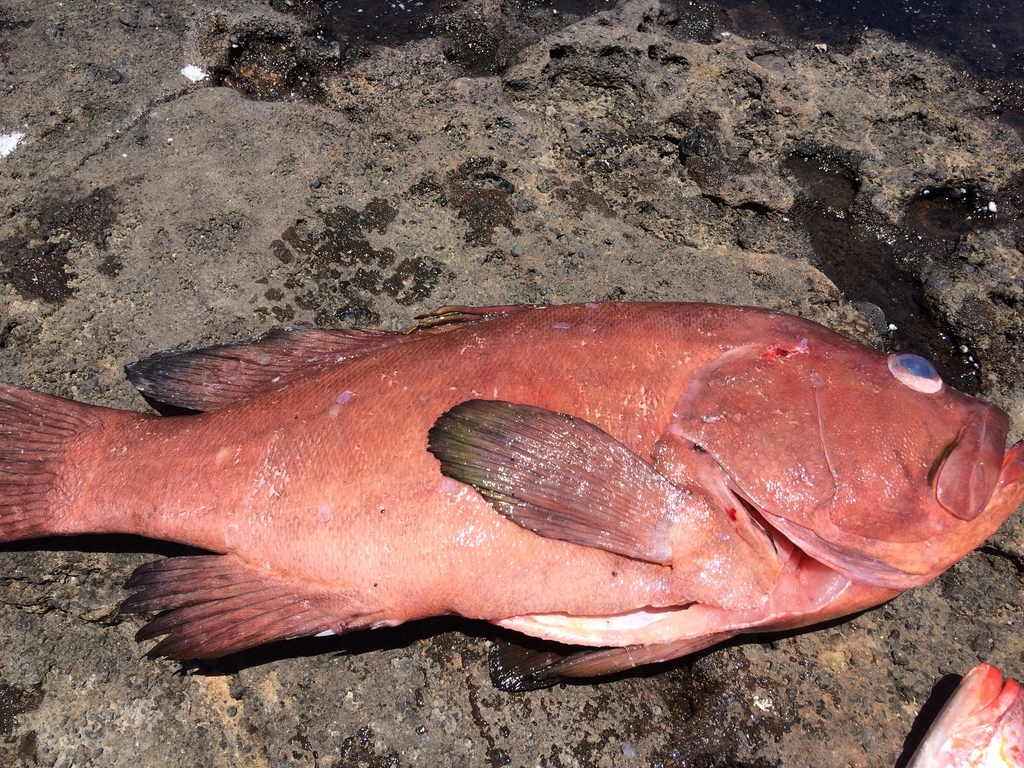
Rooster Hind
Hyporthodus acanthistius
The Rooster Hind (Hyporthodus acanthistius) is a marine fish found in the tropical eastern Pacific Ocean. It is also known as the Gulf Coney, Baqueta, Cherna Roja, Cherna Rosa, and Merou Coq in various places across its range. The Rooster Hind's dorsal fins have 16-18 rays and 11 spines with the third, fourth and fifth elongated. Their anal fins have eight rays and three spines. Mature length ranges from 63 to 68.9 cm (24.8 to 27.1 in) on average but they can reach up to at least 130 cm (51 in). They reach weights of 15 kg (33 lb). Maturity is reached at around age eight, and individuals have been documented to reach 28 years of age.
From the article Rooster hind on Wikipedia (CC BY-SA), quoted section by section
Range & habitat
The Rooster Hind is found in the tropical waters along the western coasts of tropical North, Central and South America from southern California to central Peru in the Pacific Ocean. This fish is a demersal species which inhabits rocky reefs and muddy sea floors. It lives far below the surface at depths of 46 to 90 metres (151 to 295 ft).
Wikipedia: “Distribution and habitat”
What it does
The Rooster Hind is a benthic feeder which consumes small fish, cephalopods (such as octopus and squid), and various crustaceans. It hunts by sneaking up and ambushing them in the poorly lit depths. Like other groupers, the Rooster Hind will congregate off shore near the continental shelf in areas with significant structural relief, or rocky points that are near a sharp drop off. Its ecology including behavior, reproduction, diet and habitat is poorly studied and there is little other information available on the topic.
Wikipedia: “Ecology”
At the table
Commercial and recreational harvesting of the Rooster Hind is common throughout its range, and is highly valued in some fish markets. Especially targeted in the Gulf of California, Southern Mexico and Colombia, where they call the fish "Chernas". From the years 1993 and 1996 Rooster Hind represented 22.9% by weight of groupers caught in Colombian waters.
Wikipedia: “Human uses”
In human culture
Rooster Hinds reach sexual maturity relatively late, around age eight, and generation times are long. The Rooster Hind performs aggregate spawning where large numbers gather to release their eggs and milt. The Rooster Hind exhibits sequential hermaphroditism, which means that a dominant male fish mates with a group of females, and if he dies the dominant female will become a male and take his place. Big old fat fecund female (BOFFF) groupers are more fecund than younger and thinner groupers, and therefore contribute more to the population dynamics. Grouper eggs are buoyant, and incubated in water temperatures around 21–31 °C (70–88 °F). The eggs will hatch after 24-72 hours. Newly hatched larvae live on the yolk for 3-4 days. Larvae then become planktotrophic, feeding on zooplankton and phytoplankton near the top of the water column. Once they reach a more mature size they descend down to suitable habitat.
Wikipedia: “Life history”
Where it lives
Recorded sightings
—
geo-referenced records in GBIF, from museums, herbaria and field observers.
Drag the globe to turn it. Dots are where records exist, not a range map; darker means more records.
In the stacks
Searching the stacks…
Every page naming Hyporthodus acanthistius in the Biodiversity Heritage Library →
This page is assembled live from iNaturalist, GBIF, Wikipedia, the Source Library and the Internet Archive. It is not yet part of the hand-edited codex. iNaturalist taxon 103154.