- Animals
- ›Chordates
- ›Vertebrates
- ›Ray-finned Fishes
- ›Spiny-rayed fishes
- ›Pipefishes and Allies
- ›Syngnathoidei
- ›Pipefishes, Seahorses, and Seadragons
- ›Tail-brooding Pipefishes
- ›Hippocampus
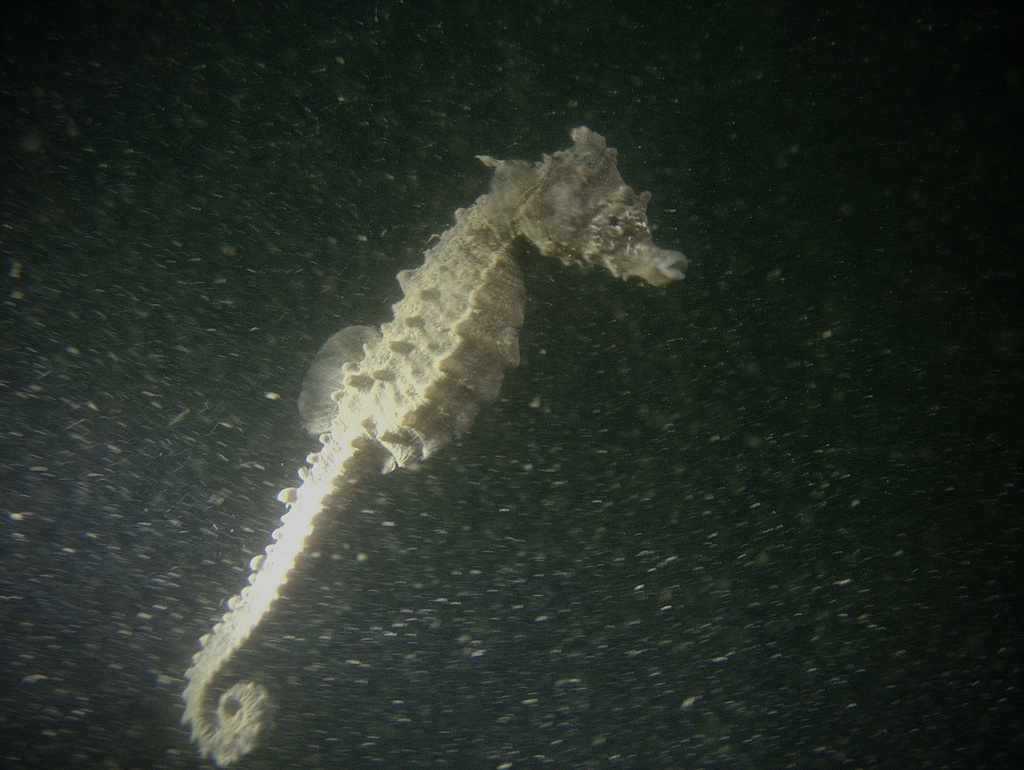
Japanese Seahorse
Hippocampus mohnikei
The Japanese seahorse (in Japanese, kitano-umi-uma and sangotatsu) or lemur-tail seahorse (Hippocampus mohnikei) is a species of fish in the family Syngnathidae. The Japanese seahorse reaches a maximum length of 8.0 cm, is usually dark brown and has a relatively long tail, a ridgelike coronet and flattened spines. Many seahorse species look similar, so in addition to any distinguishing features, individual specimens are identified using a series of specific measurements and counts of anatomical features such as spines and tail rings.
H. mohnikei has a planktonic stage in the first six months of life, after which they settle, preferably in Zostera sea grass beds or estuaries, and begin to breed. They are ovoviviparous and the males carry the eggs in a brood pouch. While several seahorse species are used in traditional Chinese medicine, H. mohnikei is not one of them.
From the article Japanese seahorse on Wikipedia (CC BY-SA), quoted section by section
Range & habitat
The mid-range of H. mohnikei distribution is around 28 N latitude. For many years the only confirmed distribution was around Japan. However, it was recently observed as far south as the Palk Bay coast of southeastern India. It has also recently been positively observed in Kampot, Cambodia. It is also suspected to be in the waters around China, Thailand and Vietnam. They have a planktonic stage during the first six months of life, when they are between the lengths of 15.1–45.5 mm, in which they drift with other plankton in the water column. As they grow their food preferences shift from smaller items such as Oithona davisae and Penilia avirostris to larger food species. After the planktonic stage, they prefer to settle in Zostera sea grass beds and estuaries.
Wikipedia: “Distribution and feeding”
Where it lives
Recorded sightings
—
geo-referenced records in GBIF, from museums, herbaria and field observers.
Drag the globe to turn it. Dots are where records exist, not a range map; darker means more records.
In the stacks
Searching the stacks…
Every page naming Hippocampus mohnikei in the Biodiversity Heritage Library →
This page is assembled live from iNaturalist, GBIF, Wikipedia, the Source Library and the Internet Archive. It is not yet part of the hand-edited codex. iNaturalist taxon 102829.