- Animals
- ›Chordates
- ›Vertebrates
- ›Cartilaginous Fishes
- ›Sharks and Rays
- ›Sharks
- ›Squalean Sharks
- ›Cow and Frilled Sharks
- ›Cow Sharks
- ›Hexanchus
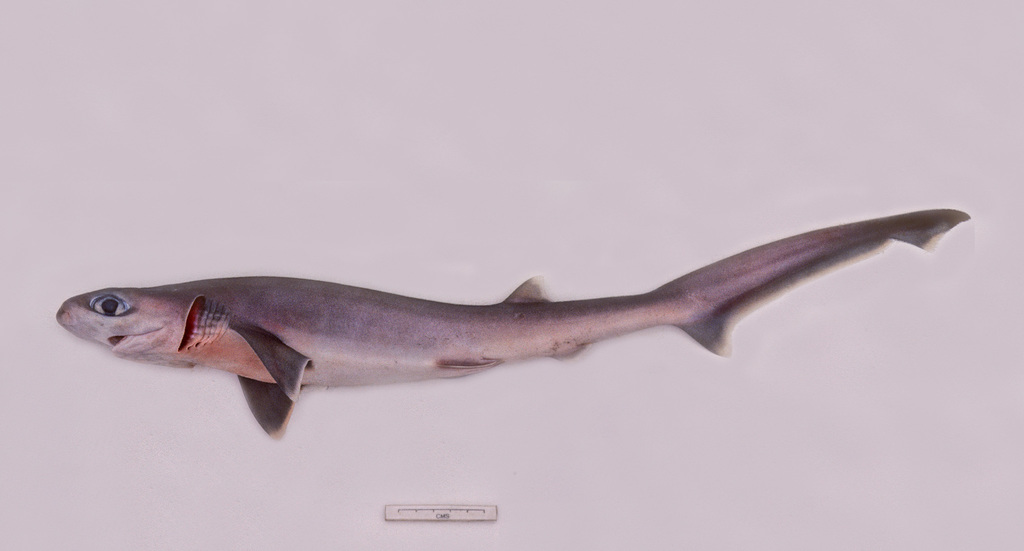
Bigeye Sixgill Shark
Hexanchus nakamurai
The bigeyed sixgill shark (Hexanchus nakamurai) is a cow shark of the family Hexanchidae. Its dorsal surface has a brownish-gray color, and is sharply separated from the light coloring of its ventral surface. The eyes are a fluorescent green while the shark is alive. The body of this shark is small, slim, and fusiform in shape. As the name suggests, this shark has six gill slits, unusual among most shark species. The head is narrow and somewhat flattened, and the mouth contains 5 rows of large, comb-shaped teeth. This shark's single dorsal fin is pushed back towards the caudal fin, and is behind the pelvic fins. The upper caudal fin is much longer than the lower, with a deep notch near the tip. All fins have thin white margins on the edge. In juveniles, the upper caudal fin has a black tip.
From the article Bigeyed sixgill shark on Wikipedia (CC BY-SA), quoted section by section
Range & habitat
Bigeyed sixgills are found in the Indian Ocean and the western Pacific Ocean. Populations in the western Atlantic Ocean formerly grouped within this species are now considered their own species, the Atlantic sixgill shark (Hexanchus vitulus). These sharks live near the sea floor between 90 and 600 m deep, but may move closer to the surface at night to take advantage of prey there. They make their home on continental shelves, insular shelves, and upper slopes. These sharks do not inhabit abyssal environments.
Wikipedia: “Range and habitat”
What it does
Little is known about the feeding habits of the bigeyed sixgill. Based on the few stomach examinations of these sharks, they are thought to feed mainly on small to moderately sized bony fish and bottom dwelling crustaceans. Like all sharks of the order Hexanchiformes found so far, this shark is ovoviviparous, meaning the eggs are retained inside the female's body until hatching. The bigeyed sixgill, after an unknown gestation period, gives birth to litters of up to 13 pups.
Wikipedia: “Behavior”
Where it lives
Recorded sightings
—
geo-referenced records in GBIF, from museums, herbaria and field observers.
Drag the globe to turn it. Dots are where records exist, not a range map; darker means more records.
In the stacks
Searching the stacks…
Every page naming Hexanchus nakamurai in the Biodiversity Heritage Library →
This page is assembled live from iNaturalist, GBIF, Wikipedia, the Source Library and the Internet Archive. It is not yet part of the hand-edited codex. iNaturalist taxon 102744.