- Animals
- ›Chordates
- ›Vertebrates
- ›Ray-finned Fishes
- ›Spiny-rayed fishes
- ›Rivulines, Killifishes, and Livebearers
- ›Cyprinodontoidei
- ›Splitfins
- ›Mexican Splitfins
- ›Girardinichthys
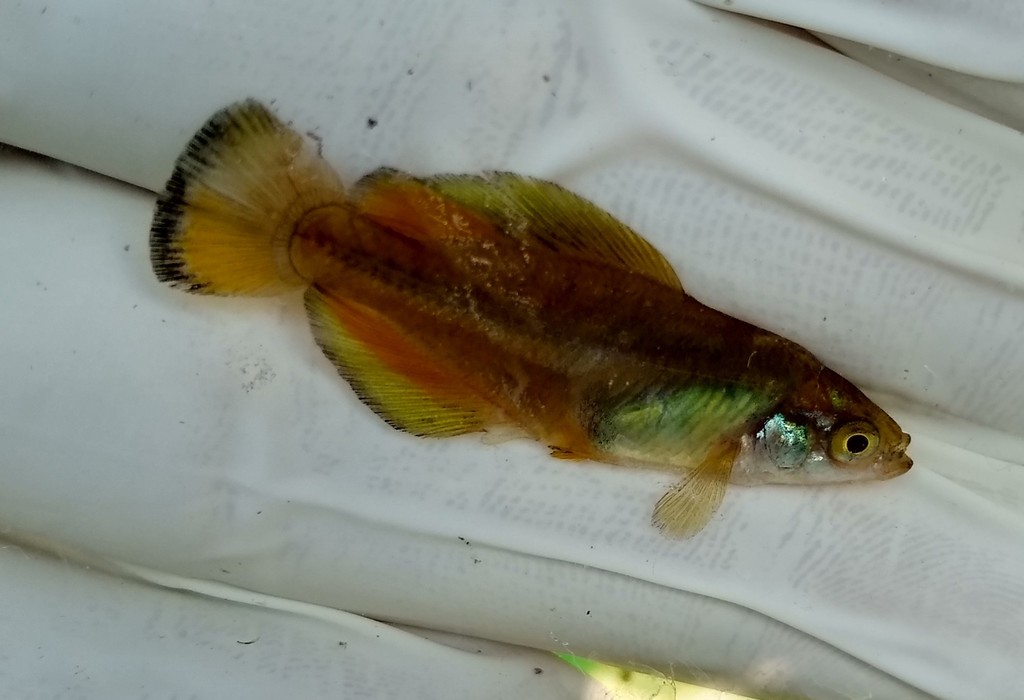
Darkedged Splitfin
Girardinichthys multiradiatus
The dark-edged splitfin (Girardinichthys multiradiatus) is a species of fish in the family Goodeidae endemic to Mexico. It is a live-bearing, cold-water fish from the mountains of Mexico. The species is incredibly temperature sensitive. If water is too cold, all offspring turn out to be male. If water is too hot, females will birth their first brood of only 1–3 fry and then die shortly thereafter, which makes it very difficult to maintain a colony. It is also a primarily carnivorous species that eats a variety of insects. Girardinichtys multiradiatus is an endangered species with multiple population threats with little conservation efforts put in place to protect the species.
From the article Dark-edged splitfin on Wikipedia (CC BY-SA), quoted section by section
Description
The dark-edged splitfin varies in shades of yellow, from a grey yellow to bright yellow. G. multiradiatus females reach about 3 inches and males 2.5 inches in length. The species is commonly called the "golden sailfin goodeid" due to their extended fins, especially the males. The males show a notch in the anal fin after the first shorter rays. Additionally, males have longer and broader dorsal and anal fins than the females. The fins of the females are typically clear while the males fins are yellow with a black band on the end. G. multiradiatus females have distinct stripes towards the posterior end of the body.
Wikipedia: “Anatomy and morphology”
Range & habitat
Girardinichthys multiradiatus can be found in still or slightly moving water in Mexico. The water in which they habitat are mainly considered small lakes, spring-fed ponds, and pools off of colder temperature streams. The dark-edged splitfin prefers bodies of water that range in clear to muddy visibility, and have a bottom of silt, mud, clay, sand, gravel, and rocks. They also prefer water depths to be less than 1 m. The habitat of the dark-edged splitfin also includes a variety of green algae. G. multiradiatus can be found in bodies of water with a pH ranging between 7 and 9, and a dissolved oxygen level between 7 and 10ppm. The preferred water temperature for the highs range from 20–25 degrees Celsius and for the lows range from 10–18 degrees Celsius.
Wikipedia: “Distribution and habitat”
What it does
G. multiradiatus tend to school with each other. They detect nearby movements using a mechanosensory system known as their lateral line system. They use this system to detect many behaviors such as schooling, rheotaxis, and predator-prey interaction. Not only do they use mechanosensory, they also use water movements to show social behaviors.
Wikipedia: “Social behavior”
Where it lives
Recorded sightings
—
geo-referenced records in GBIF, from museums, herbaria and field observers.
Drag the globe to turn it. Dots are where records exist, not a range map; darker means more records.
In the stacks
This page is assembled live from iNaturalist, GBIF, Wikipedia, the Source Library and the Internet Archive. It is not yet part of the hand-edited codex. iNaturalist taxon 101458.