- Animals
- ›Chordates
- ›Vertebrates
- ›Ray-finned Fishes
- ›Carps, Characins, Catfishes and Allies
- ›Minnows, Suckers, Carps, and Loaches
- ›Carps and Minnows
- ›True Minnows
- ›Western Minnows
- ›Gila
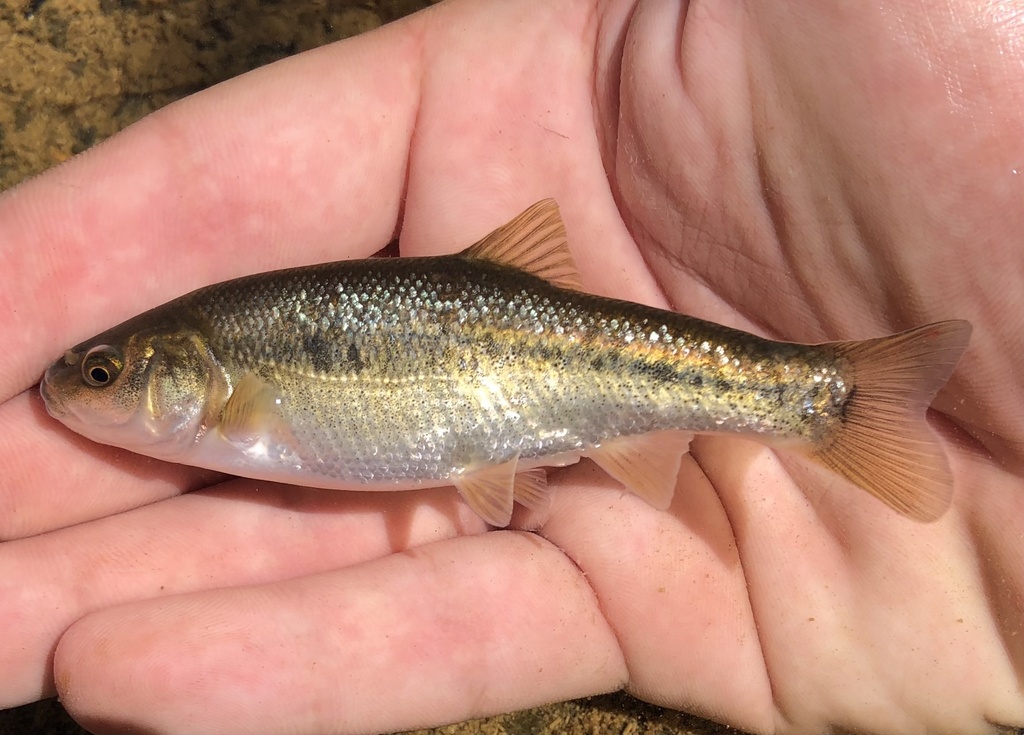
Arroyo Chub
Gila orcuttii
The arroyo chub (Gila orcuttii) is a species of freshwater ray-finned fish belonging to the family Leuciscidae, which includes the daces, chubs, Eurasian minnows and related species. This species is found only in the coastal streams of southern California, United States.
From the article Arroyo chub on Wikipedia (CC BY-SA), quoted section by section
Description
The Arroyo chub is a small to moderately small fish with a robust, fusiform body and a thick caudal peduncle. It has a rounded snout, a terminal to slightly subterminal mouth, and proportionally large eyes. Coloration: The dorsal surface is typically olive or gray, transitioning to silver or white on the ventral side. Many individuals display a faint lateral stripe. Fin anatomy: The species exhibits the typical cyprinid arrangement of a single dorsal fin along with pectoral, pelvic, anal, and forked caudal fins. The dorsal fin has 8 rays, and the anal fin has 7 rays. Males often develop enlarged fins and breeding tubercles on the pectoral fins during the spawning season. Size: Adults generally reach 7–10 cm (2.8–3.9 in), with larger individuals approaching 12 cm (4.7 in).
Range & habitat
The Arroyo chub is native to coastal streams of Southern California, occurring primarily in Los Angeles, Orange, Riverside, and San Diego counties. Its range includes drainages of the Los Angeles River (including the Arroyo Seco), San Gabriel River, Santa Ana River, San Juan Creek, Malibu Creek, Santa Margarita River, and San Luis Rey River systems. Recent surveys have detected the species in 18 of 40 sampled streams across all seven historically occupied watersheds, though often restricted to upper or less-disturbed reaches.
Wikipedia: “Native range”
What it does
Arroyo chub are omnivorous. Their diet includes algae, aquatic insects, small crustaceans, and in some cases mollusks or insect larvae (e.g. caddisfly larvae) depending on habitat conditions. In warmer water systems, algae may dominate their diet, making up a large proportion of stomach contents; in cooler creek systems, more invertebrate prey may be important. In the northern portion of its range, roots of the floating water fern (Azolla filiculoides) constitutes a significant component of the species' diet. Spawning typically occurs in spring through summer (February to August in some reports), with peak activity in June-July. Females release small batches of eggs, which adhere to vegetation, substrate, or debris. Eggs hatch in about 4 days at 24 °C (75 °F), larvae initially remain near the substrate before swimming upward to fill their swim bladders, and juveniles often congregate in slow or still water with vegetation cover. Juvenile fish may reach roughly 60 mm (2.4 in) in the first year. Hybridization: introduced populations of G. orcuttii have hybridized with the endangered Mohave tui chub (Gila bicolor mohavensis) in some cases, threatening genetic integrity of the tui chub.
Wikipedia: “Diet and behavior”
Where it lives
Recorded sightings
—
geo-referenced records in GBIF, from museums, herbaria and field observers.
Drag the globe to turn it. Dots are where records exist, not a range map; darker means more records.
In the stacks
Searching the stacks…
Every page naming Gila orcuttii in the Biodiversity Heritage Library →
This page is assembled live from iNaturalist, GBIF, Wikipedia, the Source Library and the Internet Archive. It is not yet part of the hand-edited codex. iNaturalist taxon 101442.