- Animals
- ›Chordates
- ›Vertebrates
- ›Ray-finned Fishes
- ›Carps, Characins, Catfishes and Allies
- ›Minnows, Suckers, Carps, and Loaches
- ›Carps and Minnows
- ›True Minnows
- ›Western Minnows
- ›Gila
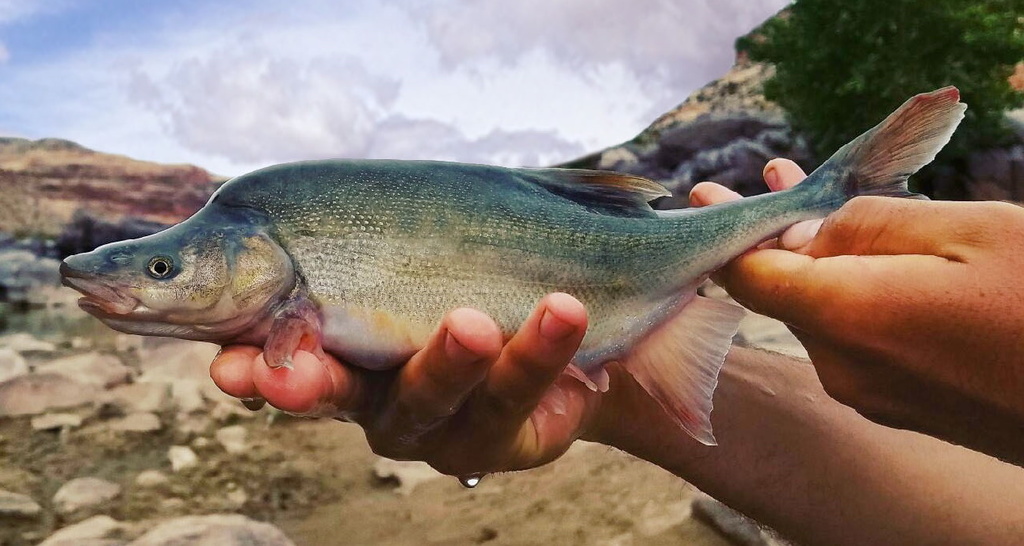
Humpback Chub
Gila cypha
The humpback chub (Gila cypha) is a federally protected fish that lived originally in fast waters of the Colorado River system in the United States. This species takes its name from the prominent hump between the head and dorsal fin, which is thought to direct the flow of water over the body and help maintain body position in the swift currents of the Colorado River. The body is almost entirely scaleless, retaining only about 80 midlateral scales along the lateral line. The fish is very streamlined, with a thin caudal peduncle and a deeply forked tail. The back is a light olive gray, the sides silver, and the belly white. The dorsal fin usually has 9 rays and the anal fin has 10 or more. Its maximum recorded length is 38 cm.
The humpback chub mostly consumes invertebrates and to a lesser extent other fish, at all levels from the bottom to the surface. The species spawns from April through June, at water temperatures of 19–21 °C (66–70 °F). The males develop nuptial tubercles on the head and paired fins. The fish spawn in slower-moving backwaters, typically over a substrate of cobbles or boulders. Young fish stay near shore and in quiet areas, preferring slightly more turbid water.
From the article Humpback chub on Wikipedia (CC BY-SA), quoted section by section
Description
The humpback chub has a streamlined body, with a concave skull on its dorsum. The caudal peduncle is thin and somewhat pencil-like but not greatly elongated, where the length of the caudle peduncle divided by length of head is less than 1.0. The head length divided by the caudal peduncle is less than 5.0. The scales are embedded deeply across the surface of the fish, especially on hump. The fins are large and curved, and the origin of the dorsal are about equidistant between the snout and caudal fin base. The mouth is inferior, and overhung by the snout. The pharyngeal arch is small, with a short lower ramus.
Range & habitat
The humpback chub historically ranged from below present-day Hoover Dam in the Colorado River upstream into Colorado, and in the larger portions of Colorado River tributaries in Arizona, Utah, Colorado, and Wyoming. Presently, the species is restricted to six population centers in the Colorado and Little Colorado Rivers in Grand Canyon, Arizona, the Colorado River in Cataract Canyon, Utah, the Colorado River in Black Rocks, Colorado, and Westwater Canyon, Utah, the Green River in Desolation and Gray Canyons, Utah, the Green River in Dinosaur National Monument, Colorado and Utah, and the Yampa River in Dinosaur National Monument, Colorado. The humpback chub is found in Arizona at and around Coconino County, Colorado, and Little Colorado River in the Grand Canyon.
Wikipedia: “Range”
Where it lives
Recorded sightings
—
geo-referenced records in GBIF, from museums, herbaria and field observers.
Drag the globe to turn it. Dots are where records exist, not a range map; darker means more records.
In the stacks
Searching the stacks…
Every page naming Gila cypha in the Biodiversity Heritage Library →
This page is assembled live from iNaturalist, GBIF, Wikipedia, the Source Library and the Internet Archive. It is not yet part of the hand-edited codex. iNaturalist taxon 101435.