- Fungi Including Lichens
- ›Ascomycete Fungi
- ›Sac Fungi and Lichens
- ›Arthoniomycetes
- ›Arthoniales
- ›Christmas lichens, comma lichens, and allies
- ›Herpothallon
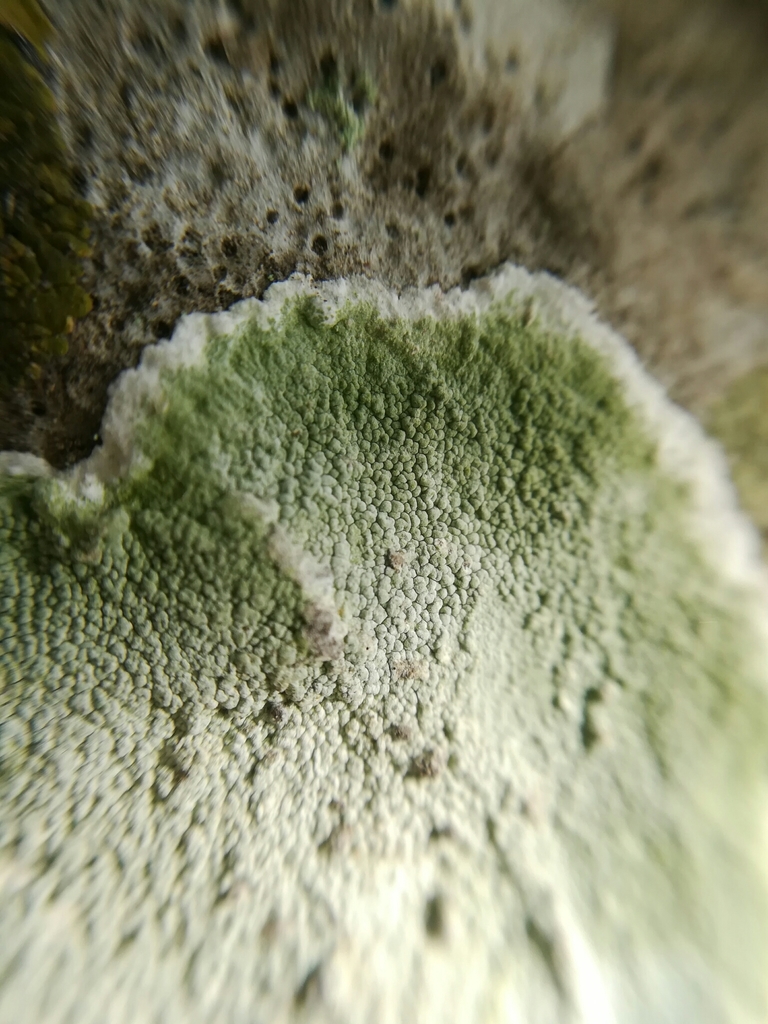
Herpothallon granulare
Herpothallon granulare is a species of lichen-forming fungus in the family Arthoniaceae. It forms distinctive white and greenish-grey growths primarily on trees in tropical regions worldwide. This lichen reproduces mainly through vegetative means rather than spores, and is particularly common in the Galápagos Islands where it grows in semi-shaded to shaded environments from the transition zones through humid areas. It has also been documented in India, Sri Lanka, and other tropical locations, where it grows on various native and introduced trees, occasionally appearing on leaves.
From the article Herpothallon granulare on Wikipedia (CC BY-SA), quoted section by section
Description
Herpothallon granulare forms a distinctive growth pattern characterized by broad white prothallus (the outermost, algae-free part of the lichen thallus) composed of loosely radiating fibrous strands of white hyphae (fungal filaments). The main thallus surface appears greenish grey to dull green, becoming paler with age. Unlike many lichens, H. granulare lacks a cortex (protective outer layer), giving it an ecorticate appearance. The entire thallus is composed of thick fibrous strands of loosely interwoven fungal hyphae. It is abundantly covered with coarsely granular pseudisidia (vegetative reproductive structures that resemble isidia but lack internal differentiation). These structures give the lichen a granular appearance. The medulla (inner layer) is poorly differentiated and indistinct, with hyphae covered by colourless to pale brownish granules, but lacking calcium oxalate crystals. Neither asci (spore-producing structures) nor pycnidia (asexual reproductive structures) have been observed in this species, indicating it reproduces primarily through vegetative means. In chemical spot tests, the thallus does not react with the reagents P, K, C, or KC, and does not fluoresce under ultraviolet light. It also tests negative with Lugol's iodine solution. …
Range & habitat
Herpothallon granulare has a pantropical distribution, occurring in tropical regions around the world. It was documented in the Galápagos Islands in 2009, representing a new record for both the archipelago and Ecuador. In the Galápagos, it is one of the most common species in its genus, found from the upper transition zone through the humid zone and into the high-altitude transition zone. It grows on a wide variety of both native and introduced trees, typically preferring semi-shaded to shaded and sheltered habitats. Occasionally, it may also be found growing on leaves. It has also been documented from the Andaman Islands, from the Agasthyamalai Biosphere Reserve in Kerala, India, and from Sri Lanka. The species is part of a diverse lichen community in the Galápagos that includes several other members of the genus Herpothallon and related genera. Its ecology is comparable to other lichen genera like Lepraria that inhabit humid, sheltered habitats and reproduce primarily through vegetative propagules rather than spores.
== References ==
Wikipedia: “Habitat and distribution”
Where it lives
Recorded sightings
—
geo-referenced records in GBIF, from museums, herbaria and field observers.
Drag the globe to turn it. Dots are where records exist, not a range map; darker means more records.
In the stacks
Searching the stacks…
Every page naming Herpothallon granulare in the Biodiversity Heritage Library →
This page is assembled live from iNaturalist, GBIF, Wikipedia, the Source Library and the Internet Archive. It is not yet part of the hand-edited codex. iNaturalist taxon 1013449.