- Animals
- ›Chordates
- ›Vertebrates
- ›Ray-finned Fishes
- ›Spiny-rayed fishes
- ›Rivulines, Killifishes, and Livebearers
- ›Cyprinodontoidei
- ›Topminnows
- ›Fundulus
- ›Fundulus
- ›Fundulus heteroclitus
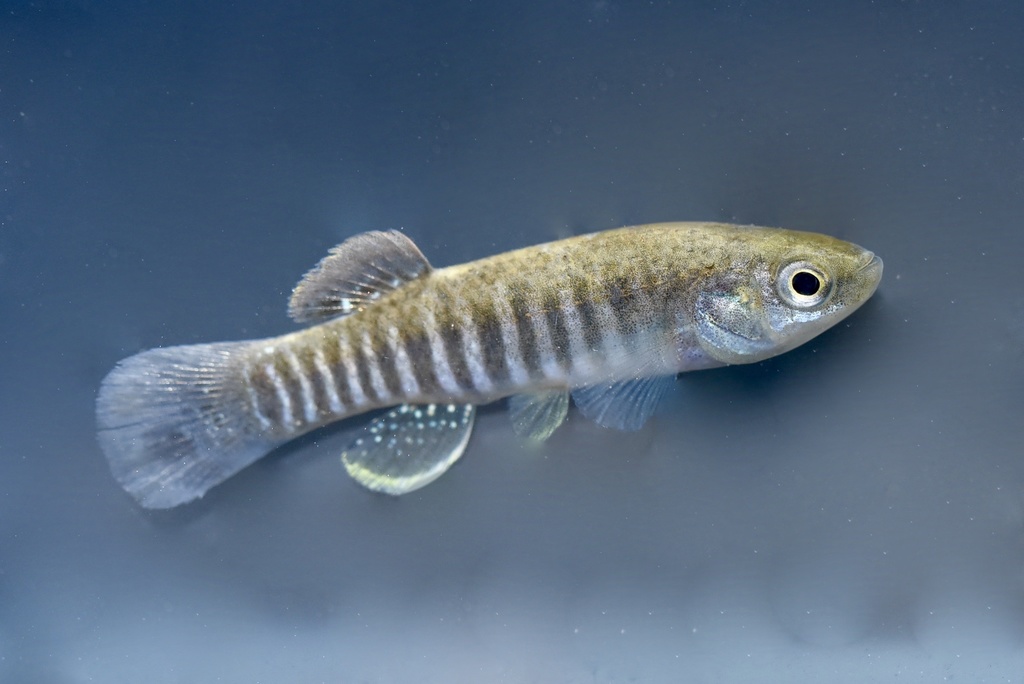
bayou topminnow
Fundulus pulvereus
The bayou killifish or bayou topminnow (Fundulus pulvereus) is a topminnow-like fish that thrives primarily in the shallow waters off the shores of the Americas, as well as fresh and brackish waters. Feeding off of small vertebrates and invertebrates, this fish displays reproduction techniques unique to its species.
A member of the family Fundulidae, the bayou killifish belongs to one of the most common orders of fish, Cyprinodontiformes, which includes most small aquarium topminnows and North American killifish. Discovered in 1892, the bayou killifish is one of over 1000 species of killifish, and remains a thriving species amongst many others in the oceans. Its scientific name derives from the Latin word "fundus," which literally means "bottom," and many view this as ironic since the fish is a type of topminnow. However, the name was coined for a bottom species of the Atlantic coast, being the least important of the fundulus mudfish. Bayou killifish are fairly small, and only grow to a maximum length of 7 centimetres (2.8 in). Given its size, the bayou killifish is fairly easy to spot in its natural environment. Living mostly in shallow waters, the male bayou killifish displays bright striped patterns of silver and olive-green, while the females are uniquely spotted.
From the article Fundulus pulvereus on Wikipedia (CC BY-SA), quoted section by section
Description
Although most killifish belonging to the family Fundulidae share similar characteristics, the bayou killifish displays its own set of definitive markings that contrast it from other closely related species of topminnows and killifish. It has a body shape resembling that of a minnow that one may see in a small tidal pool near an ocean, but it is usually easier to spot because of its size. Unlike many other minnows, the bayou killifish usually grows to a maximum length of 5–7 centimetres (2.0–2.8 in), enabling it to have the size it needs to defend itself, as well as the maneuverability of a much smaller fish. All bayou killifish, both male and female, can be distinguished from other species of fish by their wide mouth. Bayou killifish display sexual dimorphism, which is a physical difference between males and females of the same species of animal. In the species, males usually tend to have a much more elongated body than females, as well as more characteristic markings. Males display an olive-green coloration on the top half of the body near the dorsal fin, with gold sides and a silvery bottom. Sometimes, the males will have a dark spot on or near the rear dorsal fin, just above dark vertical stripes that line the gold sides. …
Wikipedia: “Description and identification”
Range & habitat
Just as the name implies, the bayou killifish predominates many freshwater and brackish environments such as bays, marshes, swamps, and bayous along the Atlantic coast. However, due to a remarkable adaptation of the killifish's lungs, the species is also capable of inhabiting marine environments such as saltwater marshes and oceans. The bayou killifish is a non-seasonal killifish, meaning that it is non-migratory, and thus occupies the same territories within the Western Atlantic waters of both Americas year round. Most populations of bayou killifish can be found in the temperate coastal waters of the Atlantic coast of North America, as well as the Gulf of Mexico. They often inhabit moderately warm waters with temperatures ranging from 15–26 °C (59–79 °F). Shallower waters such as marshes and bays along the coast serve as suitable habitats for Bayou Killifish because of the absence of unstable isotopes and fluctuating pHs that are often found in deeper and more fluent water habitats. These shallow environments provide a sufficient amount of bacteria that thrive in unstable conditions with questionable isotope ratios, and thus provide a steady system of bacterial degradation that in turn stabilizes conditions suitable for bayou killifish. Because many of these fish live in marsh-type environments, their main food source consists of small aquatic insects and isopods. …
Wikipedia: “Habitat and diet”
What it does
Many biologists studying the bayou killifish consider their reproduction one of the most important concepts of the species to understand, because most of the fish's behavior is based on its reproduction habits. Bayou killifish reproduce sexually and are oviparous, meaning that they give birth via laying eggs. This is a characteristic that most of the fish in the order Cyprinodontiformes share, though some may be viviparous. Little is known about the spawning seasons of the bayou killifish, however, biologists do know that this species of killifish spawns mainly during the spring, more specifically during the spring tides—periods of 3 to 6 days biweekly, that occur in a period known as the semi-lunar phase. Biologists conclude that this tide-associated spawning may be a common component in the reproductive strategies and behaviors of most, if not all, cyprinodontids of North America. Although many studies have been conducted involving the reproduction of these killifish, few findings have been made referring to the full reproductive habits of the Bayou Killifish. Future studies and research is crucial to understanding these creatures, and more importantly their well-being in future generations. Entire populations of F. pulvereus rely on its reproductive habits and behaviors.
Wikipedia: “Reproduction”
Where it lives
Recorded sightings
—
geo-referenced records in GBIF, from museums, herbaria and field observers.
Drag the globe to turn it. Dots are where records exist, not a range map; darker means more records.
In the stacks
Searching the stacks…
Every page naming Fundulus pulvereus in the Biodiversity Heritage Library →
This page is assembled live from iNaturalist, GBIF, Wikipedia, the Source Library and the Internet Archive. It is not yet part of the hand-edited codex. iNaturalist taxon 101068.