- Animals
- ›Chordates
- ›Vertebrates
- ›Cartilaginous Fishes
- ›Sharks and Rays
- ›Sharks
- ›Squalean Sharks
- ›Squaliform Sharks
- ›Lantern Sharks
- ›Etmopterus
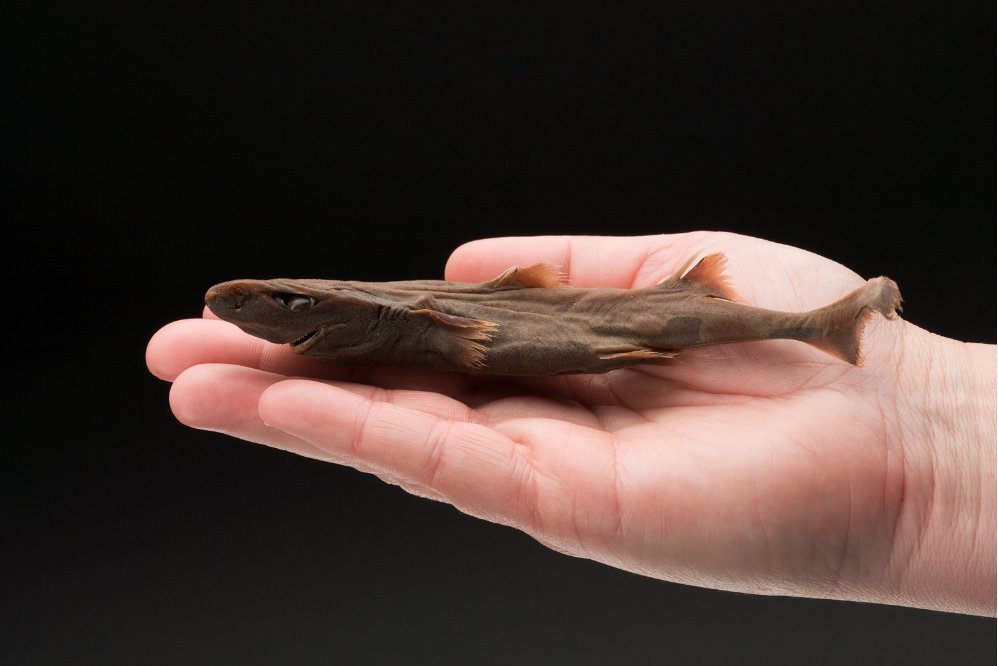
Dwarf Lantern Shark
Etmopterus perryi
The dwarf lanternshark (Etmopterus perryi) is a species of dogfish shark in the family Etmopteridae and is the smallest shark in the world, reaching a maximum known length of 20 cm (8 in). It is known to be present only on the upper continental slopes off Colombia and Venezuela, at a depth of 283–439 m (928–1,440 ft). This species can be identified by its small size at maturity, long flattened head, and pattern of black ventral markings and a mid-dorsal line. Like other members of its genus, it is capable of producing light from a distinctive array of photophores. Reproduction is aplacental viviparous, with females gestating two or three young at a time. The dwarf lanternshark is not significant to commercial fisheries, but could be threatened by mortality from bycatch; the degree of impact from human activities on its population is unknown.
From the article Dwarf lanternshark on Wikipedia (CC BY-SA), quoted section by section
Description
The dwarf lanternshark appears to reach a maximum length of about 20 cm (7.9 in) (female). It has a long, wide, flattened head comprising a fourth to a fifth of its total length. The eyes are large, twice as long as high, with the anterior and posterior corners acute. The nares are large and preceded by poorly developed flaps of skin. There are 25–32 tooth rows in the upper jaw and 30–34 tooth rows in the lower jaw. The upper teeth of adult males have a single cusp flanked by two pairs of smaller cusplets, while the upper teeth of females are more robust and have only one pair of lateral cusplets flanking the central cusp. The lower teeth each have a single, strongly oblique cusp, and their bases are interlocked to form a continuous cutting surface. Scattered, sparse papillae are inside the mouth and on the edges of the gill arches. The five pairs of gill slits are small. The trunk is short, with two relatively closely spaced, large dorsal fins bearing grooved spines in front. The first dorsal fin originates over the trailing margins of the pectoral fins. The second dorsal fin has twice the area of the first and is larger than the pectoral or pelvic fins, and originates over the end of the pelvic fin bases. There is no anal fin. The caudal fin is low, with a moderate lower lobe and a ventral notch near the tip of the upper lobe. …
Range & habitat
At present, the dwarf lanternshark has been reported only from a small area of the Caribbean Sea off the coasts of Colombia and Venezuela, occurring between Barranquilla and Santa Marta, near the Guajira Peninsula, and between the Los Testigos Islands and Grenada. This shark apparently inhabits the upper continental slope at a depth of 283–439 m (928–1,440 ft).
Wikipedia: “Distribution and habitat”
What it does
Perhaps the smallest living shark species, male dwarf lanternsharks mature at a length of 16–17.5 cm (6.3–6.9 in) and females from a length of 15.5 cm (6.1 in) with 19–20 cm (7.5–7.9 in) long pregnant individuals known. The spined pygmy shark (Squaliolus laticaudus) and the pygmy ribbontail catshark (Eridacnis radcliffei) are known to attain maturity at comparably small sizes; difficulties in assessing the reproductive maturity of sharks precludes stating one of these species as definitively smaller than the others. This species is aplacental viviparous, with the developing fetuses being sustained by a yolk sac until birth. Females bear litters of two or three young, each measuring 5.5–6.0 cm (2.2–2.4 in) long.
Wikipedia: “Biology and ecology”
Where it lives
Recorded sightings
—
geo-referenced records in GBIF, from museums, herbaria and field observers.
Drag the globe to turn it. Dots are where records exist, not a range map; darker means more records.
In the stacks
Searching the stacks…
Every page naming Etmopterus perryi in the Biodiversity Heritage Library →
This page is assembled live from iNaturalist, GBIF, Wikipedia, the Source Library and the Internet Archive. It is not yet part of the hand-edited codex. iNaturalist taxon 100588.