- Animals
- ›Chordates
- ›Vertebrates
- ›Ray-finned Fishes
- ›Spiny-rayed fishes
- ›Perches, Scorpionfishes, Sticklebacks, and Allies
- ›Perches, groupers and allies
- ›Perches, Darters, and allies
- ›Darters
- ›Etheostoma
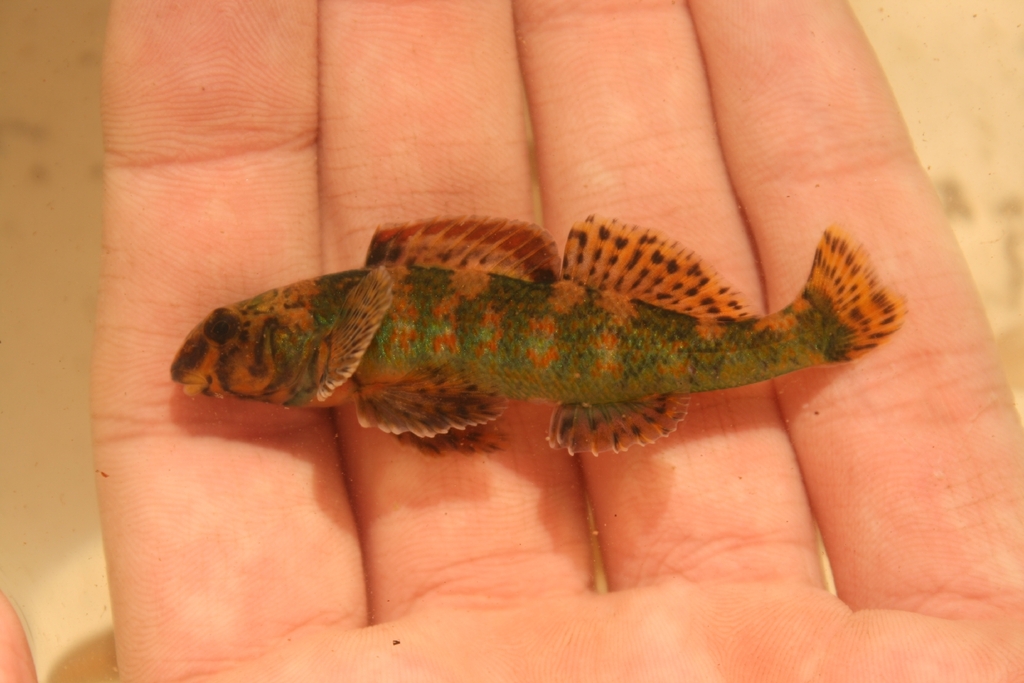
Harlequin Darter
Etheostoma histrio
The harlequin darter (Etheostoma histrio) is a species of ray-finned fish, a darter from the subfamily Etheostomatinae, part of the family Percidae which includes the perches, ruffes and pike-perches. It is endemic to the eastern half of the United States.
From the article Harlequin darter on Wikipedia (CC BY-SA), quoted section by section
Description
This species can reach 7.7 cm (3.0 in) in total length, though most only reach about 5.3 cm (2.1 in). The harlequin darter displays a green coloration on its sides, with six or seven brown saddles present along the top of the body. The belly of this darter is generally a yellow or tan color with dark blotches present, and the base of the caudal peduncle and caudal fin show a B shape. The first dorsal fin is characterized by being clear with a red boundary. The other fins are mostly dark, with many dark blotches. Males and females of this species look similar except during the breeding season, when males display a much brighter green color than females. Nuptial tubercles in this species are absent. The name harlequin darter refers to mask-like pigmentation on the face, consisting of a suborbital bar and dark blotching on the head, breast, and body.
Range & habitat
The harlequin darter was first recorded in the Ouachita River in Arkansas and the Poteau River in Oklahoma. Since then, knowledge of its geographic range has expanded to include the majority of the Southeast and the tributaries of the lower Mississippi River. This species is found from Illinois, south to Florida and as far west as Texas. The majority of the harlequin darter's population is found south of the Fall Line; however, the northernmost record of this species occurred within the Embarras River, which is a tributary of the Wabash River of Illinois. Within Tennessee, the harlequin darter only occurs in the western portion of the state, within the Mississippi River and western Tennessee River tributaries. The extent of the harlequin darter's range is believed to be underestimated due to its preferred habitat type. The harlequin darter prefers areas full of woody debris in large, fast-moving bodies of water, requiring special sampling methods and likely resulting in a high degree of sampling error. It has been removed from the Indiana list of endangered species after unknown populations were found. In addition, known populations within the Wabash River drainage in Indiana have been noticeably increasing. This species is only found in one watershed, the Escambia, in Florida. …
Wikipedia: “Distribution”
What it does
The diet of the harlequin darter consists of benthic invertebrates, including larvae from midges, caddisflies, mayflies, and blackflies. Ecological specialization is one of the top reasons darters have such an incredible amount of diversity. Within its range, the harlequin darter prefers moderate- to fast-flowing riffles with fairly high water quality conditions; but what sets it apart is its dependence on detritus and downed woody debris. It is one of the few darter species reliably found within the main channel of the Mississippi River, and it often avoids smaller streams. Agricultural runoff tends to accumulate heavily into these large water bodies, greatly increasing nitrate and phosphate levels, creating an unfavorable environment for these darters. Also, companies along these larger bodies of water tend to remove vegetation and woody debris in riparian zones, further negatively affecting the harlequin darter.
Wikipedia: “Ecology”
Where it lives
Recorded sightings
—
geo-referenced records in GBIF, from museums, herbaria and field observers.
Drag the globe to turn it. Dots are where records exist, not a range map; darker means more records.
In the stacks
Searching the stacks…
Every page naming Etheostoma histrio in the Biodiversity Heritage Library →
This page is assembled live from iNaturalist, GBIF, Wikipedia, the Source Library and the Internet Archive. It is not yet part of the hand-edited codex. iNaturalist taxon 100486.