- Animals
- ›Chordates
- ›Vertebrates
- ›Ray-finned Fishes
- ›Spiny-rayed fishes
- ›Perches, Scorpionfishes, Sticklebacks, and Allies
- ›Perches, groupers and allies
- ›Perches, Darters, and allies
- ›Darters
- ›Etheostoma
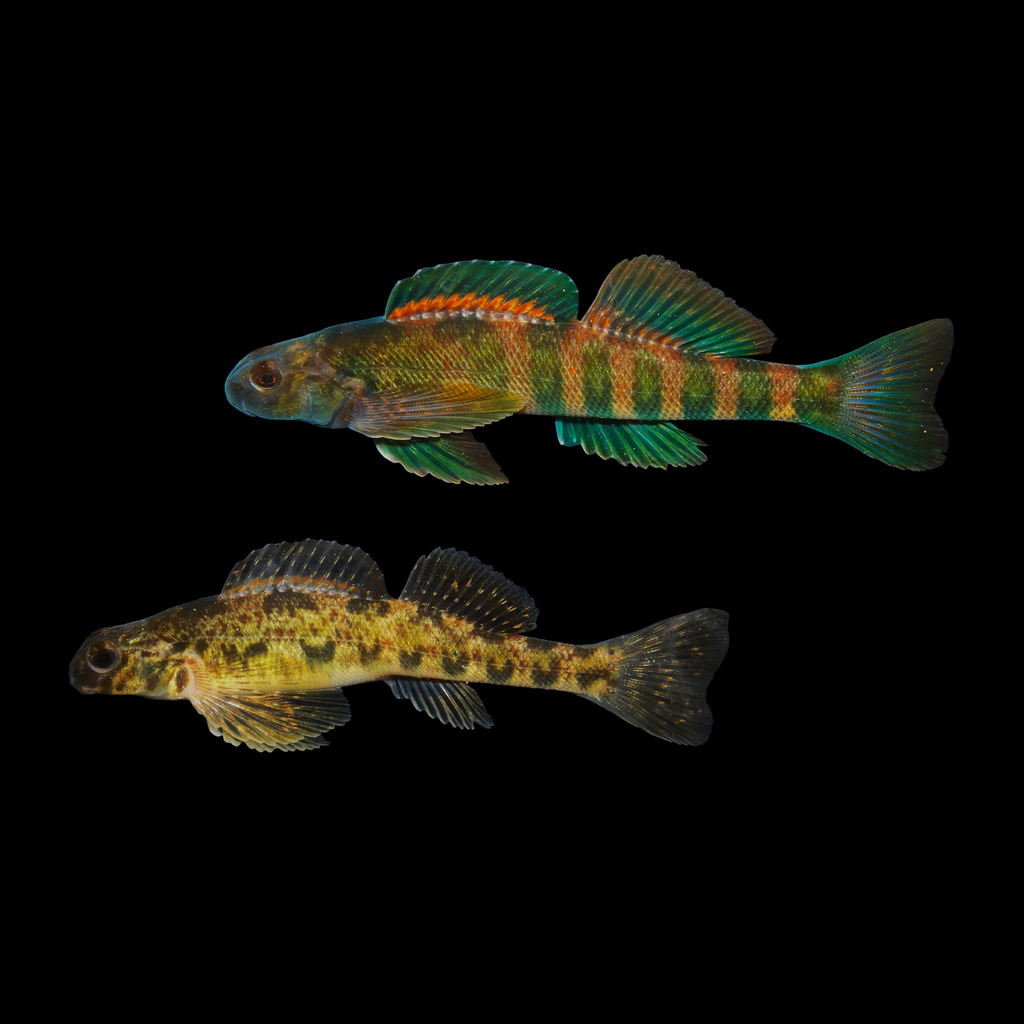
Greenside Darter
Etheostoma blennioides
The greenside darter (Etheostoma blennioides) is a species of freshwater ray-finned fish, a darter from the subfamily Etheostomatinae, part of the family Percidae, which also contains the perches, ruffes and pikeperches. It inhabits swift riffles in the eastern United States and southern Ontario.
From the article Greenside darter on Wikipedia (CC BY-SA), quoted section by section
Description
The greenside darters have an elongated body with a long and rounded snout. The dorsum is greenish-brown, with six or seven dark quadrate saddles and the sides with five to eight dark green, typically U- or W-shaped blotches. The nape, cheeks, opercle, and belly are completely scaled, with the breast naked. The anal fin has six to 10 rays (usually eight) and 13 to 16 pectoral fin rays, and both are bright green in breeding males; caudal fins are yellowish to clear; dorsal fin rays number 12 to 15, with red basal bands; breeding males have intensely bluish-green nasal and oral areas and sometimes black on the head.
Range & habitat
The E. blennioides subspecies are believed to have diverged in separate drainage systems and glacial refugia during the Pleistocene ice ages, which destroyed older connections and shaped new river systems.
E. b. blennioides (northern greenside darter) ranges throughout the Ohio River basin and northeast into the Potomac and upper Genesee Rivers. E. b. newmanii (highlands greenside darter) occurs in the Cumberland and Tennessee River drainages of Alabama, Kentucky, and Tennessee; it also occurs in the Arkansas, Ouachita, St. Francis, and White Rivers of Arkansas and Missouri. E. b. pholidotum (central greenside darter) occurs in north-flowing rivers of the northern Ozarks, the Wabash basin, the Maumee River drainage, and along the shores of Lake Erie and Lake Ontario.
Wikipedia: “Distribution”
In human culture
Etheostoma: etheo meaning filter or strain and stoma meaning mouth E. b. blennioides: referring to its resemblance to the Mediterranean blennies Constantine S. Rafinesque knew in his early years E. b. newmanii: patronymic for Francis H. Newman, aquatic biologist, who collected the type specimen E. b. pholidotum: meaning scaled, referring to its fully scaled belly.
Wikipedia: “Etymology”
Where it lives
Recorded sightings
—
geo-referenced records in GBIF, from museums, herbaria and field observers.
Drag the globe to turn it. Dots are where records exist, not a range map; darker means more records.
In the stacks
Searching the stacks…
Every page naming Etheostoma blennioides in the Biodiversity Heritage Library →
This page is assembled live from iNaturalist, GBIF, Wikipedia, the Source Library and the Internet Archive. It is not yet part of the hand-edited codex. iNaturalist taxon 100447.