- Animals
- ›Chordates
- ›Vertebrates
- ›Ray-finned Fishes
- ›Salmons, Pikes and Mudminnows
- ›Pikes and Mudminnows
- ›Pikes and Allied Mudminnows
- ›Pikes
- ›Esox
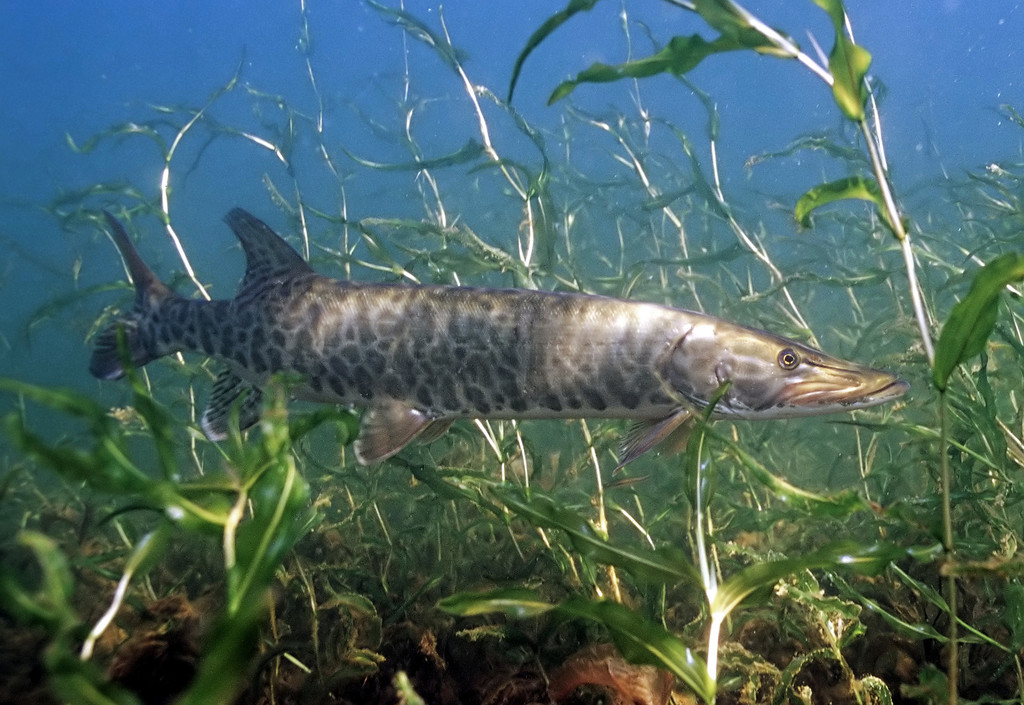
Muskellunge
Esox masquinongy
The muskellunge (Esox masquinongy), also known as muskelunge, muscallonge, milliganong, or maskinonge (and often abbreviated "muskie" or "musky"), is a species of large, relatively uncommon freshwater fish native to North America. The muskellunge is the largest member of the pike family, Esocidae. The common name comes from the Ojibwa word maashkinoozhe, meaning "ugly pike", by way of French masque allongé (modified from the Ojibwa word by folk etymology), "elongated face." The French common name is masquinongé...
From the article Muskellunge on Wikipedia (CC BY-SA), quoted section by section
Description
Muskellunge closely resemble other esocids such as the northern pike (Esox lucius) and American pickerel (E. americanus) in both appearance and behavior. Like the northern pike and other aggressive pikes, the body plan is typical of ambush predators with an elongated body, flat head, and dorsal, pelvic, and anal fins set far back on the body. Muskellunge are typically 70–120 cm (28–48 inches) long and weigh 7–16.5 kg (15–36 lb), though some have reached up to 1.8 m (6 ft) and almost 30 kg (70 lb). Martin Arthur Williamson caught a muskellunge with a weight of 27.8 kg (61.25 pounds) in November 2000 on Georgian Bay. The fish are a light silver, brown, or green, with dark vertical stripes on the flank, which may tend to break up into spots. In some cases, markings may be absent altogether, especially in fish from turbid waters. This is in contrast to northern pike, which have dark bodies with light markings. A reliable method to distinguish the two similar species is by counting the sensory pores on the underside of the mandible. A muskie will have seven or more per side, while the northern pike never has more than six. The lobes of the caudal (tail) fin in muskellunge come to a sharper point, while those of northern pike are more generally rounded. …
Range & habitat
Muskellunge are found in oligotrophic and mesotrophic lakes and large rivers from Michigan, Wisconsin, and Minnesota through the Great Lakes region, Chautauqua Lake in western New York, north into Canada, throughout most of the St Lawrence River drainage, and northward throughout the upper Mississippi valley, although the species also extends as far south as Chattanooga in the Tennessee River valley. Also, a small population is found in the Broad River in South Carolina. Several North Georgia reservoirs also have healthy stocked populations of muskie. They are also found in the Red River drainage of the Hudson Bay basin. Muskie were introduced to western Saint John River in the late 1960s and have now spread to many connecting waterways in northern Maine. The Pineview Reservoir in Utah is one of three Utah locations where the hybrid Tiger muskellunge is found. They prefer clear waters where they lurk along weed edges, rock outcrops, or other structures to rest. A fish forms two distinct home ranges in summer: a shallow range and a deeper one. The shallow range is generally much smaller than the deeper range due to shallow water heating up. A muskie continually patrols the ranges in search of available food in the appropriate conditions of water temperature.
Wikipedia: “Habitat”
What it does
Muskies are ambush predators who will swiftly bite their prey and then swallow it head first. Muskellunge are the top predator in any body of water where they occur and they will eat larger prey than most other freshwater fish. They eat all varieties of fish present in their ecosystem (including other muskellunge), along with the occasional insect, muskrat, rat, mouse, frog, or duck. They are capable of taking prey up to two-thirds of their body length due to their large stomachs. There have even been reports of large muskellunge attacking small dogs and even humans, although most of these reports are greatly exaggerated.
Wikipedia: “Diet”
In human culture
The name "muskellunge" originates from the Ojibwe word maashkinoozhe, meaning "ugly pike". The Algonquin word maskinunga is borrowed into the Canadian French words masquinongé or maskinongé. In English, before settling on the common name "muskellunge", there were at least 94 common names applied to this species, including but not limited to: muskelunge, muscallonge, muskallonge, milliganong, maskinonge, maskalonge, mascalonge, maskalung, muskinunge and masquenongez.
Wikipedia: “Etymology”
Where it lives
Recorded sightings
—
geo-referenced records in GBIF, from museums, herbaria and field observers.
Drag the globe to turn it. Dots are where records exist, not a range map; darker means more records.
In the stacks
Searching the stacks…
Every page naming Esox masquinongy in the Biodiversity Heritage Library →
This page is assembled live from iNaturalist, GBIF, Wikipedia, the Source Library and the Internet Archive. It is not yet part of the hand-edited codex. iNaturalist taxon 100429.