- Animals
- ›Chordates
- ›Vertebrates
- ›Ray-finned Fishes
- ›Spiny-rayed fishes
- ›Perches, Scorpionfishes, Sticklebacks, and Allies
- ›Perches, groupers and allies
- ›Groupers
- ›Epinephelus
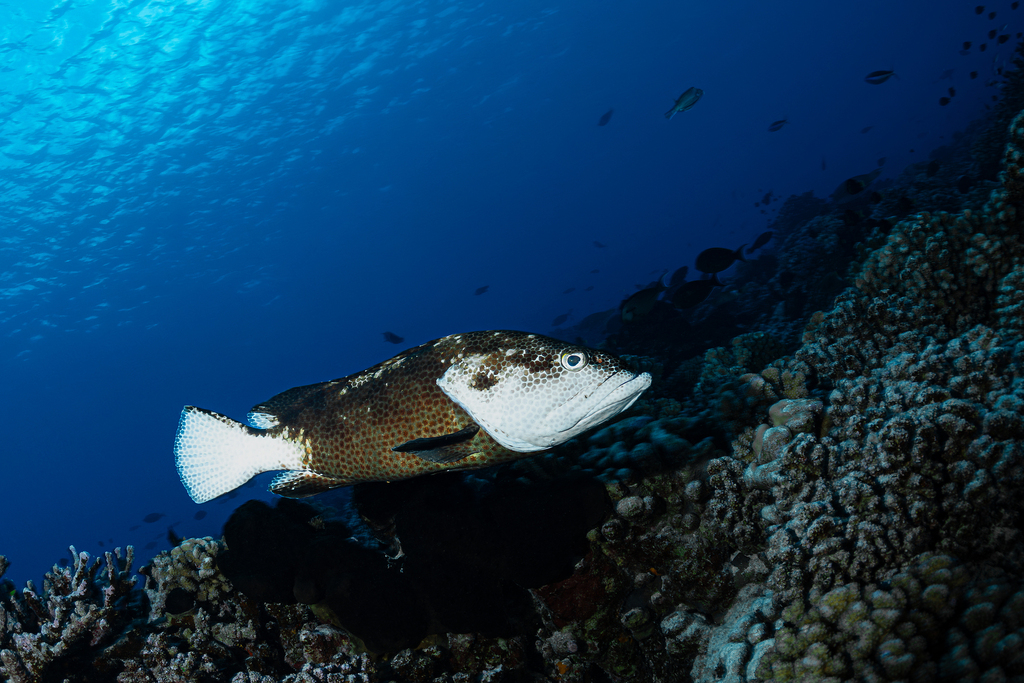
Greasy Rockcod
Epinephelus tauvina
The greasy grouper (Epinephelus tauvina), also known as the Arabian grouper or greasy rockcod, is an Indo-Pacific fish species of economic importance belonging to the family Serranidae.
From the article Greasy grouper on Wikipedia (CC BY-SA), quoted section by section
Description
Epinephelus tauvina grows up to 75 cm (30 inches) in length. These fish have a wide, upward-facing mouth with rather thick lips. Their heads and bodies are pale greenish grey or brown with round spots, varying from orange-red to dark brown. A group of black spots may be visible on the body at the base of the rear of the dorsal fin. Five vertical darker shaded bars may also be present on their bodies. It is similar to E. corallicola and E. howlandi, which, however, have shorter bodies and spots less closely spaced. Due to confusion about identifying species, much of the earlier (particularly before 1984) literature referring to E. tauvina may actually refer to other species of grouper, including Epinephelus coioides, Epinephelus malabaricus and Epinephelus lanceolatus.
Range & habitat
The greasy grouper occurs in the Red Sea and along the East African coast, east to the Pitcairn group, north to Japan, and south to Lord Howe Island. It is not common in Fiji, Tonga, or French Polynesia.
Wikipedia: “Distribution”
Where it lives
Recorded sightings
—
geo-referenced records in GBIF, from museums, herbaria and field observers.
Drag the globe to turn it. Dots are where records exist, not a range map; darker means more records.
In the stacks
Searching the stacks…
Every page naming Epinephelus tauvina in the Biodiversity Heritage Library →
This page is assembled live from iNaturalist, GBIF, Wikipedia, the Source Library and the Internet Archive. It is not yet part of the hand-edited codex. iNaturalist taxon 100141.