- Animals
- ›Arthropods
- ›Crustaceans
- ›Typical Crustaceans
- ›Malacostracans
- ›Decapods, Isopods, and allies
- ›Decapods and Krill
- ›Decapods
- ›Crabs, Lobsters, Shrimps, and Allies
- ›Crayfishes and Lobsters
- ›Reef Lobsters
- ›Reef Lobsters
- ›Enoplometopus
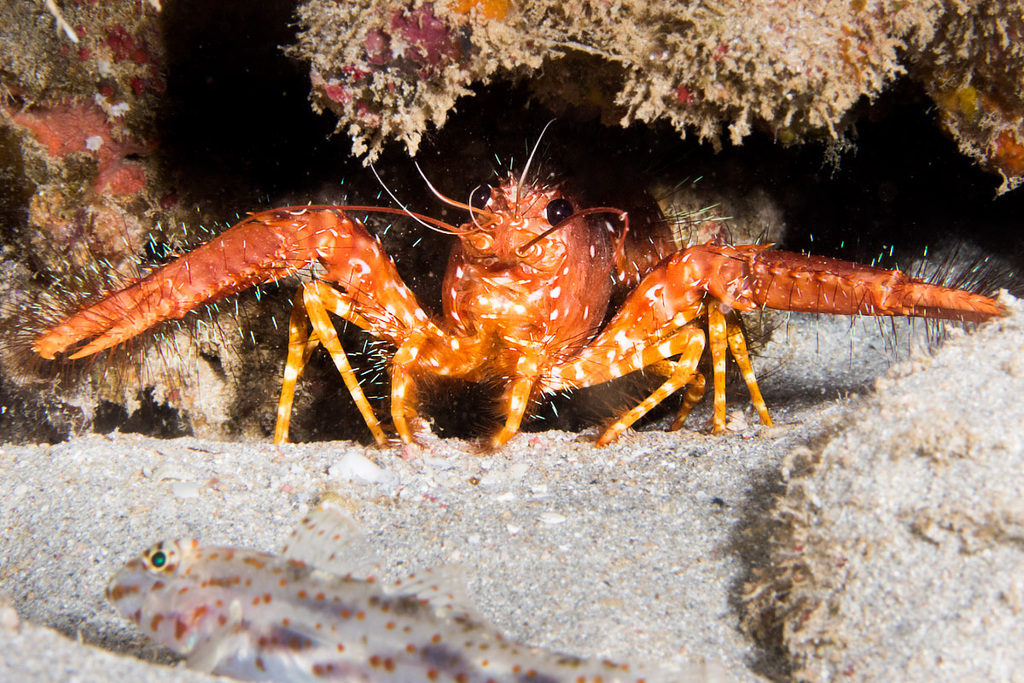
Red Reef Lobster
Enoplometopus occidentalis
Enoplometopus occidentalis, the red reef lobster, Hawaiian reef lobster, or hairy reef lobster, is a reef lobster, native to the Indo-Pacific Ocean. It is in the family Enoplometopidae. The species was first discovered by zoologist John Witt Randall, who originally classified it as Nephrops occidentalis.
From the article Enoplometopus occidentalis on Wikipedia (CC BY-SA), quoted section by section
Description
Enoplometopus occidentalis is easily identifiable due to its striking neon red or orange body, accompanied with distinctive white marking, and yellow hair-like structures. Its first pair of legs has slender, elongated claws and adult males can grow up to 14 cm (5.5 in) in length. The smooth, rounded abdominal leads to a rounded tail with a central spine and three movable side spines. In males, the first swimming limb looks leaf-like, while in females, it appears thread-like; the first pair of these limbs are modified for reproduction.
Range & habitat
The red reef lobster is commonly found in the tropical waters of the Indo-West Pacific, including regions such as the eastern coast of Africa, Indonesia, Hawaii, the Philippines, and more recently, the Indian Ocean. Its distribution has expanded due to its popularity in the aquarium trade, where it is prized for its striking colors, contributing to its presence in many regions.
Wikipedia: “Distribution”
Where it lives
Recorded sightings
—
geo-referenced records in GBIF, from museums, herbaria and field observers.
Drag the globe to turn it. Dots are where records exist, not a range map; darker means more records.
In the stacks
Searching the stacks…
Every page naming Enoplometopus occidentalis in the Biodiversity Heritage Library →
This page is assembled live from iNaturalist, GBIF, Wikipedia, the Source Library and the Internet Archive. It is not yet part of the hand-edited codex. iNaturalist taxon 100007.