 NL·0780
Herbarium of the Nature Library
- Name
- Plecotus auritus
- Family
- Vespertilionidae
- Native to
- Europe from Ireland and Iberia to the Urals, the Caucasus and western Siberia
- Habitat
- Temperate forest, Parkland, Gardens, Buildings
Brown long-eared bat
Plecotus auritus
Also calledOreillard roux (French) · Braunes Langohr (German) · Langøre (Danish) · Murciélago orejudo dorado (Spanish) · Morcego-orelhudo-castanho (Portuguese)
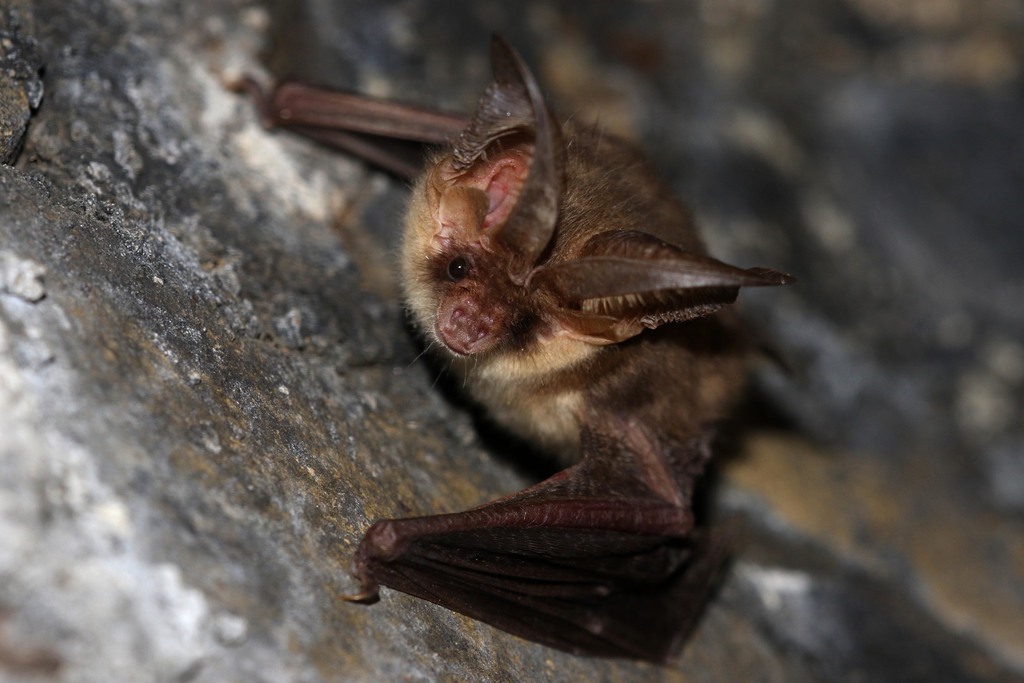
A small woodland bat with ears almost as long as its body, which it uses to hear the rustling of insects on leaves. It 'whispers' its echolocation calls and often picks moths and spiders off foliage, hovering in the canopy. It commonly roosts in the roof spaces of old houses, barns and churches.
The brown long-eared bat or common long-eared bat is a small Eurasian insectivorous bat. It has distinctive ears, long and with a distinctive fold. It is extremely similar to the much rarer grey long-eared bat, which was only validated as a distinct species in the 1960s. An adult brown long-eared bat has a body length of 4.5–4.8 cm, a tail of 4.1–4.6 cm, and a forearm length of 4–4.2 cm. The ears are 3.3–3.9 cm in length, and readily distinguish the long-eared bats from most other bat species. They are relatively slow flyers compared to other bat species. Wikipedia
What it can do
- iEars about three-quarters the length of its head and body
- iiVery quiet, low-intensity echolocation, plus passive listening to prey sounds
- iiiGleans prey off leaves and can hover
- ivHibernates in caves, cellars and trees, sometimes with ears tucked under the wings
In the field
Field marks
- aEnormous ears joined at the base over the forehead
- bAt rest, ears folded back under the wings, leaving the long pointed tragus showing
- cFluffy brown fur, pale below; pinkish-brown face
- dSigns: piles of moth and butterfly wings under porches or barn rafters (feeding perches); droppings in attics
- Not to be confused with
- Grey long-eared bat (Plecotus austriacus) is greyer, with a darker face and longer tragus; reliable separation often needs measurements. Other bats have much shorter ears.
- Where to see it
- Old churches, barns and country houses in Britain and Ireland; woodlands across Scandinavia and central Europe; Bat Conservation Trust and similar guided bat walks
- When
- Active roughly April–October; hibernates November–March
Listen
Looking for field recordings…
Life & habits
- Diet
- Moths, beetles, earwigs, spiders and other arthropods
- Habitat
- Woodland, wooded gardens and parks; roosts in attics, barns, churches and tree holes
- Size
- Body 4–5 cm, wingspan 23–28 cm; 6–12 g
- Lifespan
- Usually 4–5 years; up to about 30
Often carries large moths to a favourite perch to eat, leaving discarded wings in piles beneath.
Where it lives
Recorded sightings
—
geo-referenced records in GBIF, from museums, herbaria and field observers.
Native range
Europe from Ireland and Iberia to the Urals, the Caucasus and western Siberia
Drag the globe to turn it. Dots are where records exist, not a range map; darker means more records.
In the stacks
Searching the stacks…
Every page naming Plecotus auritus in the Biodiversity Heritage Library →
Marginalia
Long-eared bats in church roofs are a classic part of English rural life; in the UK all bat species and roosts are protected by law. In medieval Europe bats were linked with witchcraft and the night.
Curiosity
It can hear a ladybird walking on a leaf, using sound alone to find prey.
Kinship





Photographs: iNaturalist contributors under the licences shown. Records: GBIF.org. Historical plates: Source Library (CC BY-SA 4.0; originals public domain). Summary text: Nature Library editors and Wikipedia (CC BY-SA). Medicinal and edibility notes are historical and educational, not advice. iNaturalist taxon 40416.