 NL·0198
Herbarium of the Nature Library
- Name
- Lentinula edodes
- Family
- Omphalotaceae
- Native to
- East and Southeast Asia (China, Japan, Korea, Indochina); cultivated worldwide
- Habitat
- Temperate forest, Subtropical broadleaf forest
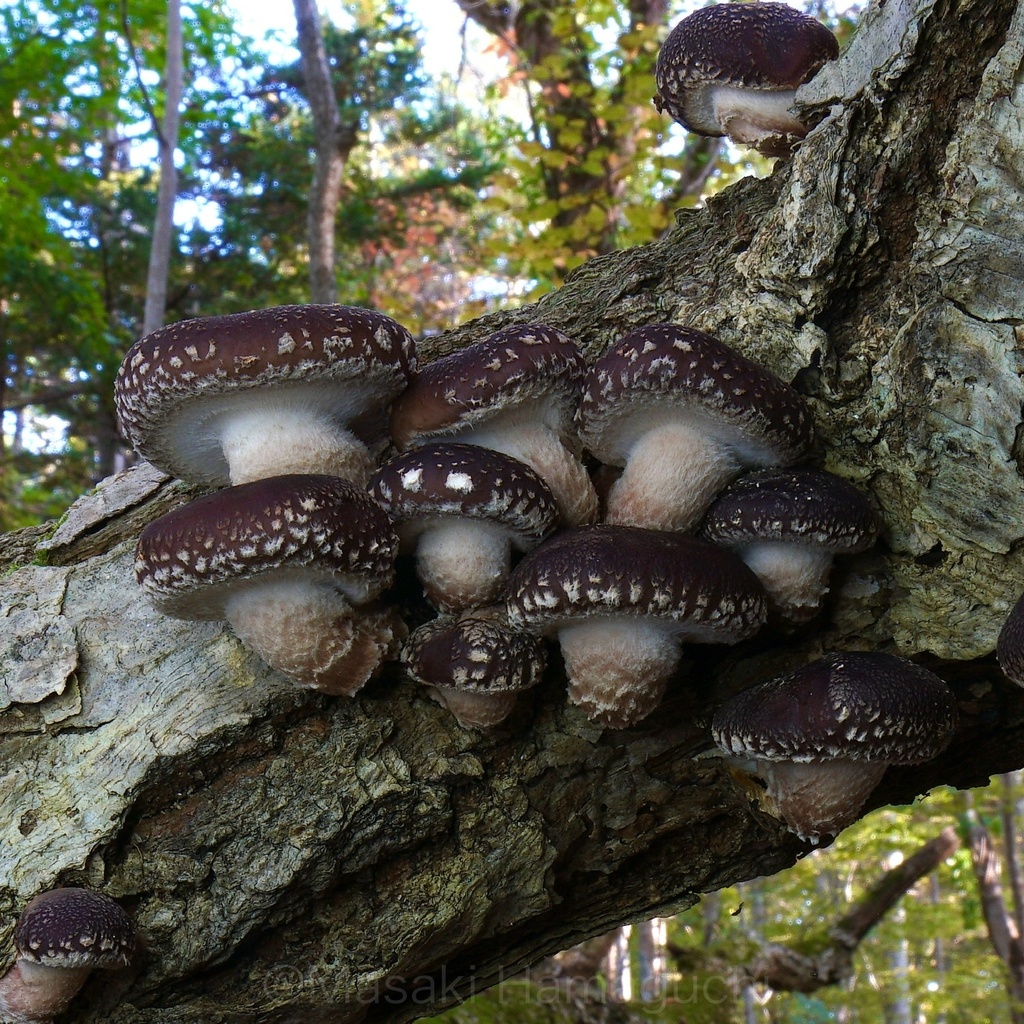
Shiitake
Lentinula edodes
Also calledXiang gu 香菇 (Chinese) · Dong gu 冬菇 (Cantonese) · Shiitake 椎茸 (Japanese) · Pyogo (Korean) · Nấm hương (Vietnamese)
One of the world's most widely grown mushrooms, making up roughly a quarter of cultivated mushroom production. It has been cultivated on logs in China for about a thousand years. It is rich in the savoury compound guanylate and the sulphur-containing flavour precursor lentinic acid.
The shiitake is an edible mushroom native to East Asia and mainland Southeast Asia, which is cultivated and consumed around the globe. The earliest written records of their cultivation dates to 1209, during the Song dynasty in China. Wikipedia
What it can do
- iDecomposes the dead wood of shii, oak, chestnut and other hardwoods (white rot)
- iiProduces lentinan, a β-glucan approved in Japan as an injectable adjunct for gastric cancer
- iiiIts sulphur flavour compound lenthionine forms when the mushroom is dried and rehydrated
- ivContains eritadenine, which lowers cholesterol in animal studies
At the table
Eatencap and stem (cooked; stems are tough)
Choice edible when cooked. Raw or undercooked shiitake can cause 'shiitake dermatitis', a whip-like itchy rash linked to lentinan that appears a day or two later. Wild collection on wood carries the risk of picking deadly Galerina marginata (funeral bell), a small brown wood-rotting mushroom with amatoxins and a rusty-brown spore print. Shiitake has a white spore print. Buy cultivated.
In the medicine cabinet
| Tradition | Use |
|---|---|
| Traditional Chinese medicine | Recorded by Wu Rui in the Ri Yong Ben Cao (Yuan dynasty) as a food that strengthens qi and the body |
| Japanese oncology | Purified lentinan given by injection alongside chemotherapy for gastric cancer |
Weight of evidence
Moderate. Some clinical trials with promising but limited or mixed results.
Active compounds
lentinan, eritadenine, lenthionine, ergosterol
Fruiting body & spores
Spores
Spore print white; spores ellipsoid, smooth, about 5–6.5 × 3–3.5 µm
- Dispersal
- Wind-borne basidiospores from the gills
How to cultivate it
Hardiness (USDA zones)
- Light
- Full shade outdoors; indirect light indoors
- Water
- Keep logs moist; soak to trigger fruiting
- Soil
- Fresh-cut oak or other hardwood logs (10–15 cm diameter), or supplemented hardwood sawdust blocks
- Propagation
- Plug or sawdust spawn
- To harvest
- Logs: 6–18 months, then fruit for 3–6 years. Sawdust blocks: about 2–3 months
- Climates
- Temperate, Subtropical
- 1Cut healthy hardwood logs in late winter and inoculate within a few weeks
- 2Drill holes about every 15 cm in a diamond pattern, tap in spawn plugs and seal with wax
- 3Stack logs in full shade and keep damp while the mycelium colonises (6–18 months)
- 4Force a flush by soaking a log in cold water for 12–24 hours; mushrooms appear in about a week at 10–25 °C
- 5Pick when caps are 70–90% open; rest the log 6–8 weeks between soakings
Where it lives
Recorded sightings
—
geo-referenced records in GBIF, from museums, herbaria and field observers.
Native range
East and Southeast Asia (China, Japan, Korea, Indochina); cultivated worldwide
Drag the globe to turn it. Dots are where records exist, not a range map; darker means more records.
In the old herbals & bestiaries
Woodcuts and engravings matched from the Source Library’s scanned books by name. Plates marked “relative” show a close kin rather than this exact species. Click a plate to read the page it came from, with translation.

In the stacks
Searching the stacks…
Every page naming Lentinula edodes in the Biodiversity Heritage Library →
Marginalia
Chinese tradition credits Wu Sangong of Zhejiang (Song dynasty, around 1000 CE) with discovering that striking logs made them fruit. Longquan and Qingyuan still honour him at temples. The technique spread to Japan, where thick-capped, cool-season 'donko' became a prized grade.
Curiosity
Drying shiitake in sunlight, gills up, sharply raises its vitamin D content.
Kinship


Fact-checked: 2 corrections made to this sheet. Photographs: iNaturalist contributors under the licences shown. Records: GBIF.org. Historical plates: Source Library (CC BY-SA 4.0; originals public domain). Summary text: Nature Library editors and Wikipedia (CC BY-SA). Medicinal and edibility notes are historical and educational, not advice. iNaturalist taxon 123351.