 NL·0734
Herbarium of the Nature Library
- Name
- Hippocampus kuda
- Family
- Syngnathidae
- Native to
- Indo-Pacific from India and the Persian Gulf to Japan, Indonesia, the Philippines and Hawaii
- Habitat
- Seagrass meadow, Estuaries, Mangrove, Coastal waters
Spotted seahorse
Hippocampus kuda
Also calledKuda laut, 'sea horse' (Malay/Indonesian) · Hǎimǎ 海马 (Chinese) · Tatsu-no-otoshigo, 'dragon's child' (Japanese) · Cá ngựa (Vietnamese)
A small, upright-swimming fish of Indo-Pacific estuaries and seagrass beds in which the male, not the female, becomes pregnant. Its species name comes from the Malay word for horse.
Hippocampus kuda is a species of seahorse, also known as the common seahorse, estuary seahorse, yellow seahorse or spotted seahorse. The common name sea pony has been used for populations formerly treated as the separate species Hippocampus fuscus, now a synonym of H. kuda. Wikipedia
What it can do
- iMales carry fertilised eggs in a brood pouch, supply them with oxygen and give birth to live young
- iiAnchors itself with a prehensile tail
- iiiMoves each eye independently
- ivSucks prey into its tube-like snout in a few milliseconds
- vChanges colour to match its surroundings
In the field
Field marks
- aUpright seahorse with a curled tail
- bYellow, black or brown with fine spots
- cLow crown and smooth body
- dLong snout
- Not to be confused with
- Other Indo-Pacific seahorses are very similar; experts check spines, crown and ring counts.
- When
- Resident
Life & habits
- Diet
- Carnivore: copepods, small shrimp and other tiny crustaceans
- Habitat
- Shallow seagrass, estuaries, mangroves and harbours, often in murky water
- Size
- Up to ~17 cm
- Lifespan
- 1–4 years
Paired seahorses often greet each other each morning with a 'dance' of changing colour and linked tails.
Where it lives
Recorded sightings
—
geo-referenced records in GBIF, from museums, herbaria and field observers.
Native range
Indo-Pacific from India and the Persian Gulf to Japan, Indonesia, the Philippines and Hawaii
Drag the globe to turn it. Dots are where records exist, not a range map; darker means more records.
In the old herbals & bestiaries
Woodcuts and engravings matched from the Source Library’s scanned books by name. Plates marked “relative” show a close kin rather than this exact species. Click a plate to read the page it came from, with translation.

Garden of Health
Jacob Meydenbach · 1491 · p.690

Ortus sanitatis
1491 · p.692

Ortus sanitatis
1491 · p.693

Garden of Health
Jacob Meydenbach · 1491 · p.691

History of Animals, Book II: On Oviparous Quadrupeds
Conrad Gessner · 1586 · p.550

History of Animals, Book II: On Oviparous Quadrupeds
Conrad Gessner · 1586 · p.635

History of Monsters
Ulisse Aldrovandi · 1642 · p.370

De medicinali materia libri sex
Dioscorides · 1552 · p.835

Books on Marine Fishes
Guillaume Rondelet · 1554 · p.755

Commentaries on the Six Books of Dioscorides
Pietro Andrea Mattioli · 1560 · p.295
In the stacks
Searching the stacks…
Every page naming Hippocampus kuda in the Biodiversity Heritage Library →
Marginalia
Its form recalls the hippocampus, the sea-horse that pulled Poseidon's chariot in Greek myth, and Conrad Gessner illustrated seahorses in his Historiae animalium (1558). Dried seahorses (hǎimǎ) are a long-standing ingredient in traditional Chinese medicine, which drives much of the trade in wild seahorses.
Curiosity
A male can give birth to hundreds of babies at once.
Kinship
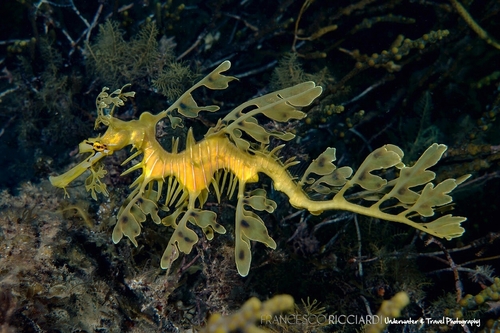





Photographs: iNaturalist contributors under the licences shown. Records: GBIF.org. Historical plates: Source Library (CC BY-SA 4.0; originals public domain). Summary text: Nature Library editors and Wikipedia (CC BY-SA). Medicinal and edibility notes are historical and educational, not advice. iNaturalist taxon 84970.