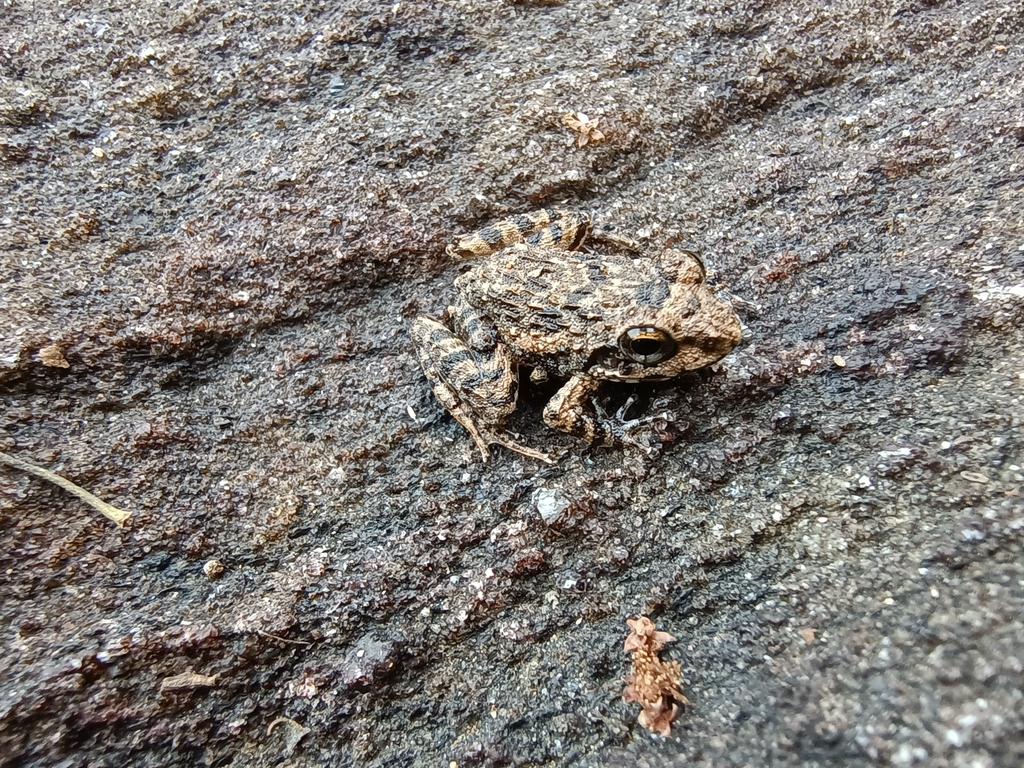
Rocky-terrain Leaping Frog
Indirana paramakri
Indirana paramakri, the rocky terrain leaping frog or Suganthagiri leaping frog, is a frog in the family Ranixalidae. It is endemic to Kerala, India in the Western Ghat mountains.
From the article Indirana paramakri on Wikipedia (CC BY-SA), quoted section by section
Description
The adult female holotype measured 30.9 mm in snout-vent length. The skin of the dorsum was red-brown in color. There was a dark black-brown stripe from each nostril running past the bottom of each eye over the tympanum to the armpit. The eardrum was black-brown in color. Parts of the lip were interspersed with dark brown and cream-colored stripes. The front and hind legs were red-brown in color with brown marks. Parts of the legs and flanks were gray-brown in color. Her ventrum was gray with some black-brown spots.
Wikipedia: “Appearance”
Range & habitat
People have seen this frog near streams on wet rocks or among the leaf litter. It lives in disturbed areas and is suspected in nearby primary forest. This frog has been observed between 823 and 1100 meters above sea level.
Wikipedia: “Habitat”
What it does
This frog lays eggs on wet rocks. The tadpoles are semi-aquatic and use their strong tails and hind limbs to move. These limbs grow in at a much younger age than those of other frogs' tadpoles.
Wikipedia: “Reproduction”
In human culture
Scientists named this species paramakri. In the Malayalam language, which is the official language of Kerala, para means "rock" and makri means "frog." This refers to the frog's tendency to inhabit rocky places.
Wikipedia: “Etymology”
Listen
Looking for field recordings…
Where it lives
Recorded sightings
—
geo-referenced records in GBIF, from museums, herbaria and field observers.
Drag the globe to turn it. Dots are where records exist, not a range map; darker means more records.
In the stacks
Searching the stacks…
Every page naming Indirana paramakri in the Biodiversity Heritage Library →
This page is assembled live from iNaturalist, GBIF, Wikipedia, the Source Library and the Internet Archive. It is not yet part of the hand-edited codex. iNaturalist taxon 517314.