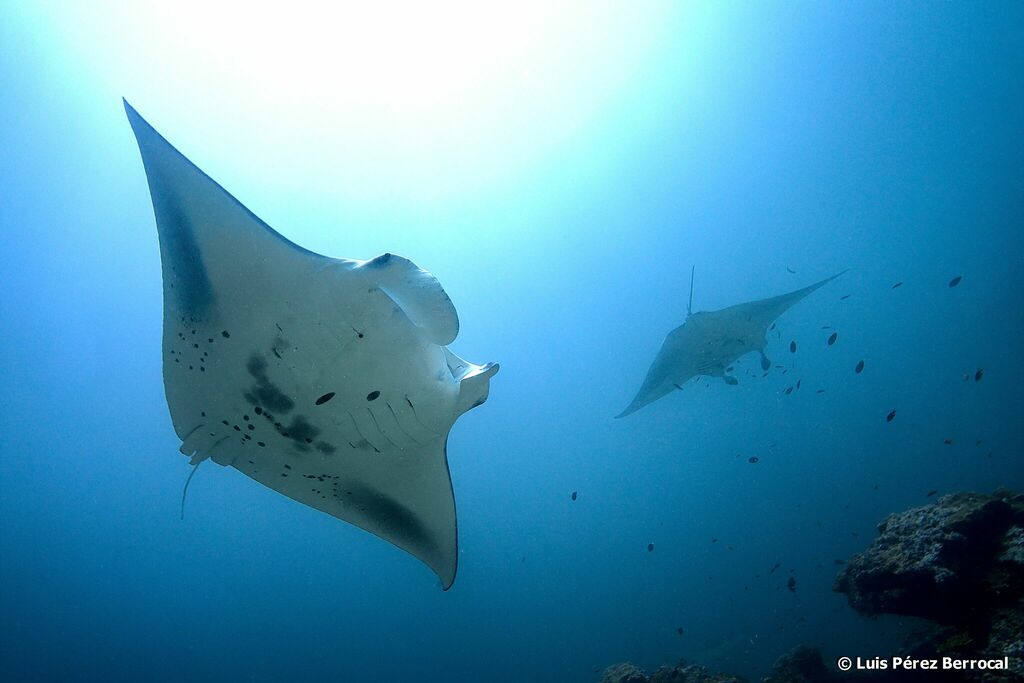
Reef Manta Ray
Mobula alfredi
The reef manta ray or hāhālua (Mobula alfredi) is a species of ray in the family Mobulidae, one of the largest rays in the world. Among generally recognized species, it is the third-largest species of ray, surpassed by the Giant oceanic manta ray and the Atlantic manta ray.
The species was described in 1868 by Gerard Krefft, the director of the Australian Museum. He named it M. alfredi in honor of Alfred, Duke of Edinburgh, the first member of the British royal family to visit Australia. It was originally described as part of the genus Manta but in 2017 was changed, along with the rest of the mantas, to be included as part of the genus Mobula.
From the article Reef manta ray on Wikipedia (CC BY-SA), quoted section by section
Description
The reef manta ray can grow to a disc size of up to 5 m (16 ft) but average size commonly observed is 3 to 3.5 m (11 ft). It is dorsoventrally flattened and has large, triangular pectoral fins on either side of the disc. At the front, it has a pair of cephalic fins which are forward extensions of the pectoral fins. These can be rolled up in a spiral for swimming or can be flared out to channel water into the large, forward-pointing, rectangular mouth when the animal is feeding. The eyes and the spiracles are on the side of the head behind the cephalic fins, and the five gill slits are on the ventral (under) surface. It has a small dorsal fin and the tail is long and whip-like. The manta ray does not have a spiny tail as do the closely related devil rays (Mobula spp.). The color of the dorsal side is dark black to midnight blue with scattered whitish and greyish areas on top head. The ventral surface is white, sometimes with dark spots and blotches. The markings can often be used to recognise individual fish. Mobula alfredi is similar in appearance to Mobula birostris and the two species may be confused as their distribution overlaps. However, there are distinguishing features.
Physical distinctions between oceanic manta ray and reef manta ray. …
Range & habitat
The reef manta ray has a widespread distribution in tropical and subtropical parts of the Indo-Pacific, with few records from the warm East Atlantic and none in the West Atlantic or East Pacific. It can be observed in several often-visited regions such as Hawaii, Fiji, French Polynesia, Micronesia, Bali, Komodo, Maldives, Mozambique, Australia and the Philippines. It is primarily found in coastal regions. Reef manta rays live in a more or less identical wide area with the possibility of short migration to follow the zooplankton. They therefore have a relatively sedentary behavior with precise areas for cleaning and feeding still within close proximity of coasts, reefs or islands.
Wikipedia: “Distribution and habitat”
Where it lives
Recorded sightings
—
geo-referenced records in GBIF, from museums, herbaria and field observers.
Drag the globe to turn it. Dots are where records exist, not a range map; darker means more records.
In the stacks
Searching the stacks…
Every page naming Mobula alfredi in the Biodiversity Heritage Library →
This page is assembled live from iNaturalist, GBIF, Wikipedia, the Source Library and the Internet Archive. It is not yet part of the hand-edited codex. iNaturalist taxon 623965.