- Animals
- ›Chordates
- ›Vertebrates
- ›Reptiles
- ›Snakes and Lizards
- ›Snakes
- ›Colubrid Snakes
- ›Dipsadine Snakes
- ›Geophis
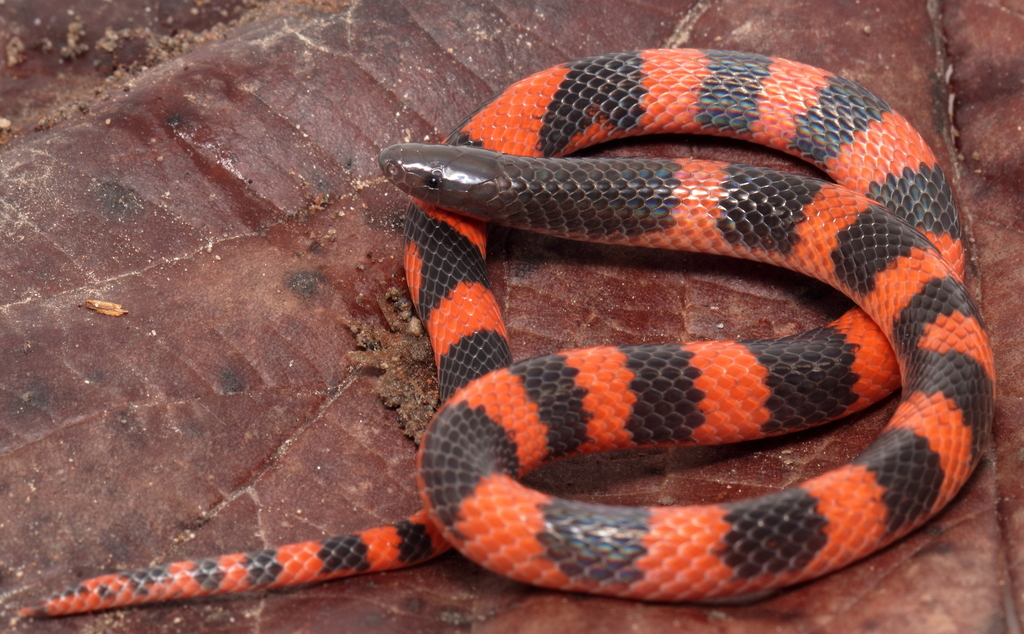
Loranca's Earth Snake
Geophis lorancai
Geophis lorancai is a snake of the colubrid family. It was formally described in 2016 and is named after Miguel Ángel de la Torre Loranca, the biologist who collected much of the type series based on which the species was described. The top and sides of the head and the anterior portion of the body are black. The rest of the body are tail are reddish-orange with saddle- and Y-shaped black transverse marks. The underside of the head is pale grey and that of the body and tail is almost spotless reddish-orange. A Mexican endemic, it is only known from the Sierra de Zongolica of west-central Veracruz and the Sierra de Quimixtlán in adjacent extreme east-central Puebla. It inhabits cloud forests at elevations of 1,210–1,700 m (3,970–5,580 ft).
From the article Geophis lorancai on Wikipedia (CC BY-SA), quoted section by section
Description
The top and sides of the head and the anterior portion of the body are black. The remainder of the body, past roughly the twelfth middorsal scale, is reddish-orange with black transverse marks. There are 13–20 black transverse marks on the body, most of which are saddle-shaped. A minority of the marks are Y-shaped. There are reddish-orange rings between adjacent saddles. The tail also has 4–10 black transverse marks. The underside of the head is pale grey and that of the body and tail is almost spotless reddish-orange. The tail surface is increasingly dark posteriorly.
Range & habitat
Geophis lorancai is only known from the Sierra de Zongolica of west-central Veracruz and the Sierra de Quimixtlán in adjacent extreme east-central Puebla. These mountains have irregular terrain with numerous hills, ascents and descents, and streams. The predominant vegetation is cloud forest and pine-oak associations. The present snake has only been recorded from leaf litter and under fallen logs in cloud forests at elevations of 1,210–1,700 m (3,970–5,580 ft).
== References ==
Wikipedia: “Distribution and habitat”
Where it lives
Recorded sightings
—
geo-referenced records in GBIF, from museums, herbaria and field observers.
Drag the globe to turn it. Dots are where records exist, not a range map; darker means more records.
In the stacks
Searching the stacks…
Every page naming Geophis lorancai in the Biodiversity Heritage Library →
This page is assembled live from iNaturalist, GBIF, Wikipedia, the Source Library and the Internet Archive. It is not yet part of the hand-edited codex. iNaturalist taxon 558899.