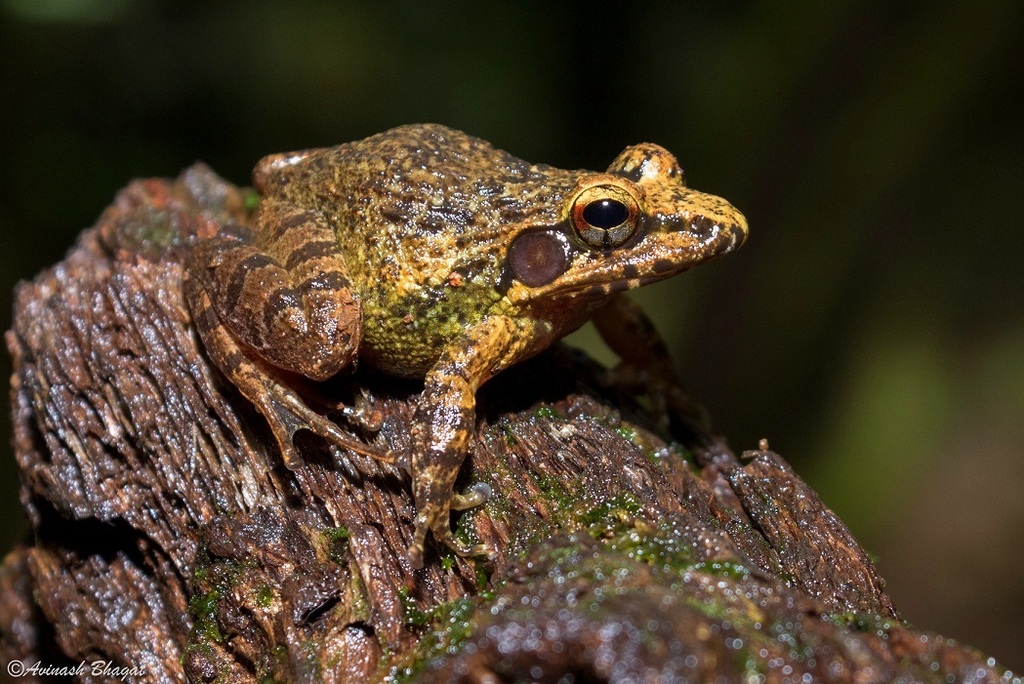
Amboli Leaping Frog
Indirana chiravasi
Indirana chiravasi (common name: Amboli leaping frog) is a species of frog endemic to the Western Ghats of India. It is only known from its type locality, the laterite plateaus by the hill-station of Amboli, Maharashtra. It was described in 2014 by a team of three scientists from IISER, Pune and MES Abasaheb Garware College.
From the article Indirana chiravasi on Wikipedia (CC BY-SA), quoted section by section
Description
Males measure 25–27 mm (0.98–1.06 in) and females 32–39 mm (1.3–1.5 in) in snout–vent length. The skin is smooth except on the sides that are granular; there are few longitudinal folds on dorsal side. Dorsal colour is olive brown with scattered yellow markings and, in males only, densely organized black spots comprising a W-shaped marking. There is a black strip running from tip of snout to shoulder through eye and tympanum. The fingers are unwebbed whereas the toes are moderately webbed.
Range & habitat
Indirana chiravasi inhabit lateritic rocky outcrops and occur in a variety of microhabitats. They are often found in the crevices of the laterite boulders; males are mostly seen while calling from the wet rocks or moss-covered boulders. Females have been found under a log in the forest and from under a roadside stone. This frog has been observed between 26 and 998 meters above sea level.
Wikipedia: “Habitat”
What it does
The tadpoles are terrestrial and have been observed feeding on algal matter on wet boulders. They move across wet rocks using their tails and hind limbs, which grow in at a younger age than those of the tadpoles of other species.
Wikipedia: “Reproduction”
Listen
Looking for field recordings…
Where it lives
Recorded sightings
—
geo-referenced records in GBIF, from museums, herbaria and field observers.
Drag the globe to turn it. Dots are where records exist, not a range map; darker means more records.
In the stacks
Searching the stacks…
Every page naming Indirana chiravasi in the Biodiversity Heritage Library →
This page is assembled live from iNaturalist, GBIF, Wikipedia, the Source Library and the Internet Archive. It is not yet part of the hand-edited codex. iNaturalist taxon 477122.