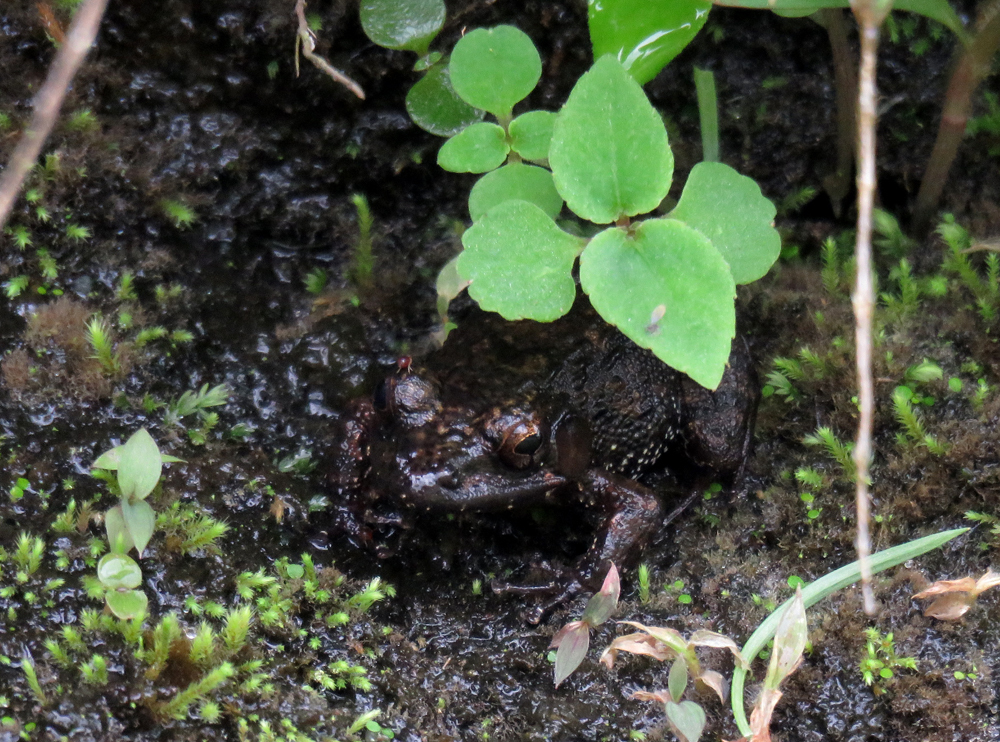
Yadera Leaping Frog
Indirana yadera
Indirana yadera, the Yadera leaping frog, is a frog in the family Ranixalidae. It is endemic to India's Western Ghat mountains.
From the article Indirana yadera on Wikipedia (CC BY-SA), quoted section by section
Description
This frog has several features that differentiate it from its congeners, including a head wider than it is long, a long, narrow snout, and a distinctive tympanum.
Wikipedia: “Appearance”
Range & habitat
This frog inhabits moist lowland and submontane forests. It can live in secondary forest, near streams and stagnant water. It appears to need both moist ground, moist leaf litter, and some canopy cover. So while it cannot live in clear-cut areas, it has been observed on arecanut plantations. It has been observed between 55 and 1075 meters above sea level.
Wikipedia: “Habitat”
What it does
The frog lays eggs on wet rocks. This frog's tadpoles are semi-aquatic and move across wet rocks and moss using their tails and their hind legs. Their back legs grow in at a younger age than other tadpoles' do.
Wikipedia: “Reproduction”
In human culture
The scientists who first described this frog named it some of their friends: yadera for Yamini, Deepa, and Ravisankaran.
Wikipedia: “Etymology”
Listen
Looking for field recordings…
Where it lives
Recorded sightings
—
geo-referenced records in GBIF, from museums, herbaria and field observers.
Drag the globe to turn it. Dots are where records exist, not a range map; darker means more records.
In the stacks
Searching the stacks…
Every page naming Indirana yadera in the Biodiversity Heritage Library →
This page is assembled live from iNaturalist, GBIF, Wikipedia, the Source Library and the Internet Archive. It is not yet part of the hand-edited codex. iNaturalist taxon 517316.