- Animals
- ›Chordates
- ›Vertebrates
- ›Reptiles
- ›Turtles and Tortoises
- ›Pond and Box Turtles
- ›Emydine Turtles
- ›Terrapene
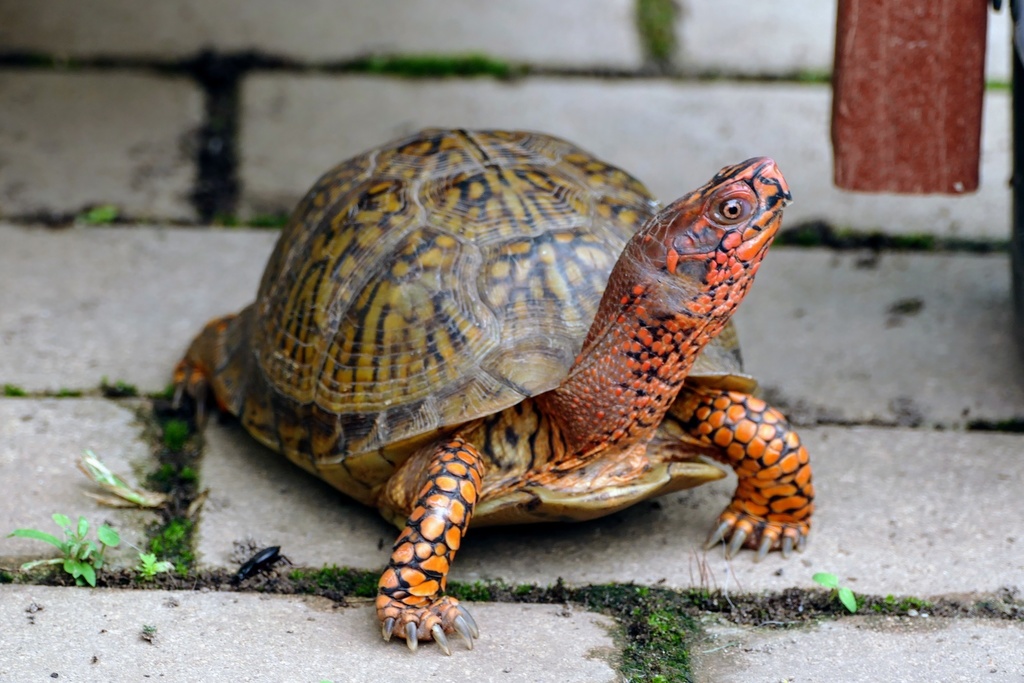
Three-toed Box Turtle
Terrapene triunguis
The three-toed box turtle (Terrapene triunguis) is a species within the genus of hinge-shelled turtles commonly referred to as box turtles. This species is native to the south-central part of the United States and is the official reptile of the state of Missouri. It is sometimes treated as a subspecies of the eastern box turtle as T. carolina triunguis.
From the article Three-toed box turtle on Wikipedia (CC BY-SA), quoted section by section
Description
Three-toed box turtles are so named due to the number of toes on the back feet, but some four-toed examples have been recorded as well. However, some speculate that the four-toed individuals are actually eastern box turtle × three-toed box turtle hybrids. Three-toed box turtles have a domed shell which grows to 5–7 inches (13–18 cm) in length. The highest part of its carapace or upper shell is more posteriorly positioned than in any of the other subspecies. The dorsal and limb coloration is commonly completely absent, although some dark blotches are common in adult turtles. These areas more often being a uniform olive green or tan color. Sometimes, faint yellow dots or lines are visible in the center of each large scute. In the males, the head and throat often display yellow, red, or orange spots. Frequently, the bottom shell or plastron is a straw yellow color, and has far fewer dark markings than the plastrons of the other subspecies.
Range & habitat
From the west to the east of its range, the three-toed box turtle can be found from eastern Texas to the northern edge of the Florida Panhandle. Its northernmost range is in Missouri and Kansas, while the southernmost one is in Louisiana. Three-toed box turtles interbreed with other subspecies of common box turtles which overlap the borders of this area. An example of this occurs in the eastern Mississippi valley, where this species is difficult to distinguish from the eastern box turtle. Being popular in the pet trade, three-toed box turtles are sometimes found well outside of their home range. It is not known whether such captives when released into the wild have any impact on the local species of such areas.These turtles are adaptive, and are possibly the only box turtle who can live happily in an indoor enclosure.
Wikipedia: “Distribution and habitat”
What it does
Three-toed box turtles are omnivores, their diets varying with availability of food sources and the seasons. They are known to eat earthworms, insects, snails, slugs, strawberries, mushrooms, and green-leafed vegetation. They have been observed eating the eggs of quail. All box turtles will prefer live foods to vegetation. It has also been speculated that these turtles eat poisonous mushrooms, but are not themselves sickened by the mushroom's toxins. Afterwards, the turtles then become poisonous themselves. Archie Carr believed this to be the reason why a group of boys in Mississippi became ill after eating roasted three-toed box turtles.
Wikipedia: “Diet”
Where it lives
Recorded sightings
—
geo-referenced records in GBIF, from museums, herbaria and field observers.
Drag the globe to turn it. Dots are where records exist, not a range map; darker means more records.
In the stacks
Searching the stacks…
Every page naming Terrapene triunguis in the Biodiversity Heritage Library →
This page is assembled live from iNaturalist, GBIF, Wikipedia, the Source Library and the Internet Archive. It is not yet part of the hand-edited codex. iNaturalist taxon 1544605.