- Animals
- ›Chordates
- ›Vertebrates
- ›Ray-finned Fishes
- ›Spiny-rayed fishes
- ›Blennies, Damselfishes and Allies
- ›Damselfishes
- ›Giant Damselfishes
- ›Similiparma
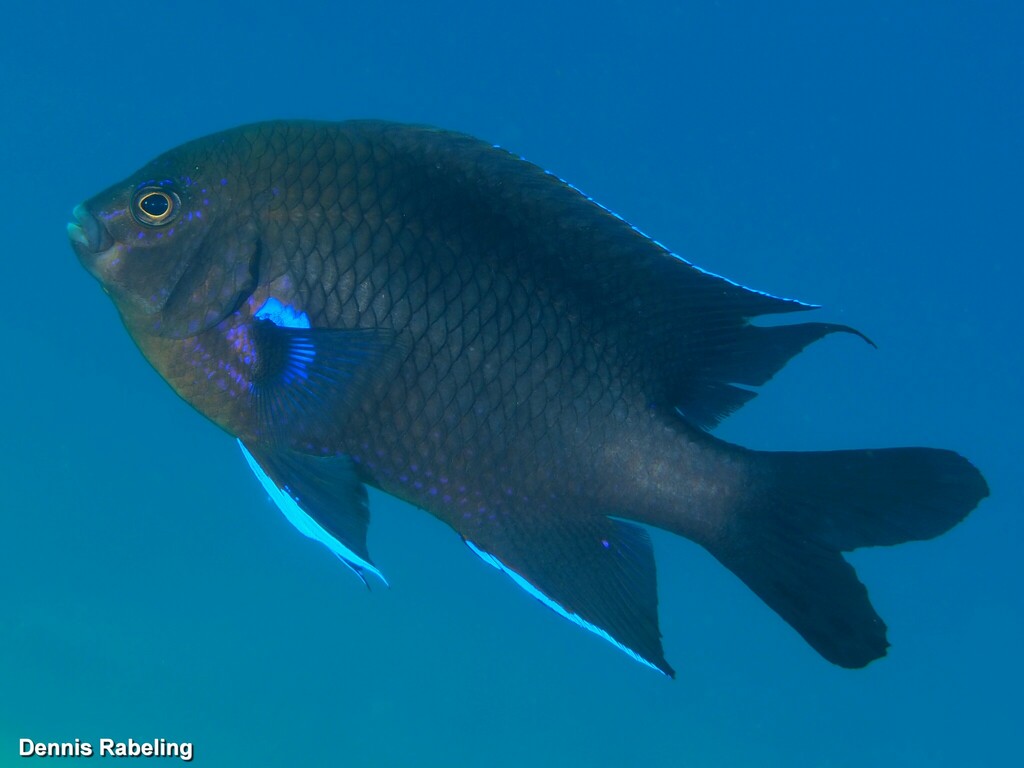
Canary Damsel
Similiparma lurida
The Canary damsel (Similiparma lurida), or Cape Verde gregory (which is also a common name of Stegastes imbricatus) is a species of marine fish of the family Pomacentridae. It lives primary in shallow, subtropical waters of the eastern Atlantic Ocean.
From the article Canary damsel on Wikipedia (CC BY-SA), quoted section by section
Description
Canary damsels have large eyes, and is primarily black to brownish black, with lighter colors on the ventral part of the body and blue fin margins. Juveniles may have lateral stripes on their bodies as well. During their mating season, adults exhibit sexual dimorphism. Individuals may grow to 15 cm in length.
Range & habitat
Canary damsels are commonly associated with rocky inshore areas of the eastern Atlantic Ocean; specifically, they are found in the waters of Macaronesia (Madeira, Azores, Savage Islands, Canary Islands, Cape Verde) and Senegal at depths to about 25 metres (82 ft). Juveniles may be found in tide pools.
Wikipedia: “Distribution and habitat”
What it does
The eggs of Canary damsels are demersal and attach to substrates. They are laid in a nest, and protected by the male.
Wikipedia: “Reproduction”
Where it lives
Recorded sightings
—
geo-referenced records in GBIF, from museums, herbaria and field observers.
Drag the globe to turn it. Dots are where records exist, not a range map; darker means more records.
In the stacks
Searching the stacks…
Every page naming Similiparma lurida in the Biodiversity Heritage Library →
This page is assembled live from iNaturalist, GBIF, Wikipedia, the Source Library and the Internet Archive. It is not yet part of the hand-edited codex. iNaturalist taxon 1256672.