- Animals
- ›Chordates
- ›Vertebrates
- ›Mammals
- ›Therians
- ›Placental Mammals
- ›Ungulates, Carnivorans, and Allies
- ›Carnivorans
- ›Pinnipeds
- ›Earless Seals
- ›Monachinae
- ›Monk Seals
- ›Neomonachus
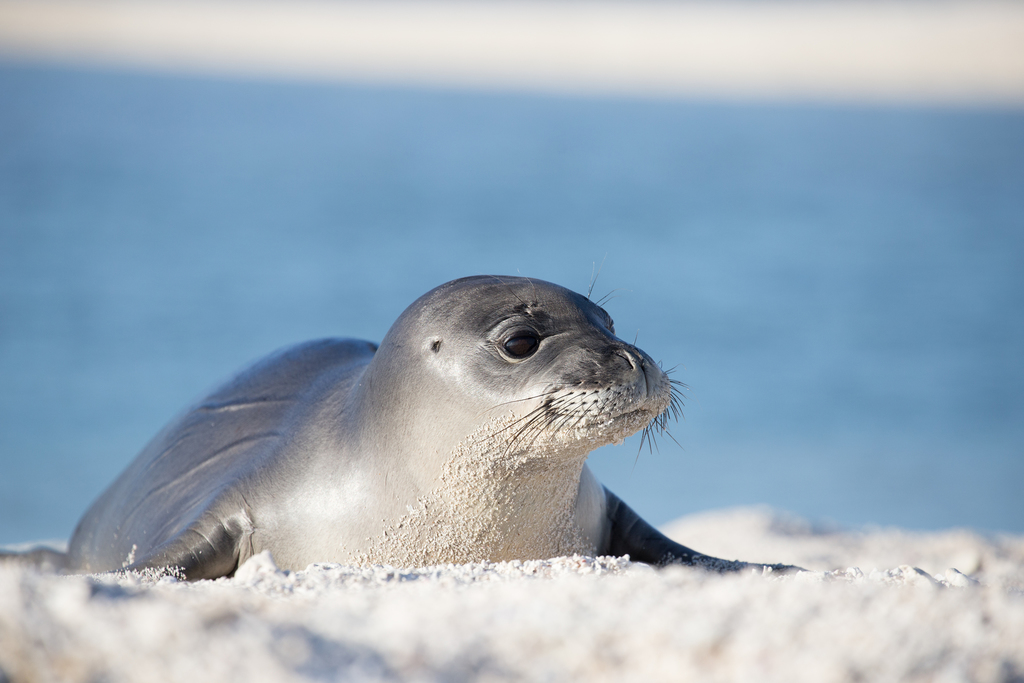
Hawaiian Monk Seal
Neomonachus schauinslandi
The Hawaiian monk seal (Neomonachus schauinslandi) is a vulnerable species of earless seal in the family Phocidae that is endemic to the Hawaiian Islands.
The Hawaiian monk seal is one of two extant monk seal species; the other is the Mediterranean monk seal. A third species, the Caribbean monk seal, is extinct. It is the last living member of the genus Neomonachus.
From the article Hawaiian monk seal on Wikipedia (CC BY-SA), quoted section by section
Description
Its grey coat, white belly, and slender physique distinguish them from the distantly related harbor seal (Phoca vitulina). The monk seal's physique is ideal for hunting its prey: fish, lobster, octopus and squid in deep water coral beds. When it is not hunting and eating, it generally basks on the sandy beaches and volcanic rock of the Northwest Hawaiian Islands. The Hawaiian monk seal is part of the earless seal family Phocidae, being named so for its characteristic lack of external ears and inability to rotate its hind flippers under the body. The Hawaiian monk seal has a relatively small, flat head with large black eyes, eight pairs of teeth, and short snouts with the nostril on top of the snout and vibrissae on each side. The nostrils are small vertical slits which close when the seal dives underwater. Additionally, their slender, torpedo-shaped body and hind flippers allow them to be very agile swimmers. Adult males are 300 to 400 pounds (140 to 180 kilograms) in weight and 7 feet (2.1 meters) in length while adult females tend to be, on average, significantly larger, at 400 to 600 lb (180 to 270 kg) and 8 ft (2.4 m) in length. When monk seal pups are born, they average 30 to 40 lb (14 to 18 kg) and 40 in (1 m) in length. …
Range & habitat
The majority of the Hawaiian monk seal population can be found around the Northwest Hawaiian Islands but a small and growing population lives around the main Hawaiian Islands. These seals spend two-thirds of their time at sea. Monk seals spend much of their time foraging in deeper water outside of shallow lagoon reefs at sub-photic depths of 300 metres (160 fathoms) or more. Hawaiian monk seals breed and haul-out on sand, corals, and volcanic rock; sandy beaches are more commonly used for pupping. Due to the immense distance separating the Hawaiian Islands from other land masses capable of supporting the Hawaiian monk seal, its habitat is limited to the Hawaiian Islands.
Wikipedia: “Habitat”
What it does
Hawaiian monk seals mainly prey on reef dwelling bony fish, but they also prey on cephalopods and crustaceans. They appear to prefer fish belonging to the families Muraenidae, Labridae, Holocentridae, Balistidae, and Polymixiidae. Both juveniles and sub-adults prey more on smaller octopus species, such as Octopus leteus and O. hawaiiensis, nocturnal octopus species, and eels than the adult Hawaiian monk seals, while adult seals feed mostly on larger octopus species such as O. cyanea. Hawaiian monk seals have a broad and diverse diet due to foraging plasticity which allows them to be opportunistic predators that feed on a wide variety of available prey. Hawaiian monk seals can hold their breath for up to 20 minutes and dive more than 550 m (1,800 ft); however, they usually dive an average of 6 minutes to depths of less than 60 m (200 ft) to forage at the seafloor.
Wikipedia: “Feeding”
In human culture
Known to native Hawaiians as ʻīlio-holo-i-ka-uaua, or "dog that runs in rough water", its scientific name is from Hugo Schauinsland, a German scientist who discovered a skull on Laysan Island in 1899. Its common name, and the genus (first element) of its scientific name, comes from short hairs on its head, said to resemble a monk. It is the official state mammal of Hawaii.
Wikipedia: “Etymology”
Listen
Looking for field recordings…
Where it lives
Recorded sightings
—
geo-referenced records in GBIF, from museums, herbaria and field observers.
Drag the globe to turn it. Dots are where records exist, not a range map; darker means more records.
In the stacks
Searching the stacks…
Every page naming Neomonachus schauinslandi in the Biodiversity Heritage Library →
This page is assembled live from iNaturalist, GBIF, Wikipedia, the Source Library and the Internet Archive. It is not yet part of the hand-edited codex. iNaturalist taxon 446640.