- Animals
- ›Chordates
- ›Vertebrates
- ›Mammals
- ›Therians
- ›Placental Mammals
- ›Ungulates, Carnivorans, and Allies
- ›Carnivorans
- ›Pinnipeds
- ›Earless Seals
- ›Monachinae
- ›Monk Seals
- ›Neomonachus
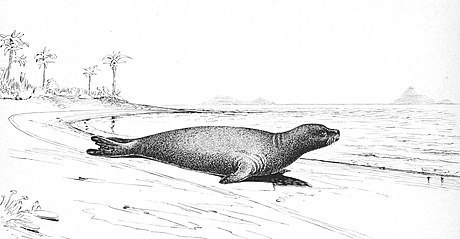
Caribbean Monk Seal
Neomonachus tropicalis
The Caribbean monk seal (Neomonachus tropicalis), also known as the West Indian seal or sea wolf, is an extinct species of seal native to the Caribbean. The main natural predators of Caribbean monk seals were American crocodiles, large sharks, such as great whites and tiger sharks, and possibly transient orcas (though killer whales are not often sighted in the Caribbean); however, humans would become their most lethal enemy. Overhunting of the monk seals for oil and meat, as well as overfishing of their natural prey, are the likely reasons for the seals' extinction.
The last confirmed sighting of a Caribbean monk seal was in 1952, at Serranilla Bank, in the waters west of Jamaica and off the eastern coast of Nicaragua. In 2008, the species was officially declared extinct by the United States, after an exhaustive five-year search. This analysis was conducted by the National Marine Fisheries Service of the National Oceanic and Atmospheric Administration (NOAA). The Caribbean monk seal is closely related to the Hawaiian monk seal, a vulnerable species which is restricted to the central Pacific Ocean surrounding the Hawaiian Islands, and the Mediterranean monk seal, a vulnerable species, predominantly found in the waters off of Greece.
From the article Caribbean monk seal on Wikipedia (CC BY-SA), quoted section by section
Description
Caribbean monk seals had a relatively large, long, robust body, could grow to nearly 2.4 metres (8 ft) in length and weighed 170 to 270 kilograms (375 to 600 lb). While historical accounts suggested males were larger, modern research into the genus Neomonachus suggests females may have been the larger sex, similar to their closest relative, the Hawaiian monk seal. Like other monk seals, this species had a distinctive head and face. The head was rounded with an extended broad muzzle. The face had relatively large wide-spaced eyes, upward opening nostrils, and fairly big whisker pads with long light-colored and smooth whiskers. When compared to the body, the animal's foreflippers were relatively short with little claws and the hindflippers were slender. Their coloration was brownish and/or grayish, with the underside lighter than the dorsal area. Adults were darker than the more paler and yellowish younger seals. Caribbean monk seals were also known to have algae growing on their pelage, giving them a slightly greenish appearance, which is similar to Hawaiian monk seals.
Range & habitat
Caribbean monk seals were found in warm temperate, subtropical and tropical waters of the Caribbean Sea, Gulf of Mexico, and the western Atlantic Ocean. They probably preferred to haul out at low sandy beaches above high tide on isolated and secluded atolls and islands, but occasionally would visit the mainland coasts and deeper waters offshore. This species may have fed in shallow lagoons and reefs.
Wikipedia: “Habitat”
What it does
Historical records show that this species may have "hauled out" at resting areas on land in large social groups, typically 20–40 animals, but sometimes up to 100 individuals, throughout its range. The groups may have been organised based on age and life stage differences. Their diet most likely consisted of fish and crustaceans. Like other true seals, the Caribbean monk seal was sluggish on land. Its lack of fear of humans, and an unaggressive, curious nature was taken advantage of by human hunters.
Reproduction and longevity. Caribbean monk seals had a long pupping season, which is typical for pinnipeds living in subtropical and tropical habitats. In Mexico, breeding season peaked in early December. Like other monk seals, this species had four retractable nipples for suckling their young. Newborn pups were probably about 1 metre (3 ft 3 in) in length and weighed 16 to 18 kilograms (35 to 40 lb) and reportedly had a sleek, black lanugo coat when born. It is believed this animal's average lifespan was approximately twenty years. The Caribbean monk seal nasal mite (Halarachne americana) was entirely dependent on the seal, living inside of its nasal cavity, and went extinct with it.
Wikipedia: “Behavior and ecology”
Listen
Looking for field recordings…
Where it lives
Recorded sightings
—
geo-referenced records in GBIF, from museums, herbaria and field observers.
Drag the globe to turn it. Dots are where records exist, not a range map; darker means more records.
In the stacks
Searching the stacks…
Every page naming Neomonachus tropicalis in the Biodiversity Heritage Library →
This page is assembled live from iNaturalist, GBIF, Wikipedia, the Source Library and the Internet Archive. It is not yet part of the hand-edited codex. iNaturalist taxon 446641.