- Animals
- ›Chordates
- ›Vertebrates
- ›Reptiles
- ›Snakes and Lizards
- ›Snakes
- ›Colubrid Snakes
- ›Dipsadine Snakes
- ›Pseudalsophis
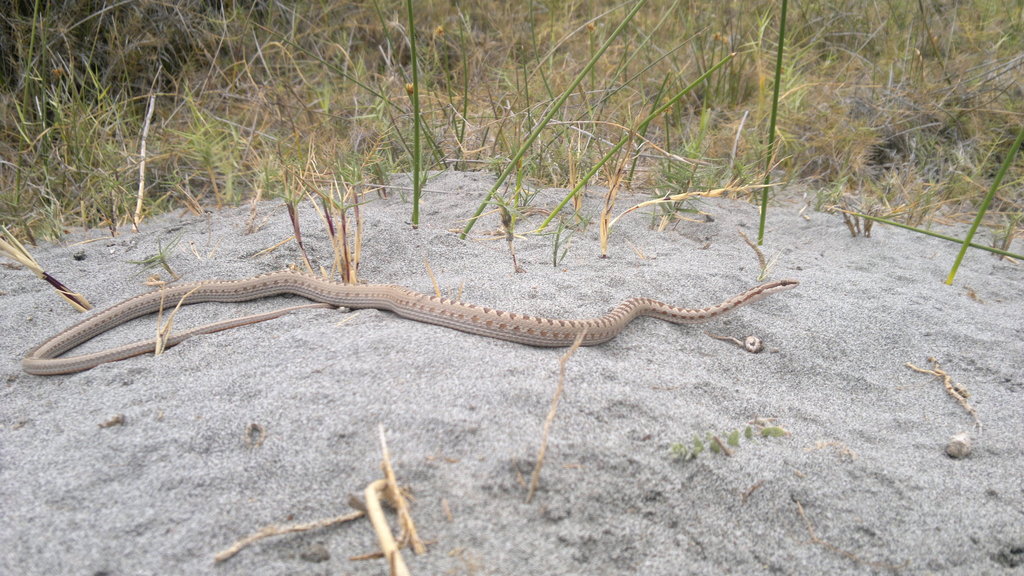
South American Elegant Racer
Pseudalsophis elegans
Pseudalsophis elegans is a species of snake of the family Colubridae. Common names include South American elegant racer and Guayaquil racer. It is the only snake species of the genus Pseudalsophis not found in the Galapagos Islands.
From the article Pseudalsophis elegans on Wikipedia (CC BY-SA), quoted section by section
Description
Pseudalsophis elegans is a small-to-medium-sized snake. The maximum reported snout-vent length is 41.5 cm for males and 99.1 cm for females. The dorsal scales are smooth and in 19 rows near the head and at midbody, and 15 or 17 rows near the tail. There are 187−213 ventral scales and 87-119 subcaudal scales. On the head, there are usually 8 supralabials, 10 infralabials, 1 preocular and 2 postocular scales.
Wikipedia: “Morphology”
Range & habitat
This snake is found in the southwestern part of mainland Ecuador, as well as in coastal Peru and northern Chile, west of the Andes Mountains.
Wikipedia: “Geographic range”
What it does
There are no detailed studies of the diet of P. elegans. They have been reported to feed on lizards, including the cercosaurine gymnophthalmid Macropholidus ruthveni and the teiid Dicrodon guttulatum.
Wikipedia: “Diet”
Toxicity
Snakes of the genus Pseudalsophis are opisthoglyphous and mildly venomous, but not dangerous to humans.
Wikipedia: “Venom”
In human culture
The specific epithet elegans (Latin for "elegant") refers to the dorsal pattern, a dark longitudinal stripe with undulating margins toward the head, changing to straight-edged and unbroken toward the tail.
Wikipedia: “Etymology”
Where it lives
Recorded sightings
—
geo-referenced records in GBIF, from museums, herbaria and field observers.
Drag the globe to turn it. Dots are where records exist, not a range map; darker means more records.
In the stacks
Searching the stacks…
Every page naming Pseudalsophis elegans in the Biodiversity Heritage Library →
This page is assembled live from iNaturalist, GBIF, Wikipedia, the Source Library and the Internet Archive. It is not yet part of the hand-edited codex. iNaturalist taxon 30130.