- Animals
- ›Chordates
- ›Vertebrates
- ›Ray-finned Fishes
- ›Spiny-rayed fishes
- ›Gobies, cardinalfishes and allies
- ›Gobies and allies
- ›Gobies
- ›Sea Gobies
- ›Tigrigobius
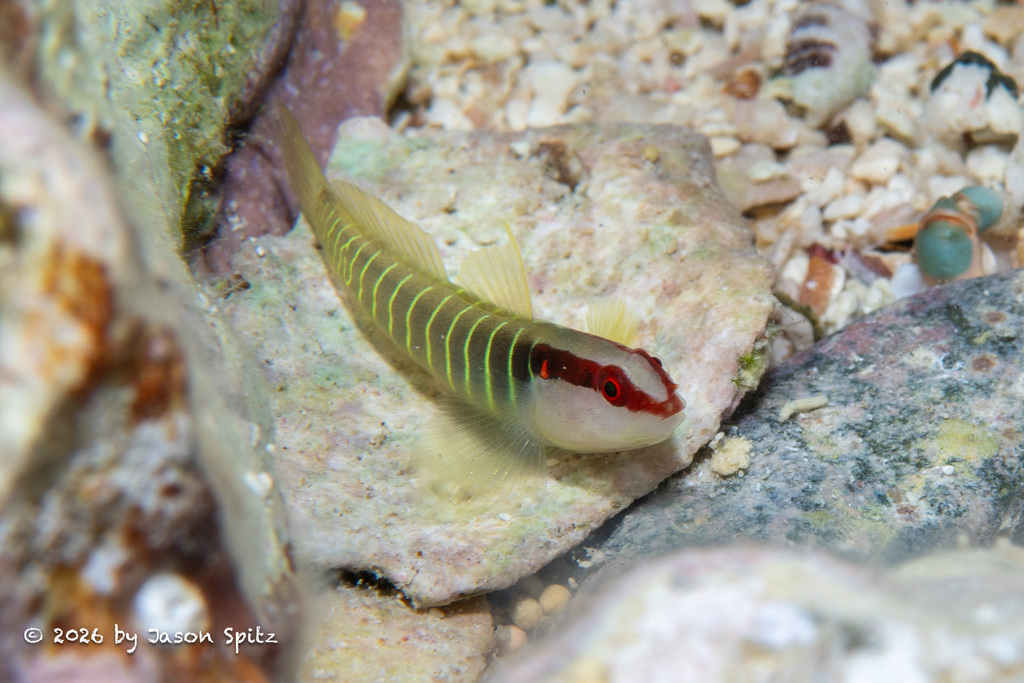
Greenband Goby
Tigrigobius multifasciatus
Tigrigobius multifasciatus, the green banded goby, is a member of the goby family native to the western Atlantic Ocean, from the Bahamas and Central America to northern South America. As the name implies, they are dark green with 17-23 pale green bars, and have a brown stripe through the eye interrupted with a bright red spot. It is believed by many that these markings imitate the Juvenile Schoolmaster Snapper.
Equally bright as their coloration is their personality; they are valued additions to reef aquaria, with a reputation for being friendly and entertaining.
From the article Tigrigobius multifasciatus on Wikipedia (CC BY-SA), quoted section by section
Description
Tigriogobius multifasciatus have a generally fusiform shape. At maturity they can reach a length of 3.5 cm.
What it does
Gobiodon sp. start life as females, and are bi-directional protogynous hermaphrodites, meaning that when paired up, if necessary, one changes sex to form a breeding pair. In the case of two females forming a pair, the larger of the two becomes male, and in the case of two males, the smaller changes sex to become female.
Wikipedia: “Reproduction”
Where it lives
Recorded sightings
—
geo-referenced records in GBIF, from museums, herbaria and field observers.
Drag the globe to turn it. Dots are where records exist, not a range map; darker means more records.
In the stacks
Searching the stacks…
Every page naming Tigrigobius multifasciatus in the Biodiversity Heritage Library →
This page is assembled live from iNaturalist, GBIF, Wikipedia, the Source Library and the Internet Archive. It is not yet part of the hand-edited codex. iNaturalist taxon 614976.