- Animals
- ›Chordates
- ›Vertebrates
- ›Mammals
- ›Therians
- ›Placental Mammals
- ›Ungulates, Carnivorans, and Allies
- ›Bats
- ›Yangochiroptera
- ›Vespertilionoid Bats
- ›Evening Bats
- ›Mouse-eared Bats
- ›Myotis
- ›Pizonyx
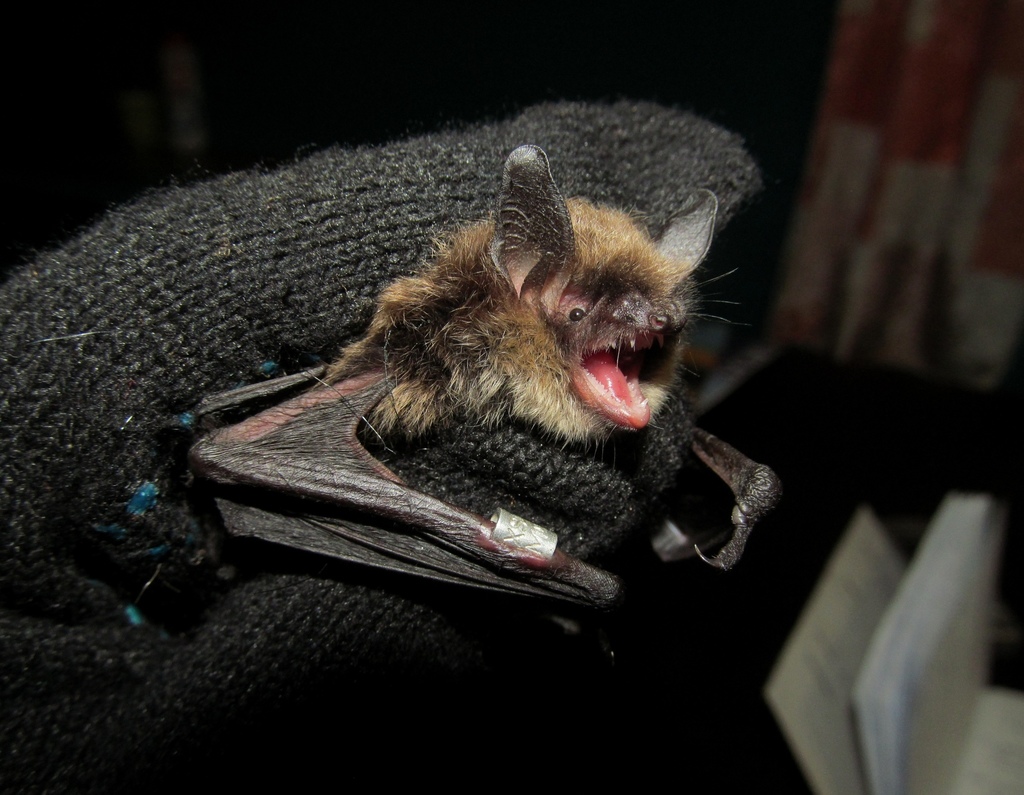
Siberian Bat
Myotis sibiricus
The Siberian bat or Siberian whiskered myotis (Myotis sibiricus) is a species of vesper bat in the family Vespertilionidae. It is found throughout northeastern Asia, primarily in Siberia. It is known for its high life expectancy relative to its body size, approximately twice that of humans, and holds the record for the oldest bat; in 2005, one individual was discovered in a cave in Siberia that had been banded in 1964, making the bat at least 41 years old.
From the article Siberian bat on Wikipedia (CC BY-SA), quoted section by section
Description
It is a small bat, with the length of its head and body only 39–51 mm (1.5–2.0 in). Its forearm is 33–39 mm (1.3–1.5 in) long; its tail is 32–44 mm (1.3–1.7 in) long; its hind feet are 7–9 mm (0.28–0.35 in) long; its ears are 12–17 mm (0.47–0.67 in). It has long fur relative to its body size. The fur on its back is pale brown with a golden sheen, while the fur on its ventral side is paler gray, sometimes with a yellowish tinge. Its tragus is narrow and pointed.
Range & habitat
It is found throughout much of the Palearctic east of the Ob River, from eastern Kazakhstan east throughout southern Siberia to the Kamchatka Peninsula, and south to northern China, northern Mongolia, North Korea, and northern South Korea. It is also known from Sakhalin & the Kuril Islands in Russia, and Hokkaido in Japan. It inhabits both lowland and mountain forests as well as forest-steppe ecosystems. During the summer it takes shelter in tree hollows, caves, and even buildings, but it winters exclusively in caves.
Wikipedia: “Distribution and habitat”
What it does
During the summer, females will form maternity colonies to raise their young. The litter size is one pup, though occasionally two are born. Pups are born in early summer, with pups becoming volant around one month of age. Maternity colonies are frequently in manmade structures.
Wikipedia: “Reproduction”
Listen
Looking for field recordings…
Where it lives
Recorded sightings
—
geo-referenced records in GBIF, from museums, herbaria and field observers.
Drag the globe to turn it. Dots are where records exist, not a range map; darker means more records.
In the stacks
Searching the stacks…
Every page naming Myotis sibiricus in the Biodiversity Heritage Library →
This page is assembled live from iNaturalist, GBIF, Wikipedia, the Source Library and the Internet Archive. It is not yet part of the hand-edited codex. iNaturalist taxon 940158.