- Animals
- ›Chordates
- ›Vertebrates
- ›Ray-finned Fishes
- ›Spiny-rayed fishes
- ›Butterflyfishes, Angelfishes, and Allies
- ›Angelfishes
- ›Centropyge
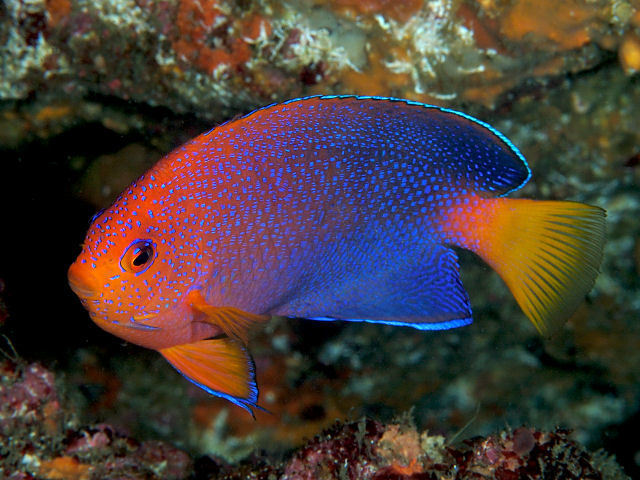
Japanese Angelfish
Centropyge interrupta
The Japanese angelfish or Japanese pygmy angelfish (Centropyge interrupta) is a very rare marine angelfish. It has an orangey yellow body with purplish blue spots completed with a bright yellow tail. The spots are larger towards the tail, and the bottom part the rear of the fish gradually becomes purple. The spots also turn from blue to purple towards the tail. They are native to the Ogasawara Islands south of Japan.
From the article Japanese angelfish on Wikipedia (CC BY-SA), quoted section by section
Description
The Japanese angelfish has an orange body marked with purple and blue spots It has an orangey yellow body with purplish blue spots completed with a bright yellow tail. The spots are larger towards the tail, and the bottom part the rear of the fish gradually becomes purple. The spots also turn from blue to purple towards the tail. Juveniles has a blue margined black ocellus on the posterior part of the dorsal fin. The dorsal fin contains 14 spines and 16 soft rays while the anal fin has 3 spines and 17 soft rays. This species attains a maximum total length of 15 centimetres (5.9 in).
Range & habitat
The Japanese angelfish is found in the western Pacific Ocean. They occur in southern Japan from Tokyo to Shikoku, as well as around the Izu Islands and the Ogasawara Islands south of Japan. They also occur in United States waters around Midway Atoll and Kure Atoll and reaching south to Pearl and Hermes Atoll.
Wikipedia: “Distribution”
Where it lives
Recorded sightings
—
geo-referenced records in GBIF, from museums, herbaria and field observers.
Drag the globe to turn it. Dots are where records exist, not a range map; darker means more records.
In the stacks
Searching the stacks…
Every page naming Centropyge interrupta in the Biodiversity Heritage Library →
This page is assembled live from iNaturalist, GBIF, Wikipedia, the Source Library and the Internet Archive. It is not yet part of the hand-edited codex. iNaturalist taxon 619598.